Эрдэмтэд Антарктидын Тэйлор мөсөн голын гүнд даралттай сувгуудаар дамжин урсдаг давстай ус хэрхэн гадаргуу дээр гарч ирдэгийг олж тогтоолоо.
Антарктидын Тэйлор мөсөн голын цагаан гадаргуу дээрх улаан өнгийн урсгал буюу “Цусны хүрхрээ” нь 1.5 сая жилийн өмнө мөсөн голд хавчуулагдсан, төмрөөр баялаг давстай ус юм. Энэхүү ус нь маш их давс агуулдаг тул маш хүйтэн температурт ч хөлддөггүй бөгөөд агаартай шүргэлцэх үед исэлдэж, зэв мэт улаан өнгөтэй болдог байна. Луизианагийн их сургуулийн судлаач Питер Доран болон түүний баг мөсөн голын дотоод бүтэц, даралтын өөрчлөлтийг ажигласнаар, уг ус хэрхэн гадаргуу руу шахагдан гарч ирдгийг баталжээ.
Уг судалгаагаар, мөсөн голын доорх давстай ус хөлдөх явцдаа дулаан ялгаруулж, эргэн тойрныхоо мөсийг хайлуулан суваг үүсгэдэг болох нь тогтоогдсон. Энэхүү үйл явц нь Тэйлор мөсөн голыг дэлхийн хамгийн хүйтэн, тогтмол урсгалтай ус бүхий мөсөн гол болгож байна. Мөн энэ урсгал нь мөсөн голын гадаргуугийн өндөр болон хөдөлгөөнд нөлөөлдөг болохыг эрдэмтэд ажиглажээ.
Хамгийн гайхалтай нь, энэхүү мөсөн голын гүнд, нарны гэрэл болон хүчилтөрөгчгүй орчинд сая гаруй жилийн турш амьдарч ирсэн нянгийн бүхэл бүтэн экосистем оршдог. Эдгээр бичил биетэн нь сульфатыг эрчим хүчний эх үүсвэр болгон ашиглаж амьдардаг бөгөөд “Цусны хүрхрээ” нь манай нарны аймгийн бусад хэт хүйтэн, хүчилтөрөгчгүй орчинд амьдрал байж болох эсэхийг судлах гол талбар болж байна.
Дэлгэрэнгүйг эх сурвалжаас харах
↓Эх сурвалжийг нээх ↓
In an arid world of ice and snow, a glacier is ‘bleeding’.
A deep red flow of water stains the white landscape surrounding it, remaining liquid even at temperatures well below freezing. And it’s been doing this for more than a century.
This is Antarctica’s Blood Falls – and its internal world is even stranger than it looks.
A new paper published this year in Antarctic Science has finally shed light on how the falls burst open in the first place. It’s the latest piece of a puzzle scientists have been assembling for over a century.
When Australian geologist Griffith Taylor first stumbled across the site in 1911, he assumed that red-hued algae were responsible for the color and quickly named the place Blood Falls. But he was wrong – it turned out to be neither blood nor algae.
In fact, Blood Falls is the result of slowly oozing, iron-rich saltwater that’s been trapped beneath the northern end of the Taylor Glacier for at least 1.5 million years, sealed off when an ancient pocket of seawater got isolated as the glacier advanced.
Over time, the water became saltier and saltier – to the point it is now more accurately described as brine, and can no longer freeze at regular temperatures.
When this water finally reaches the surface, it meets oxygen and oxidizes, just like rust, hence the red color.
For decades, nobody knew exactly how the brine made its way from its source, hundreds of meters below the ice, all the way up to the surface.
In 2017, a team led by researchers from the University of Alaska Fairbanks finally traced its route, using radar to map a 300-meter (985-foot) path through a hidden network of pressurized channels inside the glacier.
Their discovery solved an even stranger puzzle: How can liquid water move through ice this cold at all?

It turns out the brine’s saltiness lowers its freezing point enough to keep it liquid. And where it does freeze, it releases heat that warms the surrounding ice, helping keep the rest of the channel open.
“While it sounds counterintuitive, water releases heat as it freezes, and that heat warms the surrounding colder ice,”said one of the team, glaciologist Erin Pettit, at the time.
“Taylor Glacier is now the coldest known glacier to have persistently flowing water.”
But perhaps the most fascinating part of Blood Falls isn’t the chemistry. It’s what’s been living in the dark inside it.
Hundreds of meters beneath the ice, sealed away from sunlight, oxygen, and the rest of the world for more than a million years, an entire community of bacteria has been quietly surviving – using sulfate as their main source of energy, because nothing else is available to them down there.
They’ve never seen sunlight. They’ve never ‘breathed’ oxygen. And they’ve been down there since long before humans existed.
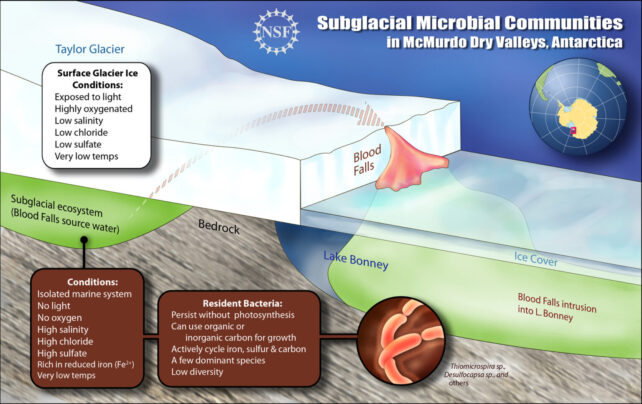
It took microbiologist Jill Mikucki, now at the University of Tennessee, several years just to get a usable sample of the water – but when she finally did, the analysis revealed a thriving microbial ecosystem.
Scientists don’t think this is unique to Antarctica, either. Blood Falls has become a key study site for astrobiology – a real-world stand-in for what extreme, icy, oxygen-starved environments might look like elsewhere in the Solar System.
Even now, scientists are still watching Blood Falls reveal new secrets.
The new paper in Antarctic Science, led by earth scientist Peter Doran from Louisiana State University, sheds light on the process around the falls bursting.
In September 2018, the team had three separate instruments running at once near Taylor Glacier almost by chance: a GPS station tracking the glacier’s surface, a camera photographing Blood Falls daily, and a string of temperature sensors in the lake below.
None of them were specifically designed to catch an outflow event – but in what the team calls a “serendipitous alignment of observations”, they did.
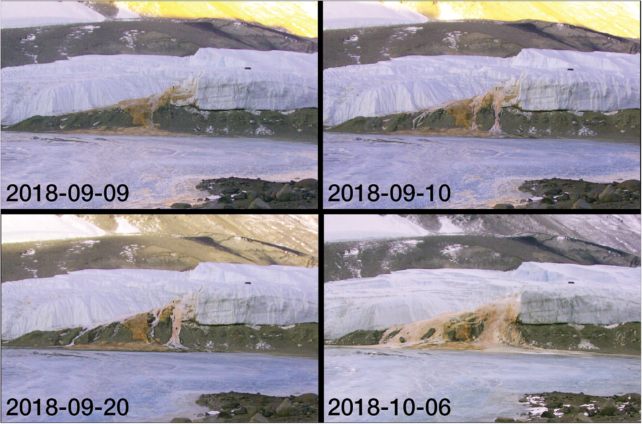
Over the following weeks, the glacier’s surface dropped by about 15 millimeters and its forward movement slowed by nearly 10 percent.
At the same time, the lake recorded a sudden cold-water anomaly, and the camera caught fresh red staining spreading at Blood Falls almost daily.
In other words, scientists watched the glacier visibly shift as the brine escaped.
Their conclusion is that as pressure builds in the trapped brine beneath the glacier, it eventually forces its way out in pulses – and each pulse measurably reshapes the ice above it, lowering the surface and slowing its movement, before the cycle quietly resets and begins building pressure again.

Researchers say continued monitoring could help reveal whether these events are changing in frequency or intensity over time – turning Blood Falls into an unlikely early-warning system for what’s happening inside the Taylor Glacier.
Related: The Mystery Path of Antarctica’s Blood Falls Has Finally Been Revealed
It’s just another reason Blood Falls is one of the coolest (literally) and most fascinating places on Earth.
The research was published in Antarctic Science.
This article was fact-checked by Rebecca Dyer and edited by Clare Watson. While we pride ourselves on our process, we are only human. If you spot a mistake, please let us know.