Эрдэмтэд хүний арьсны нүхэнд амьдардаг Demodex folliculorum хачиг нь бие даасан амьдралаа алдаж, хүний биетэй салшгүй холбогдон хувьсаж байгааг тогтоожээ.
Molecular Biology and Evolution сэтгүүлд нийтлэгдсэн судалгаагаар, хүний нүүрний арьсны нүхэнд амьдардаг D. folliculorum хачиг нь гаднын орчноос бүрэн хамааралтай болж байгааг тогтоожээ. Эдгээр бичил биет нь хүний үхэжсэн арьсны эсээр хооллож, амьдралынхаа туршид нүүрний нүхэнд байрладаг бөгөөд зөвхөн шөнийн цагаар хослохын тулд гадагш гардаг байна.
Бангорын их сургуулийн генетикч Гилберт Смит, Венийн их сургуулийн биологич Алехандро Манзано-Марин нарын удирдсан баг хачгийн геномыг шинжилж, тэдний бие махбод хүний арьсны орчинд дасан зохицохын тулд эрс өөрчлөгдсөнийг илрүүлжээ. Эдгээр хачиг нь байгалийн бусад дайсан, өрсөлдөгч байхгүй орчинд амьдардаг тул тэдний геном маш энгийн болж, шаардлагагүй генүүдээ гээсэн байна. Тухайлбал, тэд хэт ягаан туяанаас хамгаалах болон өдрийн цагаар сэрүүн байх генүүдээ алджээ.
Биологич Алехандра Пероттигийн тайлбарласнаар, нүхэнд амьдрах дасан зохицол нь тэдний биеийн бүтэц болон зан үйлийг өөрчилсөн байна. Тэдний нөхөн үржихүйн эрхтэн биеийн урд хэсэг рүү шилжиж, үржлийн үйл явц нь өвөрмөц хэлбэртэй болжээ. Судлаачид эдгээр хачиг нь удахгүй “үүргийн хувьд заавал хамааралтай симбионт” буюу хүний биеэс салж амьдрах чадваргүй нэгэн төрлийн хамтрагч болж хувирах шатандаа яваа гэж үзэж байна.
Өмнө нь эдгээр хачиг нь ялгаруулах эрхтэнгүй, үхсэнийхээ дараа арьсны асуудал үүсгэдэг гэж таамаглаж байсан ч судалгаагаар тэд ялгаруулах системтэй болохыг тогтоожээ. Зоологч Хенк Браагийн үзэж буйгаар, хачиг нь хүний арьсны нүхийг бөглөрөхөөс сэргийлэх зэрэг ач холбогдолтой байж болох талтай. Ийнхүү хүний арьстай олон сая жил хамт оршсон энэхүү бичил биет нь хүний биеийн салшгүй нэг хэсэг болон хувьслын шинэ шатанд шилжиж байна.
Дэлгэрэнгүйг эх сурвалжаас харах
↓Эх сурвалжийг нээх ↓
If you are reading this, you are probably not alone.
Most people on Earth are habitats for mites that spend the majority of their brief lives burrowed, head-first, in our hair follicles, primarily on the face.
In fact, humans are the only habitat for Demodex folliculorum. They are born on us, they feed on us, they mate on us, and they die on us.
Their entire life cycle revolves around munching your dead skin cells before kicking the teeny tiny bucket.
So reliant is D. folliculorum on humans for its survival, research suggests, that the microscopic mites are in the process of evolving from an ectoparasite into an obligate symbiont – possibly one that shares a mutually beneficial relationship with its hosts (that’s us).
In other words, these mites may be gradually ‘merging’ with our bodies, becoming so specialized to their human habitat that they can no longer survive independently, according to a 2022 paper published in Molecular Biology and Evolution.
In the study, scientists sequenced the genomes of these ubiquitous little beasts, and the results show that their human-centered existence could be wreaking changes not seen in other mite species.
“We found these mites have a different arrangement of body part genes to other similar species due to them adapting to a sheltered life inside pores,” explained invertebrate biologist Alejandra Perotti of the University of Reading in the UK.
“These changes to their DNA have resulted in some unusual body features and behaviors.”
D. folliculorum is actually a fascinating little creature. Human skin detritus is its sole food source, and it spends the majority of its three-week lifespan in pursuit thereof.
The individuals emerge only at night, in the cover of darkness, to crawl painstakingly slowly across the skin to find a mate, and hopefully copulate before returning to the safe darkness of a follicle.
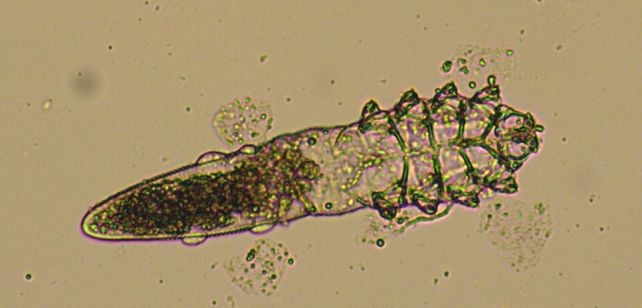
Their tiny bodies are just a third of a millimeter in length, with a cluster of tiny legs and a mouth at one end of a long, sausage-shaped body – just right for scooching down human hair follicles to get at the tasty noms therein.
The work on the mite’s genome, co-led by geneticist Gilbert Smith of Bangor University in the UK and biologist Alejandro Manzano-Marin of the University of Vienna, revealed some of the fascinating genetic characteristics that drive this lifestyle.
Because their lives are so cruisy – they have few natural threats, little competition, and limited exposure to other mites – their genome has been reduced down to just the bare essentials.
Each leg is powered by just three single-cell muscles, and their bodies have the absolute minimum number of protein-coding genes, only what is needed for survival. It’s the smallest number ever seen in its wider group of related species.

This pared-down genome is the reason for some of D. folliculorum‘s other strange peccadilloes, too.
For instance, the reason it only comes out at night. Among the genes lost are those involved in UV protection and those that wake animals up at daylight.
They are also unable to produce melatonin, a hormone found in most living organisms and with various functions. In humans, melatonin is important for regulating the sleep cycle, whereas in small invertebrates it promotes mobility and reproduction.
This hasn’t seemed to have hindered D. folliculorum, however; instead, the researchers suggest it may use melatonin secreted by human skin at dusk.
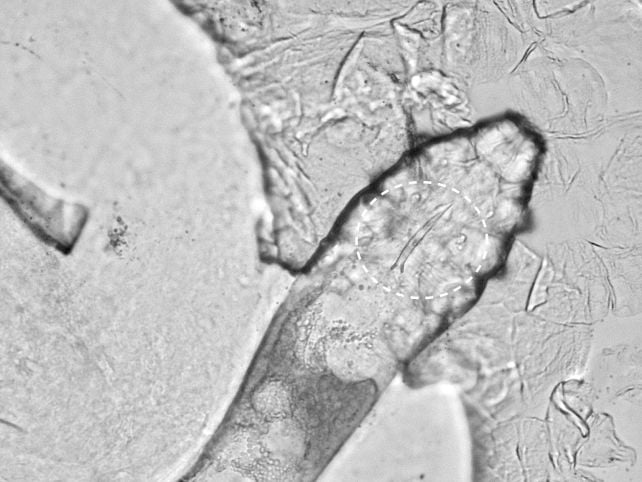
Unlike other mites, the reproductive organs of D. folliculorum have moved towards the front of their bodies, with male mites’ penises pointing forwards and upwards from their backs.
This means he has to arrange himself underneath the female as they perch precariously on a hair for mating, which they do all night, AC/DC-style(presumably).
Although mating is pretty important, the potential gene pool is very small; there is very little opportunity to expand genetic diversity. The researchers suggest this could put the mites on track for an evolutionary dead end.
Related: Your Face Is Covered in Thousands of These, And They’re Not Always Nice
Interestingly, the team also found that the nymph stage of development, between the larva and adult, is when mites have the greatest number of cells in their bodies.
When they advance to the adult stage, they lose cells – which the researchers interpret as the first evolutionary step in the march of an arthropod species toward a symbiotic lifestyle.
One might wonder what possible benefits humans can gain from these peculiar animals; something else the researchers found might partially hint at the answer.
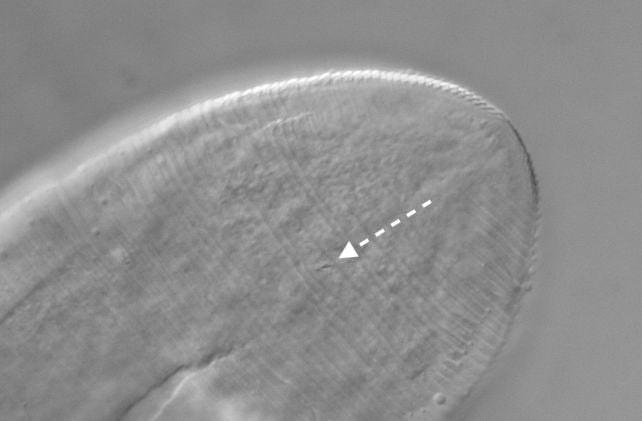
For years, scientists have thought that D. folliculorum doesn’t have an anus, instead accumulating waste in its body to explode out when the mite dies, and thus causing skin conditions.
The team found that this is simply not the case. The mites do indeed have tiny little buttholes; your face probably isn’t full of mite poop expelled posthumously.
“Mites have been blamed for a lot of things,” said zoologist Henk Braig of the University of Bangor and the National University of San Juan in Argentina.
“The long association with humans might suggest that they also could have simple but important beneficial roles, for example, in keeping the pores in our face unplugged.”
The research was published in Molecular Biology and Evolution.
This article was fact-checked by Clare Watson and edited by Rebecca Dyer. While we pride ourselves on our process, we are only human. If you spot a mistake, please let us know.