
Мельбурны музейн судлаачид Виктория мужийн Мэриборо хотын орчмоос олдсон 17 кг жинтэй, ер бусын хүнд чулуу нь сансрын ховор олдвор болохыг баталлаа.
2015 оны тавдугаар сард нутгийн иргэн Дэвид Хоул металл хайгчаар алт хайж яваад энэхүү чулууг олжээ. Тэрээр үүнийг алтны судалтай гэж таамаглан хөрөө, өрөм, хүчил, бүр алх ашиглан нээхийг оролдсон боловч ямар ч ул мөр үлдээж чадаагүй байна. 2018 онд уг чулууг Мельбурны музейд хүргүүлснээр геологич Дермот Хенри болон Билл Бирч нар үүнийг солир болохыг тогтоожээ. Чулууны гадаргуу дээрх агаар мандалд шатах үед үүсдэг “регмаглипт” хэмээх хонхорхой нь түүний жинхэнэ гарал үүслийг илтгэж байв.
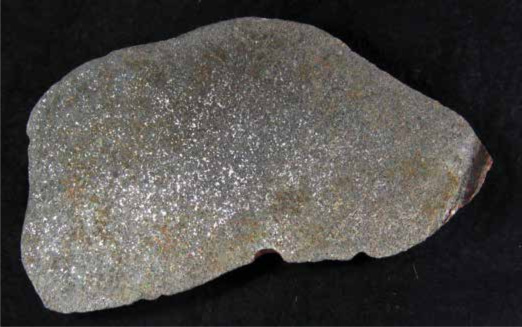
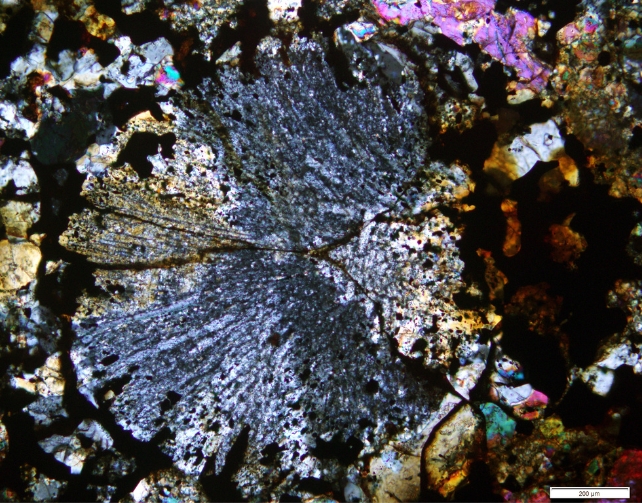
Эрдэмтэд алмазан хөрөөгөөр чулууг зүсэж үзэхэд нарны аймгийн үүсэлтэй холбоотой “хондрул” хэмээх жижиг дусал бүтэц илэрчээ. Энэ нь уг олдворыг 4.6 тэрбум жилийн настай, төмрийн өндөр агууламж бүхий “H5 энгийн хондрит” солир болохыг баталсан байна. Нүүрстөрөгч-14-ийн шинжилгээгээр уг солир Дэлхий дээр 100-1000 жилийн өмнө унасан байх магадлалтай гэж үзжээ.
Виктория мужаас олдсон 17 дахь солир болсон энэхүү олдвор нь нарны аймаг болон Дэлхийн үүслийн түүхийг судлахад чухал ач холбогдолтой юм. Одоо уг ховор олдвор нь Museums Victoria-гийн цуглуулгад орж, олон нийтэд дэлгэгдээд байна.
Дэлгэрэнгүйг эх сурвалжаас харах
↓Эх сурвалжийг нээх ↓
In May 2015, David Hole, a resident of the small Victorian town of Maryborough, was sweeping a metal detector through the yellow clay of Maryborough Regional Park, about two kilometers outside town, when he picked up a strong signal. He dug down and lifted out a heavy, reddish rock roughly the size of a shoebox, its surface pitted and dimpled in a way he had never seen on a stone before. Maryborough sits at the center of Victoria’s 19th-century gold rush country, where prospectors have pulled thousands of nuggets from the ground.
Given where he was standing, Hole assumed his detector had finally led him to gold. He carried the rock home convinced a nugget was sealed somewhere inside its reddish crust, and he wasn’t shy about testing that theory. The rock was denser than anything its size should have been, and its scarred, sculpted surface only added to his suspicion that something valuable was hidden underneath.
Over the following months Hole tried a rock saw, then switched to an angle grinder that sparked against the surface without leaving a mark. He drilled into it. He soaked it in acid. Finally he swung a sledgehammer at it as hard as he could, and the hammer bounced back without leaving so much as a fracture, as ScienceAlert reported. Whatever sat inside that reddish shell was not built like any ordinary stone, and it stayed on Hole’s property, unopened, for years.
A Trip to Melbourne Museum Solves the Mystery
Still curious about what he had found, Hole eventually drove the rock to Melbourne Museum in 2018 and handed it to the geology department. It was not an unusual visit for museum staff. Suspected meteorites are brought in by members of the public fairly often, and almost all of them turn out to be ordinary terrestrial rocks with unusual shapes or colors. Museum staff have a name for these: meteor-wrongs.
Geologist Dermot Henry was well placed to judge. He has spent 37 years at the museum examining rocks that hopeful visitors believed were meteorites, and in that time only two of those specimens turned out to be genuine. Hole’s rock, it turned out, would become one of the two.
Henry and fellow geologist Bill Birch noticed the rock’s texture almost immediately. “It had this sculpted, dimpled look to it,” Henry said, describing a pattern known as regmaglypts that forms when an object burns through Earth’s atmosphere, melting on the outside as the air sculpts its surface. Following photography and moulding, the pair weighed and measured the specimen: 17 kilograms, and 38.5 by 14.5 by 14.5 centimeters.
The rock’s unusual weight was another giveaway. An ordinary Earth rock that size should not have felt nearly as heavy in the hand, and that mismatch between size and mass was one of the clues that pointed the geologists toward a very different explanation than the one Hole had been chasing for three years.
Chondrules and Iron Content Confirm a Meteorite
To look inside, the geologists used a diamond saw, the only tool capable of cutting through the rock’s dense shell. The slice revealed tiny, spherical mineral droplets called chondrules, structures that form when dust in the early solar system’s protoplanetary disk was rapidly heated and then cooled in a microgravity environment. Chondrules do not occur in rocks that form on Earth, and their presence confirmed the specimen was a chondrite, a meteorite that preserves primitive material from the solar system’s formation.
Laboratory analysis classified the rock as an H5 ordinary chondrite. The H refers to a high total iron content, roughly 25 to 30 percent by weight. The 5 indicates the rock underwent significant thermal metamorphism, meaning its chondrules were partially recrystallized and its minerals homogenized by heat while it was still part of a larger parent asteroid.
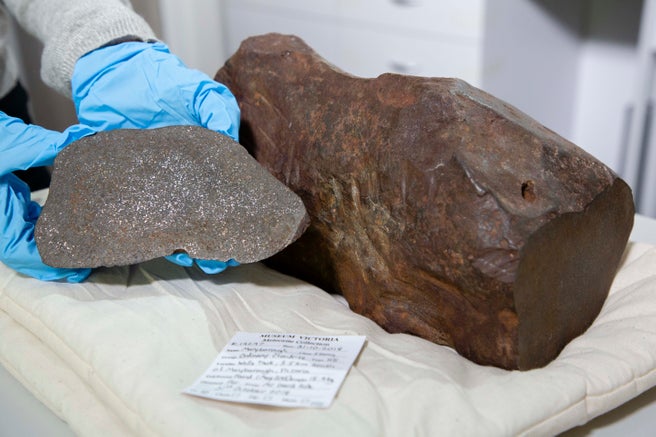
Mineral analysis also identified kamacite and taenite, two iron-nickel alloys common in meteorites, along with minor amounts of native copper. Those metals explained why the rock had triggered such a strong reading on Hole’s metal detector in the first place, three years before anyone knew what it actually was.
The Rock Is Older Than Earth Itself
The Maryborough meteorite formed about 4.6 billion years ago, before Earth had even finished forming, most likely in the asteroid belt between Mars and Jupiter. Collisions between asteroids in that belt can knock fragments loose and send them on paths that eventually cross Earth’s orbit, which researchers believe is roughly what happened to this specimen long before it ever landed in the Victorian clay Hole was searching.
Figuring out when it arrived on Earth took a different kind of analysis. Carbon-14 testing, conducted at the University of Arizona, measured cosmogenic isotopes that build up in a rock while it travels through space and decay after it lands. The results indicated the meteorite reached Earth sometime between 100 and 1,000 years ago.
Historical records add a possible clue to that window. Local news in the Maryborough district reported several meteor sightings between 1889 and 1951. Researchers cannot confirm the meteorite is linked to any one of those specific sightings, but the timing is consistent with the radiometric dating, raising the possibility that its fall was witnessed, and then forgotten, long before Hole ever dug it up.
Rarer in Victoria Than Any Gold Nugget
The Maryborough meteorite is only the 17th meteorite ever recorded in the state of Victoria. Victoria’s Goldfields region, by contrast, has produced thousands of gold nuggets since the 19th-century rush began, a gap researchers point to when explaining why the find matters more than the gold Hole originally set out to find.
It also joins a short list of previously documented Victorian meteorites. The last one found before it turned up at Willow Grove in Gippsland in 1995, an iron-nickel specimen. The most recently confirmed is the Ballarat meteorite, discovered in the 1860s but not formally identified until 2002; it is regarded as a “fossil” meteorite because it was found buried in river gravels under basalt, and it remains on display in the museum’s Dynamic Earth exhibition.
“Meteorites provide the cheapest form of space exploration,” Henry said, explaining that such specimens carry clues to the age, formation, and chemistry of the solar system, including Earth’s own history.
The meteorite is now part of the State Collection held by Museums Victoria, joining more than 400 other specimens, including the well-studied Murchison meteorite. It has been placed on public display at Melbourne Museum, including during National Science Week, when Henry gave a free talk explaining meteorites to visitors.
The meteorite remains part of the museum’s public exhibits today, on view for anyone who wants to see the rock that resisted a saw, a grinder, acid, and a sledgehammer before finally revealing itself as a fragment of the early solar system.
Enjoyed this article? Subscribe to our free newsletter for engaging stories, exclusive content, and the latest news.


