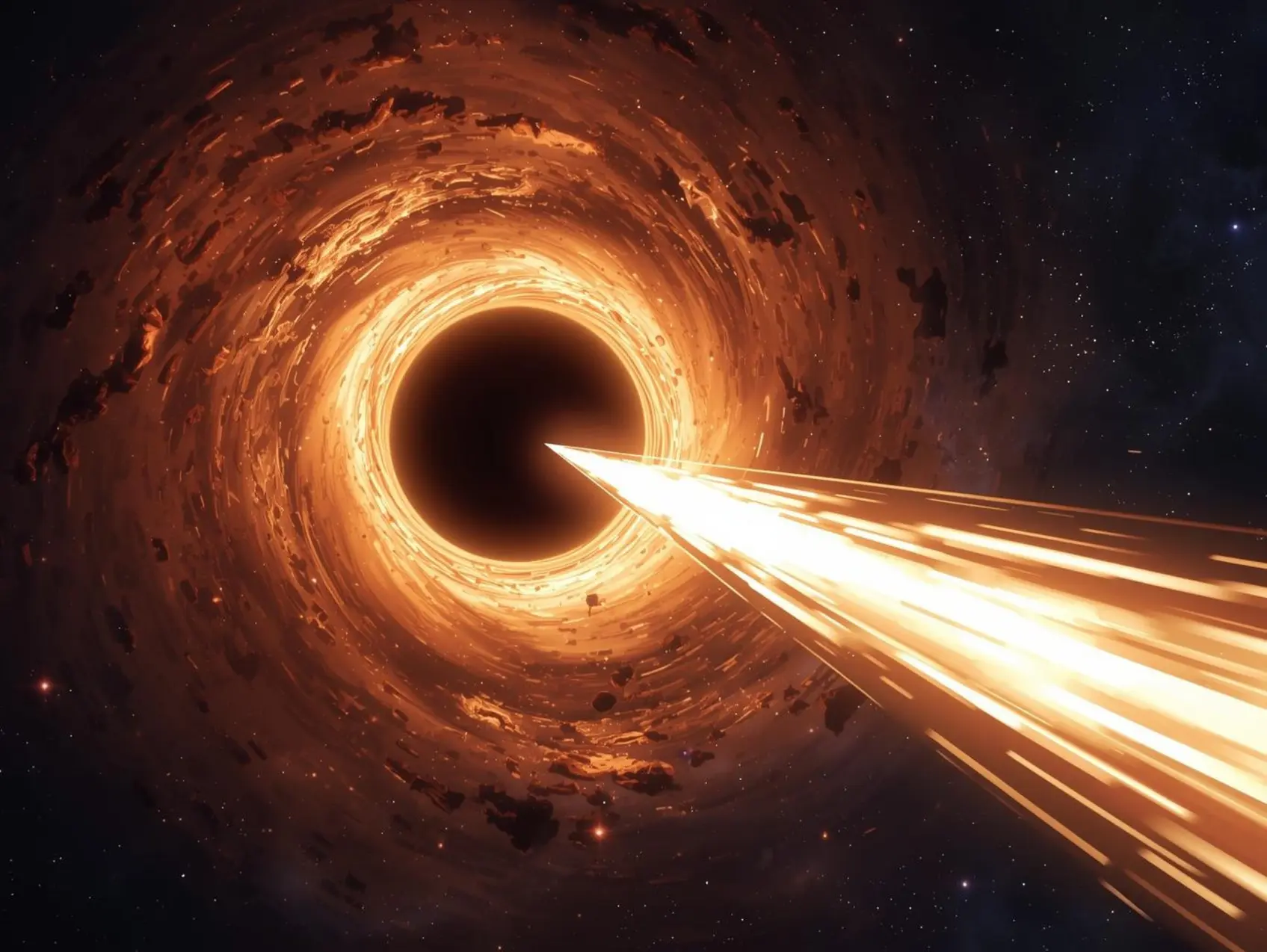
Олон улсын судлаачдын баг анх удаагаа хар нүхний радио долгионы хүчтэй цацраг олон жилийн турш тасралтгүй үргэлжилж буй үзэгдлийг ажиглажээ.
Max Planck Institute for Radio Astronomy (MPIfR)-ийн судлаач Стефани Комоссагаар ахлуулсан олон улсын баг Дэлхийгээс 1.8 тэрбум гэрлийн жилийн зайд орших Лео одны ордны SDSS J110546.07+145202.4 спираль галактикийг судалжээ. Энэхүү галактикийн төвд байрлах хэт их масс бүхий хар нүх нь сүүлийн найман жилийн турш радио долгионы мужид маш тод гэрэлтэж байна. Хар нүхний эргэн тойронд үүсдэг ийм төрлийн идэвхтэй галактикийн цөмийн (AGN) үзэгдэл нь ихэвчлэн хэдхэн хоног эсвэл долоо хоног үргэлжилдэг тул энэ нь урьд өмнө бүртгэгдээгүй анхны тохиолдол болж байна.
https://www.mpifr-bonn.mpg.de/pressreleases/2026/a-nearby-black-hole-as-a-window-into-the-early-universe
Судлаачид рентген, оптик, радио болон хэт улаан туяаны олон талт мэдээллийг нэгтгэн шинжилсний дүнд уг хар нүх нь харьцангуй бага масстай хэдий ч хүрээлэн буй орчны материйг маш хурдацтай шингээж байгааг тогтоожээ. Энэхүү идэвхтэй шимэгдэлт нь хар нүхнээс гарах тийрэлтэт урсгалыг өдөөсөн байна. Стефани Комоссагийн тэмдэглэснээр, хөнгөн жинтэй хар нүхнээс ийм удаан хугацааны радио цацраг ялгарах нь маш ховор бөгөөд шинжлэх ухаанд анх удаа ажиглагдаж байгаа юм.
Энэхүү үзэгдэл нь эртний орчлонд түгээмэл байх төлөвтэй боловч бидний орчлон ертөнцийн сүүлийн 2 тэрбум жилийн түүхэнд ховор тохиолдох шинэ төрлийн галактикийн загвар болж байна. Sydney Institute for Astronomy-ийн судлаач Кови Роуз энэ төрлийн өндөр энерги бүхий үйл явдлуудыг ажиглах нь хар нүхний физик болон тийрэлтэт урсгалын үүсэл, хувьслыг судлах онцгой боломж олгодог гэв. Ирээдүйд Square Kilometer Array (SKA) зэрэг шинэ үеийн дуран авайнууд ашиглалтад орсноор ижил төстэй радио үзэгдлүүдийг илрүүлж, эртний орчлон ертөнцийн талаарх ойлголтоо гүнзгийрүүлэх боломжтой болно.
https://iopscience.iop.org/article/10.3847/1538-4357/ae610f/meta
Дэлгэрэнгүйг эх сурвалжаас харах
Эх сурвалжийг нээх ↓
An international team led by researchers from the Max Planck Institute for Radio Astronomy (MPIfR) recently made a first-ever discovery when observing SDSS J110546.07+145202.4, a spiral galaxy located about 1.8 billion light-years from Earth in the constellation Leo. For eight years, this galaxy has glowed extremely brightly in the radio spectrum due to intense radiation coming from the supermassive black hole (SMBH) at its center.
Short-lived sources of radio emissions are sometimes known to originate in the vicinity of black holes, due to the extreme physical conditions in their accretion disks. This phenomenon, known as an Active Galactic Nucleus (AGN), causes the centers of galaxies to temporarily outshine all the stars in their disks. While most observed radio transients last only days or weeks, this particular source has persisted for several years, making it the first known event of its kind. The results were published in The Astrophysical Journal.
The research was led by MPIfR researcher Stefanie Komossa, who was joined by researchers from the Australia Telescope National Facility (ATNF), the Sydney Institute for Astronomy (SIfA), the Osservatorio Astrofisico di Torino, the State Key Laboratory of Radio Astronomy and Technology, the University of Science and Technology of China, the HUN-REN–ELTE Extragalactic Astrophysics Research Group, the Konkoly Observatory, the MTA Center of Excellence, the International Gemini Observatory, and multiple universities.
*Composite image of SDSS J110546.07+145202.4, showing the galaxy in visible light and near-infrared. Credit and ©: DESI Legacy Survey*
Komossa and her colleagues studied SDSS J110546.07+145202.4 by combining new observations with archival data from multiple observatories and multiple wavelengths, ranging from X-rays and optical data to radio and infrared. The SMBH at the center of SDSS J110546.07+145202.4 is relatively low mass, but is growing at an exceptional rate through the accretion of matter in its disk. Based on the massive dataset they analyzed, the team concluded that the black hole has been accreting material for several years, triggering the jet they observed.
“Luminous radio radiation from rapidly growing, lightweight black holes is rare to begin with. Their transition into a long-lasting, radio-bright state has never been observed before,” said Komossa in a MPIfR press release. The reasons for the SMBH accreting more material and the outburst lasting so long have not yet been determined. However, follow-up observations with facilities such as the Very Long Baseline Array (VLBA) could shed further light on this mystery.
What is clear is that this event is a prototype of a new class of galaxies that experience rapid changes in radio emissions. This kind of behavior, where an SMBH accretes lots of material and grows rapidly, is something astronomers expect to see from galaxies in the early Universe. This particular galaxy, however, is located within the last 2 billion years of cosmic history, making it an outlier. Its proximity also allows for detailed observations that could lead to a better understanding of the physics surrounding black holes, jet formation, and their evolution.
“Such high-energy events can provide astronomers with a wealth of insights. By observing these jets and outbursts, we can study the physical processes in some of the most extreme environments in the Universe”, says co-author Kovi Rose from the Sydney Institute for Astronomy. In the near future, said Komossa, next-generation arrays like the Square Kilometer Array (SKA) will become operational and reveal even more about this unique discovery:
With sensitive facilities like the incoming SKA telescopes, we’ll be able to identify similar radio transients in future sky surveys. This is crucial for filling the gaps in our understanding of the early Universe.
Further Reading: MPIFR, The Astrophysical Journal


