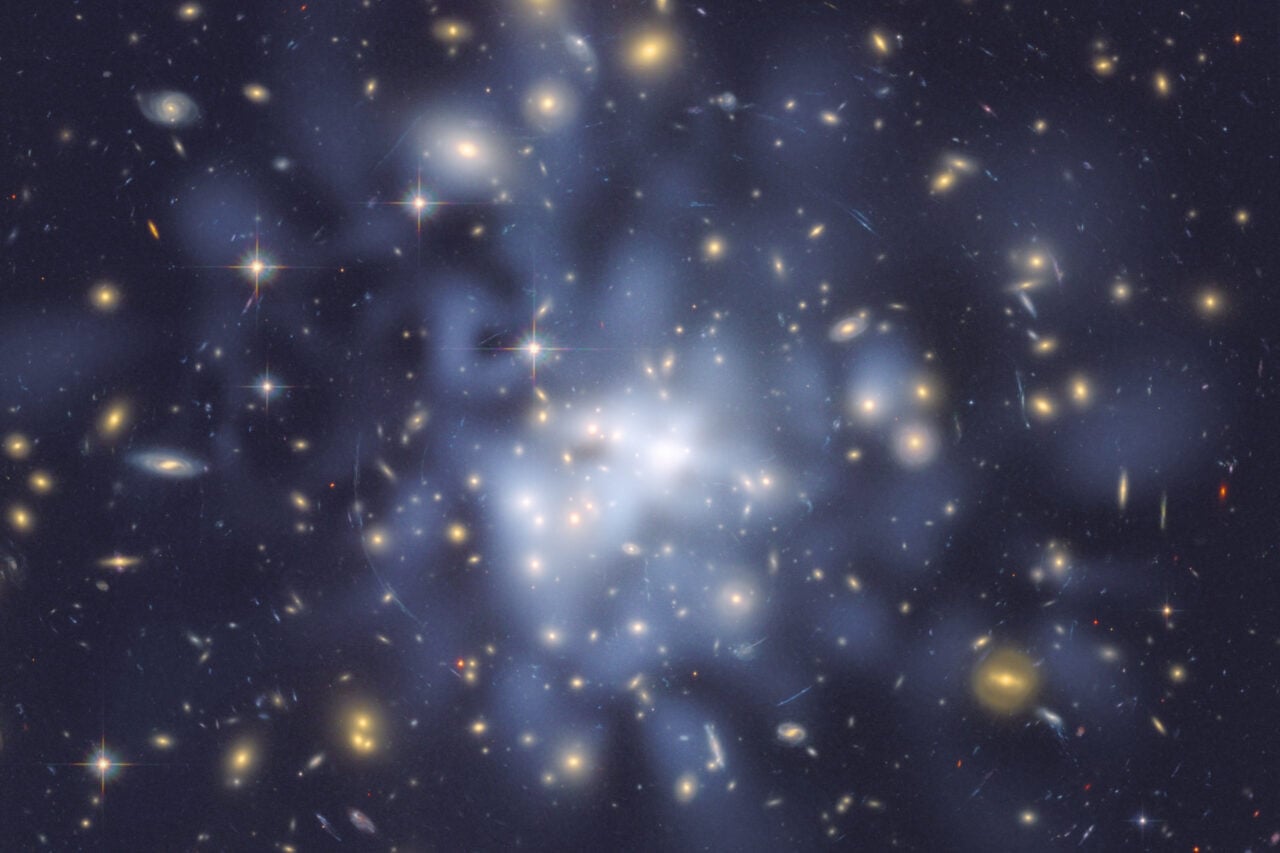
Хятадын Шинжлэх ухааны академийн судлаачид сансрын гамма туяаны Fermi телескопоос цуглуулсан 15.5 жилийн мэдээлэлд дүн шинжилгээ хийж, хар материйн шинж чанарыг агуулсан байж болох гамма туяаны тод дохиог илрүүлжээ.
Хар матери нь орчлон ертөнцийн массын 85 орчим хувийг бүрдүүлдэг ч гэрэлтэй харилцан үйлчлэлцдэггүй, үл үзэгдэх бодис юм. Эрдэмтэд хар матери нь сул харилцан үйлчлэлцэгч хүнд бөөмс буюу WIMP-ээс бүрддэг гэсэн онолыг дэвшүүлдэг бөгөөд эдгээр бөөмс хоорондоо мөргөлдөж устгагдах үед гамма туяа ялгардаг гэж үздэг. Физикч И-Жун Фан болон түүний багийнхан илрүүлсэн гамма туяаны энэхүү тод дохио нь хар материйн бөөмсийн оршин тогтнолыг батлах чухал нотолгоо байж болохыг Physical Review Letters сэтгүүлд нийтэлсэн судалгаандаа дурджээ.
Гамма туяаны ийм төрлийн дохиог хар материйн онолыг батлах “нотлох баримт” гэж үздэг ч үүнийг батлахад бэрхшээлтэй байдаг. Өмнө нь илэрсэн ижил төстэй дохионууд зарим тохиолдолд багажийн алдаа эсвэл бусад хүчин зүйлээс үүдэлтэй байсан нь тогтоогдож байв. Судлаачид энэ удаагийн дохио нь багажийн алдаа биш гэж үзэж байгаа ч тухайн гамма туяаны үүсгүүр нь галактикийн бөөгнөрөлд гарсан ер бусын үзэгдэл байх магадлалтайг үгүйсгээгүй юм.
Энэхүү судалгаа нь хар материйг хайх чиглэлээр хийгдсэн анхны оролдлого биш бөгөөд өнгөрсөн хугацаанд сүүлийн үеийн мэдээлэлд тулгуурлан хийсэн олон судалгаа гарч байсан. Ирэх жилүүдэд олон улсын сансрын агентлагууд илүү хүчин чадалтай гамма туяаны телескопуудыг хөөргөхөөр төлөвлөж байгаа нь хар материйн нууцыг тайлахад шинэ боломж нээж магадгүй юм.
Дэлгэрэнгүйг эх сурвалжаас харах
Эх сурвалжийг нээх ↓
Dark matter, the elusive, invisible stuff that astronomers say constitutes roughly 85% of the universe’s mass, doesn’t interact with light. Scientists only suspect it’s there because of the way the things we can see interacts with it. But now, one team in China says it’s found the most direct evidence for dark matter yet.
According to a recently published study in Physical Review Letters, astrophysicists with the Chinese Academy of Sciences found a “sharp” gamma-ray signal among 15.5 years’ worth of data from the Fermi Gamma-ray Space Telescope (FGST). The signal, the paper argues, is observable support for the leading theory of dark matter, which posits that dark matter is composed of weakly interacting massive particles (WIMPs). This gamma-ray signal is what you would expect to see when those particles collide and annihilate each other.
“Discovering a sharp gamma-ray line would be the ultimate ‘smoking gun’ evidence proving the existence of dark-matter particles and revealing their properties in particle physics,” Yi-Zhong Fan, the study’s first author, told New Scientist.
Gamma rays are among the most powerful types of radiation in nature and a key area of interest in the search for dark matter, especially for scientists who support the WIMP theory. As per their name, WIMPs interact too weakly with the electromagnetic and nuclear forces to be observable via light or other particle interactions with normal matter.
On the other hand, WIMP-to-WIMP collisions should produce telltale gamma rays.
An intense gamma ray source with unknown origins is naturally going to leads some scientists to wonder if dark matter was responsible. At least, the latest study is far from being the first to do so. Last year, one team argued that the gamma glow at the Milky Way’s center was dark matter. Then one month later, another researcher claimed WIMPs were responsible for another odd gamma-ray signal, also from FGST data.
That said, gamma-ray “smoking guns” aren’t easy to prove. There have been times when purported dark matter signals of this nature were later proven to be just an instrument error. The study also observed a handful of galaxy clusters, so it’s always possible that this particular cluster was an anomaly.
However, the team argued in the paper that its calculations considering signal-to-noise ratios “disfavors an instrumental origin.” Either way, it seems worthwhile to investigate the signal’s physical origin, given its significantly sharp, clear nature, the researchers added in the study.
It’s also worth noting that, again, it’s not just this one team clocking some really unexplainable gamma-ray signals. The FGST is still active and will have doubled its dataset by 2040. International space agencies are also preparing to launch new gamma-ray telescopes in the next few years, so who knows? Perhaps gamma rays really will end up being humanity’s first contact with dark matter.


