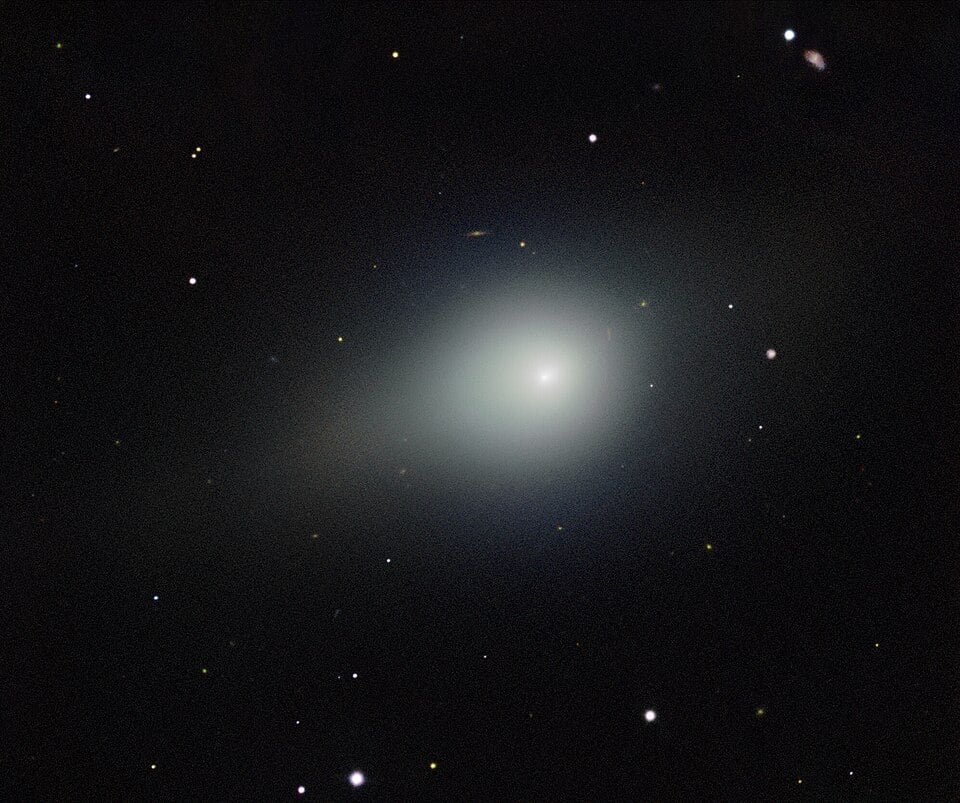
Энэхүү сансрын биет нь манай нарны аймгаас гаралтай сүүлт одуудаас эрс ялгаатай химийн найрлагатай болохыг эрдэмтэд илрүүлжээ.
Манай галактикийн нэгэн хөгшин одны системээс хөөгдөж, одод хоорондын орон зайг туулан 2025 оны аравдугаар сарын 30-нд Дэлхийтэй ойртон өнгөрсөн 3I/ATLAS (3I) сүүлт одыг одон орон судлаачид судалжээ. Шотландын Эдинбургийн их сургуулийн одон орон судлаач Сириэль Опитомын удирдсан баг Чили улс дахь “Very Large Telescope” (VLT) дурангийн хэт ягаан туяа болон харагдах спектрографийг ашиглан уг сүүлт одны хийн бүрхүүлийн химийн найрлагыг шинжилсэн байна. Судлаачид уг биетийг гариг үүсэх процессын “чулуужсан олдвор” хэмээн тодорхойлж байгаа юм.
https://www.youtube.com/embed/MfZk99thlKE
Судалгаагаар 3I сүүлт одны хийн бүрхүүлд азот болон нүүрстөрөгчийн изотопын харьцаа манай нарны аймгийн сүүлт одуудаас хоёр дахин өндөр байгааг илрүүлжээ. Лиежийн их сургуулийн судлаач Аравинд Кришнакумарын тайлбарласнаар, энэхүү химийн өвөрмөц шинж чанар нь уг сүүлт од манай Нарнаас хамаагүй өмнө, хүнд элементүүд багатай, устөрөгч болон гелиэр баялаг эртний одны эргэн тойронд үүссэнийг гэрчилж байна. Энэ нь орчлон ертөнц одоогийнхоосоо химийн найрлагын хувьд илүү ядуу байсан үед уг систем бүрэлдсэнийг илтгэж байгаа юм.
Финландын Хельсинкийн их сургуулийн судлаач Розмари Дорсийн тэмдэглэснээр, 3I/ATLAS нь манай Нарны аймгаас хоёр дахин илүү настай байж болзошгүй аж. VLT-ээс гадна Жэймс Вэбб дуран (JWST) ашиглан хийсэн ажиглалтууд ч мөн адил үр дүнг баталж, уг сүүлт од өөрийн эх одны системийн гаднах хэсэгт үүссэнийг тогтоожээ.
Өмнө нь 2017 онд 1I/’Oumuamua, 2019 онд 2I/Borisov зэрэг одод хоорондын биетүүд бүртгэгдэж байсан ч 3I нь найрлагыг нь нарийвчлан судлах боломж олгосон анхны тохиолдол болж байна. Энэхүү нээлт нь цаашид манай аймагт зочлох бусад биетийг судлах шинэ арга хэрэгсэл, мэдээллийн санг бүрдүүлж байгаа юм.
Дэлгэрэнгүйг эх сурвалжаас харах
Эх сурвалжийг нээх ↓
Somewhere in the Milky Way Galaxy is an old star that has lost one of its comets. By some quirk of orbital mechanics, that frozen nucleus of ice and dust got kicked out of its home system and into a long and winding trajectory across interstellar. It entered our Solar System sometime in the distant past and traveled somewhat near to Earth on October 30, 2025, on its way through the system. After its discovery in 2025, astronomers pointed telescopes at the interstellar visitor, named 3I/ATLAS (3I), to study the gases in its coma. What they’ve found so far points to a distant and very ancient origin for the comet.
A team of observers, led by astronomer Cyrielle Opitom of the University of Edinburgh, Scotland, captured spectra of the coma using the Ultraviolet and Visual Echelle Spectrograph on the Very Large Telescope (VLT) in Chile. They found the chemical fingerprints of another solar system hidden away in the gas and dust flowing off of 3I. All comets contain a treasury of chemical clues locked away in their nuclei, evidence that points to specifics about the origin and evolution of planetary systems. That’s what makes cometary nuclei such great objects to study, according to Opitom. “They are sort of fossils from a planetary formation process that happened very far away, but that we get the chance to study from much closer,” she said.
Chemical Traces of an Interstellar Origin
The specific chemical clues to this comet’s origins include higher-than-expected isotopic ratios of nitrogen and carbon in the coma. The nitrogen ratio is roughly double the value found in comets native to our Solar System, as is the ratio of carbon 12 to carbon 13. These point to a very different chemical environment around the star than the one where the Solar System’s comets formed.
Scientists use the isotopic ratios of carbon and nitrogen because they’re very sensitive to the conditions where cometary nuclei form. The ratios give a very accurate measurement of what the environment was like in the circumstellar disk where a planetary system forms around a star. In the case of 3I, the ratios are not like they are here in our own Solar System, according to researcher Aravind Krishnakumar of the Université of Liège. “Unlike comets from our Solar System, this interstellar visitor carries unusually high carbon and nitrogen isotopic ratios,” he said.
The unusual isotopic ratios indicate that 3I probably formed in the outer regions around an old, low-metallicity star. That’s a star with mostly hydrogen and helium, and very few other heavier elements. The low metallicity is a tantalizing clue that points toward a star that formed long before the Sun did. When that older star formed, the Universe was less chemically rich than it is today.
*This image of the interstellar comet 3I/ATLAS was taken on 18 January 2026 with the FORS2 instrument on ESO’s Very Large Telescope (VLT). It is a stack of several images spanning 14 minutes. As the comet moves on the sky, the stars appear as trails in the background. Credit: ESO/O. Hainaut*
Evidence from various observations suggests that 3I/ATLAS itself is more than twice as old as the Sun. “3I/ATLAS is a really exciting opportunity to probe the composition of another planetary system, one that formed long before our Sun and Solar System even existed,” said Opitom’s co-author Rosemary Dorsey, a researcher at the University of Helsinki, Finland. In fact, the star likely formed at a time when the Universe was metal-poor itself. As time passes and stars die and spread their material to space, the Universe gets enriched with heavier and heavier materials. Stars that form in that “richer” time will reflect that chemical makeup. It’s also worth noting that some stellar and planetary formation stages can also produce these chemical changes, although that’s likely not the case with 3I’s parent star.
Other Observations Point the Way
VLT is not the only telescope to focus on this wandering interloper from another system. The James Webb Space Telescope (JWST) detected similar isotopic ratios of carbon in the cloud around the nucleus, as well as enhanced amounts of deuterium (an isotope of hydrogen). The measurements made by VLT, JWST, and other observations can pinpoint where in its star’s disk it formed: somewhere in the outer disk, similar to the region where comets formed in our own Solar System. However, those different chemical ratios in this comet are what suggested to researchers that 3I’s parent star was already old and metal-poor.
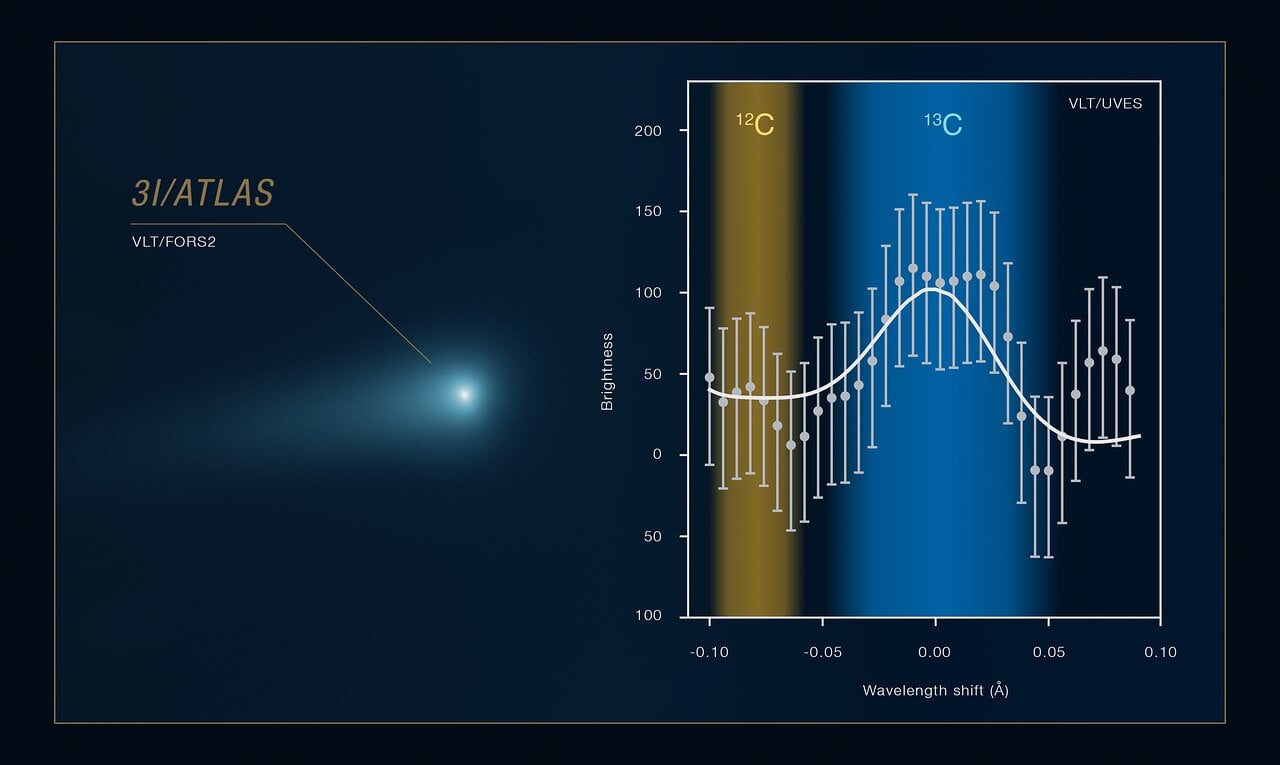
*The spectrum of 3I/ATLAS shown here (taken with UVES on the Very Large Telescope), contains spectral features produced by 12C, an isotope of carbon, and 13C (another carbon isotope). The team performed similar measurements with two isotopes of nitrogen, 14N and 15N. By comparing the 12C/13C and 14N/15N ratios with those measured in Solar System comets and in the discs of material around young stars, the team concluded that 3I/ATLAS likely formed in the outskirts of the disc around a star older than the Sun. Credit: ESO/C. Opitom, J. Manfroid et al. Comet image: O. Hainaut*
More Revelations to Come
3I is not the only interstellar comet to come racing through our system. One was 1I/’Oumuamua, first spotted in 2017. The other was 2I/Borisov, which was first seen in 2019. Unfortunately, no gas was detected around ‘Oumuamua, and Borisov was fairly dim, which made it very difficult to study. So, 3I is the first good chance astronomers have had to study a comet that formed in a region similar to our Kuiper Belt and Oort Cloud in the Solar System. The recent measurements not only allow scientists to figure out this comet’s evolution and age, but also give new tools to use when the next interstellar interloper comes through the Solar System.
For More Information
Older Than the Sun: Astronomers Find New Clues to the Origin of Interstellar Comet 3I/ATLAS
Older than the Sun: New Clues to the Origin of Interstellar Comet 3I/ATLAS

