
АНУ-ын Харилцаа холбооны хороо (FCC) Reflect Orbital компанийн Eärendil-1 хиймэл дагуулыг хөөргөх анхны туршилтыг зөвшөөрснөөр дэлхийн тойрог замд нарны гэрлийг эх дэлхий рүү ойн тусгах технологийн эхлэл тавигдлаа.
Reflect Orbital компани нь 18х18 метрийн хэмжээтэй толин тусгал бүхий хиймэл дагуулуудыг 2035 он гэхэд 50,000 гаруйг тойрог замд байршуулахаар төлөвлөж байна. Энэхүү Eärendil-1 хиймэл дагуулыг энэ оны сүүлээр дэлхийгээс 625 км-ийн өндөрт, 88 хэмийн налуу тойрог замд хөөргөхөөр төлөвлөж байгаа бөгөөд тус компани үүнийг хөдөө аж ахуй, гамшгийн үеийн тусламж болон ажлын цагийг сунгах зорилгоор ашиглах боломжтой гэж үзэж байна. Одоогоор FCC байгууллага нь зөвхөн радио давтамжийн хуваарилалтын хүрээнд зөвшөөрөл олгоод байгаа юм.
https://docs.fcc.gov/public/attachments/DA-26-706A1.pdf
https://www.reflectorbital.com/
Сансарт толин тусгал байрлуулах санаа нь шинэ зүйл биш бөгөөд 1992 онд ОХУ-ын Mir сансрын станцаас Znamya-2 нэртэй 20 метрийн диаметртэй толийг туршиж байсан түүхтэй. Одоогийн төлөвлөгөөгөөр Eärendil-1 нь бүтэн сарны гэрэлтэй тэнцэхүйц -12.6 магнитудын тод гэрлийг 4.8 км орчим (3 миль) талбайд төвлөрүүлэх зорилготой байгаа нь одон орон судлаачдын санааг зовоож байна. Америкийн одон орон судлалын нийгэмлэгээс агаар мандлын сарнилт болон сансрын ажиглалтын төвүүдэд үзүүлэх нөлөөллийг нарийвчлан судлах шаардлагатайг мэдэгдлээ.
https://www.reflectorbital.com/blog-posts/reflect-orbital-seeks-collaboration-with-dark-skies
Компанийн гүйцэтгэх захирал Бэн Новак эхний гурван хиймэл дагуулыг орлого олох зорилгоор ашиглана гэж мэдэгдсэн ч одон орон судлаачид шөнийн тэнгэрийн харанхуй байдал алдагдаж, олон улсын хэмжээний ажиглалтын төвүүдийн үйл ажиллагаанд сөргөөр нөлөөлөх вий гэж болгоомжилж байна. Reflect Orbital компаниас гэрлийн бохирдлыг бууруулахын тулд ашиглаагүй үедээ толин тусгалыг идэвхгүй горимд шилжүүлэх боломжтой гэж тайлбарлаж байгаа ч ирээдүйд олон мянган ийм хиймэл дагуул тойрог замд байршвал эрсдэл нэмэгдэх магадлалтай юм.
https://www.youtube.com/embed/z5dp0Gzz7mA
https://www.youtube.com/embed/FPRqeF1c6kc
Дэлгэрэнгүйг эх сурвалжаас харах
Эх сурвалжийг нээх ↓
Reflect Orbital moves ahead with the company’s first Eärendil launch, ahead of concerns from the astronomical community.
Move over, Starlink. A new constellation of bright reflector satellites could soon compete with the night sky.
The United States Federal Communications Commission (FCC) recently approved the first demonstration launch of Reflect Orbital’s Eärendil-1 satellite. Sporting an 18 by 18 meter-wide reflector once unfurled, the satellite will test the ability to reflect sunlight back to Earth, on demand. The company envisions more than 50,000 reflectors girding the Earth in low Earth orbit by 2035, while many in the astronomical community have raised concerns on the project’s impact.
A future fleet of orbital mirrors. Credit: Reflect Orbital.
The first launch could occur as early as late this year. The FCC’s role in approval was related to the allocation of the radio frequency spectrum the satellite will use, versus the reflector’s overall impact. Reflect Orbital plans to launch three unfoldable test reflectors three months apart, starting with this year’s first approved launch of Eärendil-1. Reflect Orbital CEO Ben Nowack states that these first three will also be used as revenue generating vehicles for the company. The FCC approval notes a near-polar, 88 degree inclination orbit 625 kilometers from the surface of the Earth for the first launch, suggesting a Vandenberg launch, probably with SpaceX.
Putting reflectors in space is actually a very old idea, going back to the Vietnam war and the early space age. Russia fielded a 20-meter space mirror known as Znamya-2 in 1992. Deployed from the late Mir space station, Znamya 2 created a 5 kilometer light patch as bright as a Full Moon that traversed Europe early on the morning of February 4th, 1993.
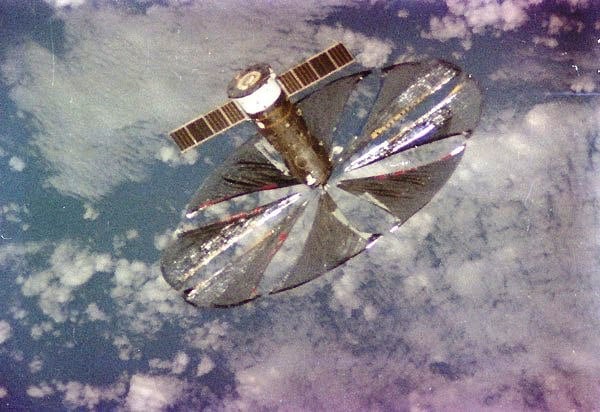 The Znamya-2 reflector, shortly after release from Mir. Credit: RSC Energia.
The mission name comes from a character from Lord of the Rings who carried the light of the morning star on his brow. For context, the Echo-1 communications satellite fielded by NASA in 1960 featured a balloon 30-meters in diameter, just under twice the span of Eärendil-1.
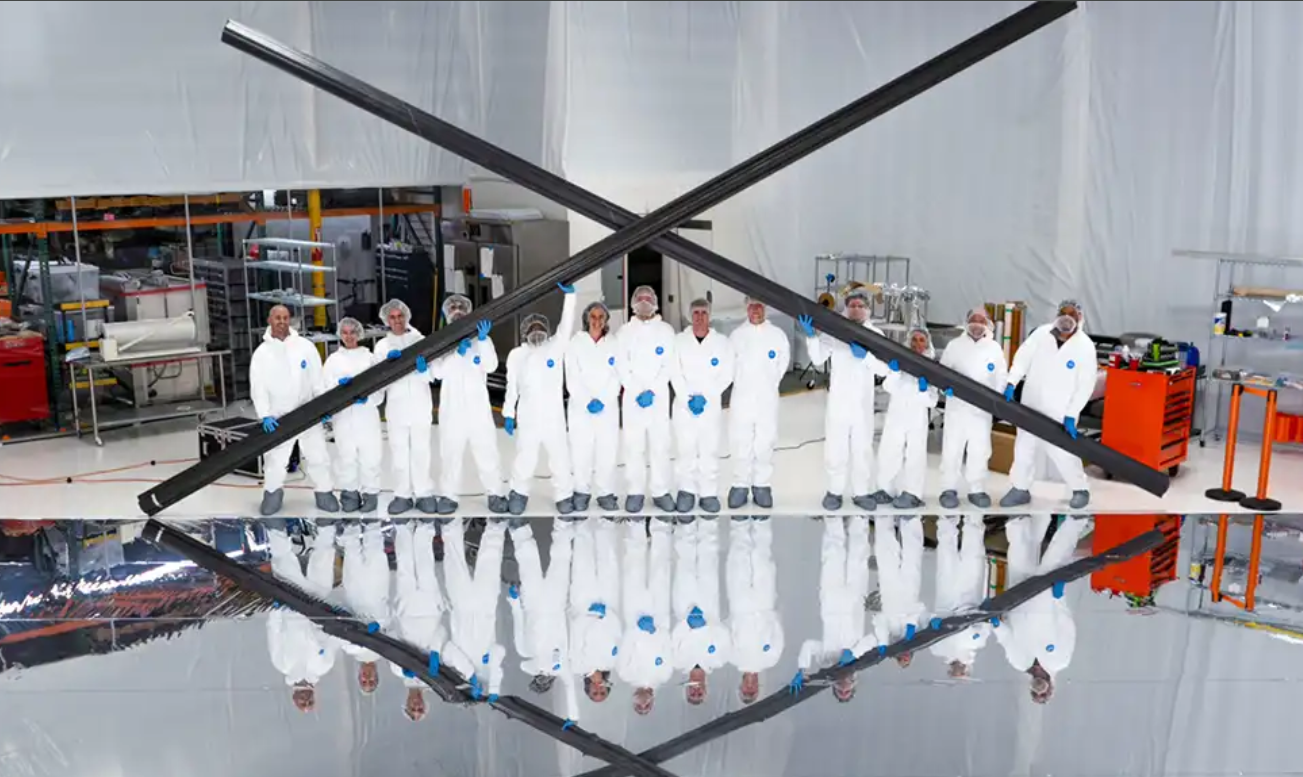 Reflect Orbital engineers. Credit: Reflect Orbital.
Reflect Orbital’s plan is to use on-demand solar for everything from extending working hours to disaster relief and agriculture. Read between the lines, and the U.S. Department of Defense could also potentially be a prime consumer of this technology. Certainly, the ability to generate and sell solar power at peak times has a lucrative appeal to the company.
Of course, the push back on the plan extends beyond the astronomical community. Reflect Orbital states that the plan for Eärendil-1 is to show the ability to project the brightness of a Full Moon at magnitude -12.6 magnitude over a 3-mile wide area… but all that brightness would be concentrated in a pinpoint source, rather than a half and degree-wide Moon. Also, the goal of generating solar power from such a source suggests that Reflect Orbital has a much brighter goal in mind.
The night sky has been under siege over the past decade, as SpaceX’s Starlink, China’s rival Qianfan ‘Thousand Sails’ mega constellation and AST Space Mobile’s Bluewalker and Bluebird satellites have all taken to the night skies. These were all incidental reflectors, photo-bombing the twilight sky view. What Reflect Orbital envisions seems more like it’s in direct conflict with the nighttime sky.
The company is aware of concerns, and has stated their wish to work with astronomical community to provide pinpoint service while announcing when and where the sunlight beams will be deployed. What would be key if this constellation of mirrors comes to pass would be the creation of exclusion zones for dark sky preserves and major observatories.
Unfortunately, this might also mean that the truly dark natural skies on your doorstep might soon become a thing of the past. We already see the difference at nightfall now, as the next ‘star’ you wish upon may very well be an artificial one. All-sky surveys like the Vera C. Rubin observatory took decades to go from planning to seeing first light. They’re an investment on a national scale, threatened by obsolescence shortly after the observatory shutter opens. Plus, if this venture proves lucrative, perhaps the next startup in the field won’t be as interested in preserving the night sky.
Beyond the impact on astronomy, there’s safety concerns surrounding the project in terms of the public and aviation, as well as the impact on nocturnal wildlife, plus the potential for bright flashing objects in the sky to confuse satellite based star-trackers and more.
The American Astronomical Society has voiced the astronomical community’s concerns, and “stressed the importance of advance modeling of the full effects of atmospheric scattering as an input to understanding the severity of these risks” in a statement.
The company’s plan to mitigate light pollution includes ideas to quickly pivot reflectors into a passive configuration when not in use. The company is counting on the specular (non-diffuse) nature of its mirrors to focus and pinpoint light only where needed. This first mission could test that capability, though it’s tough to envision scaling this up, once thousands of reflectors are in space.
Universe Today reached out to Reflect Orbital for comment on the approval and the launch, with no reply.
Perhaps, we need something equivalent to the FCC, in terms of an authoritative international agency able to analyze and approve missions and their night sky impact.
Our science fiction future is indeed here, and with it, we’ll need to give some thought as to how it will look draped across our night sky.



