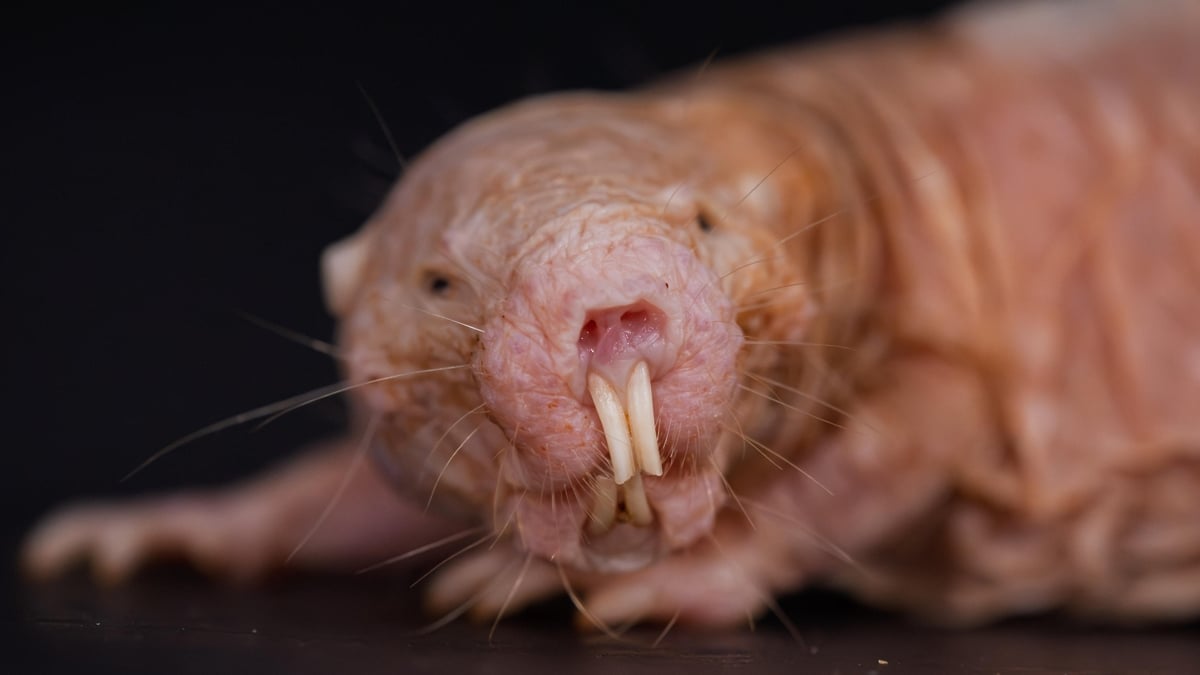
Heterocephalus glaber буюу нүцгэн сохор номин нь хөгширдөггүй, өвчин болон өвдөлтөд тэсвэртэй, удаан амьдардаг онцлогтой мэрэгч амьтан юм. Макс Дельбрюкийн нэрэмжит төвийн судлаач Мохаммед Халлаф болон түүний баг нүцгэн сохор номингийн колони дахь нийгмийн дэг журмыг хатан хааны ялгаруулдаг “изопропил миристат” (IPM) хэмээх бодис зохицуулдаг болохыг Nature сэтгүүлд нийтэлсэн судалгаагаар баталжээ. Энэхүү химийн нэгдэл нь хатан хаан байхгүй үед ч сүргийн гишүүдийн үржил болон түрэмгий зан үйлийг дарангуйлж, энх тайвныг хадгалдаг байна.
Судалгааны явцад IPM бодистой холбоотой үнэр нь нүцгэн сохор номингийн тархины үнэрлэхүйн хэлхээг идэвхжүүлж, тэдний дааврын түвшинд нөлөөлдөг болох нь тогтоогджээ. Энэхүү бодист өртсөн эмэгчин номингуудын цусан дахь сүү ялгаруулалтыг дэмждэг пролактин дааврын хэмжээ нэмэгдэж, үржил хөгжлийг хариуцдаг прогестерон дааврын түвшин буурдаг байна. Ингэснээр хатан хаан өөрийн биеэр байхгүй байсан ч үнэрээр дамжуулан сүргийн эмх цэгцийг бүрэн удирддаг ажээ.
Энэхүү нээлт нь зөгий, шоргоолж зэрэг нийгэмч амьтдын хатан хаантай адил нүцгэн сохор номин ч мөн үнэрээр дамжуулан нийгмийн бүтцээ хадгалдаг болохыг харуулж байна. Энэ нь өөр өөр зүйлийн амьтад ижил төстэй хувьслын замыг туулж, нийгмийн нарийн төвөгтэй харилцааг химийн дохиогоор зохицуулах чадварыг хөгжүүлсний тод жишээ болж байна.
Дэлгэрэнгүйг эх сурвалжаас харах
↓Эх сурвалжийг нээх ↓
Naked mole-rats are wonderfully strange. First off, they’re awesomely cute or terrifyingly ugly, depending on your taste, with furless, wrinkly skin and buck teeth.
Their chirps have accents. They can live without oxygen for up to 18 minutes.
Naked mole-rats (Heterocephalus glaber) also have ridiculously high levels of pain resistance. They kidnap each other’s young – and enslave them.
But they’re probably most famous for their longevity.
Considered a ‘non-aging’ animal that defies Gompertz’s Law, not only have some lived for almost 40 years (about ten times longer than any other rodent), but they show little cognitive decline as they age, and they don’t appear to get cancer.
It’s those disease- and aging-resistance feats that have long drawn researchers to better understand how the naked mole rat differs from other mammals, and how the secrets of their long, healthy lives might inform treatments or drugs to help humans do the same.
But that’s not all these wrinkly weirdos can teach us. New research published in Nature shows that they govern by scent.
“The idea that a single scent can maintain peace and prevent violence may sound like science fiction,” says Mohammed Khallaf, a neuroscientist at the Max Delbrück Center in Berlin and first author of the study.
“In the world of naked mole-rats, it is reality.”
Naked mole-rats live most of their lives underground, like ants.
And also like ants (and bees), they live in cooperative colonies with a single breeding female, the queen, while dozens of other females remain infertile, helping instead to dig tunnels, defend the nest, and raise pups.
Scientists have known for decades that removing the queen sparks a dramatic power struggle, with dominant females battling – sometimes to the death – for the chance to replace her.
But how does the queen keep everyone else from reproducing before her decline?
Scientists identified a chemical called isopropyl myristate (IPM) that is abundant in queens but almost absent in non-breeding mole-rats. (IPM isn’t detectable by humans – they tested that too – and is used in cosmetics.)
The compound appears to function much like the queen pheromones that keep worker bees and ants from reproducing, making it one of the clearest examples yet of a mammalian chemical signal controlling an entire society.
“It works even when the queen is absent, and the animals are exposed only to the scent,” says Khallaf.
The researchers first confirmed that naked mole-rats rely heavily on smell to recognize colony members.
Next, they analyzed hundreds of samples collected from more than 350 mole-rats, and the team identified hundreds of volatile compounds.
One stood out because it was consistently abundant in queens, but almost undetectable in non-breeding animals. Levels were highest when queens were ovulating, suggesting it was closely linked to reproductive status.
Unlike many odor molecules that quickly evaporate, IPM can linger in the tunnels where naked mole-rats spend their lives. Queens, which patrol their colonies more actively than other animals, probably spread the compound throughout the underground network.
Finding the molecule was useful, but they also needed to show that it actually changed behavior.
They found that high-ranking females – the animals most likely to become the next queen – actively avoided bedding treated with IPM, while lower-ranking animals didn’t seem to care. Brain imaging also showed the compound activated olfactory circuits, confirming that the animals could detect it.
Most importantly, exposure changed hormone levels.
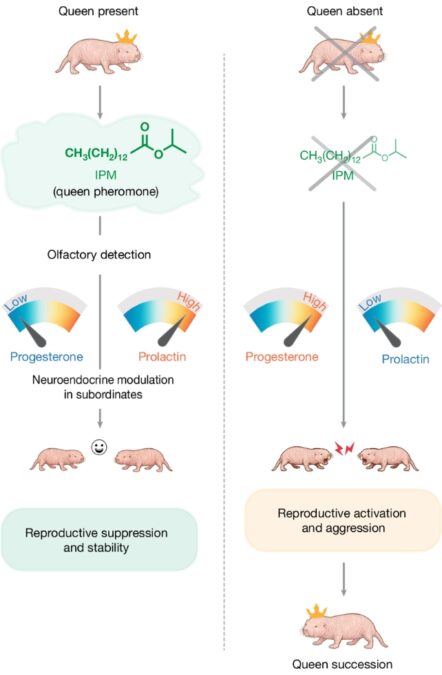
Non-breeding females exposed to IPM had increased levels of prolactin, a hormone best known in mammals for stimulating milk production after pregnancy. High prolactin also suppresses fertility, by interfering with reproductive hormone signaling.
The ultimate test came when researchers removed queens from colonies. Normally, that triggers a rapid breakdown of social order as dominant females compete for the throne. Instead, colonies given daily doses of IPM remained peaceful for three months.
Progesterone (a hormone associated with reproduction) stayed low, no succession battles emerged, and no females became pregnant.

As Lewin explains, the “queen’s physical presence is not essential for maintaining harmony in the colony. Simply spraying isopropyl myristate into the colony each day was enough.” That’s some powerful scent!
When the researchers stopped adding the chemical, the colony quickly descended into conflict. Aggression erupted so a new queen could be found.
Related: Experiments Show Women Can Sniff Out Single And Married Men
The discovery suggests naked mole-rats may have independently evolved something strikingly similar to the queen pheromones long known in bees, ants and termites – a case of very different animals arriving at surprisingly similar solutions for maintaining complex societies. (A great example of convergent evolution.)
After decades of wondering how one tiny queen manages to rule an entire underground kingdom, scientists may finally have identified one of her most powerful tools: a simple smell that has the power to change other naked mole-rats’ own hormone balance, and futures.
The research has been published in Nature.
This article was fact-checked by Clare Watson and edited by Peter Dockrill. While we pride ourselves on our process, we are only human. If you spot a mistake, please let us know.

