
University College London-ийн судлаачид хүний гэдэсний дуу чимээг таних чадварыг хэмжих шинэлэг туршилт хийж, үр дүнг Scientific Reports сэтгүүлд нийтэлжээ.
Судлаачид 45 эрүүл оролцогчийг гурван цаг мацаг бариулсны дараа дижитал чагнуураар гэдэсний дуу чимээг (borborygmi) бичиж авсан байна. Оролцогчид өлөн үедээ, хийжүүлсэн ус уусны дараа болон уурагт коктейль уусны дараа гэсэн гурван өөр төлөвт өөрийн гэдэсний шууд дамжуулж буй дуу болон хэдэн минутын өмнө бичигдсэн дууг ялгах даалгавар гүйцэтгэжээ.
Туршилтын үр дүнд оролцогчдын 56-60 хувь нь өөрийн гэдэсний чимээг зөв таньсан нь санамсаргүй таавраас ялимгүй илүү үзүүлэлт болсон байна. Гэсэн хэдий ч мацаг барих үед таван хүн тутмын нэг, харин шингэн болон хоол хэрэглэсний дараа дөрвөн хүн тутмын нэг нь гэдэсний дуу чимээг өндөр нарийвчлалтайгаар таньжээ. Энэ нь бие махбодын физиологийн байдал өөрчлөгдөхөд дотоод эрхтний дохиог хүлээн авах чадвар буюу интерoцепцийн түвшин өөрчлөгддөгийг харуулж байна.
Интерoцепци буюу “зургаа дахь мэдрэхүй” нь өлсөх, цангах, өвдөх зэрэг мэдрэмжээс гадна сэтгэл хөдлөл, сэтгэл зүйн зохицуулалтад чухал үүрэгтэй. Судлаачид энэхүү энгийн бөгөөд нээлттэй эх сурвалж бүхий аргыг ашигласнаар хоол боловсруулах эрхтний тогтолцооны мэдрэмж алдагдахтай холбоотой хооллолтын эмгэг, цочромтгой гэдэсний хам шинж, түгшүүр, сэтгэл гутрал зэрэг эмгэгийг судлах боломжтой гэж үзэж байна. Мөн гэдэсний дуу чимээг таних чадвар нь бага наснаас эхлэн нийгмийн орчинд суралцах замаар бүрэлддэг байж болзошгүйг тэмдэглэжээ.
Дэлгэрэнгүйг эх сурвалжаас харах
↓Эх сурвалжийг нээх ↓
As a kid, I used to put a toy stethoscope to my cats’ and dogs’ bellies to listen to all the strange sounds (and even tried it on myself a few times).
The noise was weird and funny – and instantly recognizable, as anyone with a digestive system that has blasted out a deep growl at an inopportune time knows.
It’s amusing when it’s someone else’s stomach; cringe-worthy when it’s your own.
But could you recognize your stomach rumbles and match them to your current state?
That’s what a team led by researchers at University College London recently did in a creative new experiment published in Scientific Reports, in which people had to identify whether they’re listening to a live recording of their own stomach or one recorded a few minutes earlier.
Why?
Called Rumble Recognition (by the researchers themselves), the test isn’t trying to prove you can recognize your stomach’s ‘voice’.
Instead, it’s designed to measure something called gastrointestinal interoception – our ability to detect and interpret signals coming from inside the digestive system.
Interoception (AKA the ‘sixth sense’) has become a hot topic in neuroscience because it underpins everything from physical sensations like hunger, thirst, or a full bladder – but also includes emotions.
“Gastrointestinal sensations contribute to what are colloquially referred to as ‘gut-feelings’ and are an often-reported aspect of emotional feelings,” write the researchers.
Interoception is important because it’s a key way for us to assess whether we are feeling energetic, hungry, stressed, sick, afraid, or relaxed – which is really important for emotional and psychological regulation.
Some people are pretty tuned into their bodies in this way, but being overtuned can lead to panic attacks and distraction, while having low interoception can lead to over- and under-eating, dehydration, and ignoring pain. (Ever been hangry? Me too.)
In the case of feelings of hunger, researchers have had surprisingly few practical ways to study how people perceive signals from the stomach and intestines – even though there are myriad health issues that involve it.
Most existing methods for measuring how we understand hunger and digestion cues are frankly unpleasant, like inflating balloons inside the stomach or rectum to test sensitivity.
Newer approaches require swallowing electronic capsules. It means that getting volunteers to join these experiments has been an understandable challenge.
The approach debuted in this research is much simpler.
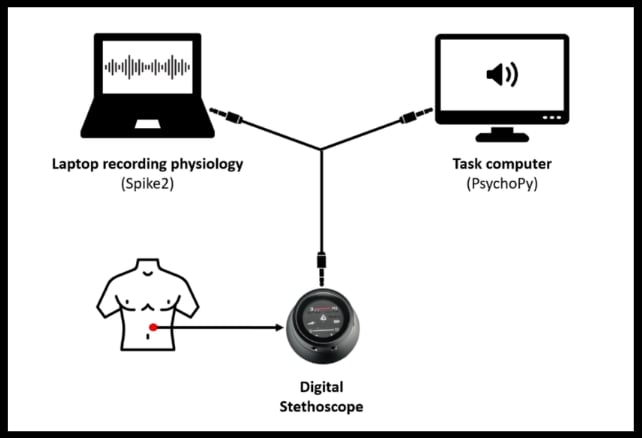
Forty-five healthy adults (two-thirds were women) arrived at the lab after fasting for three hours. A digital stethoscope was placed on their abdomen to capture the constant soundtrack of digestive life: borborygmi – the scientific term for bowel sounds.
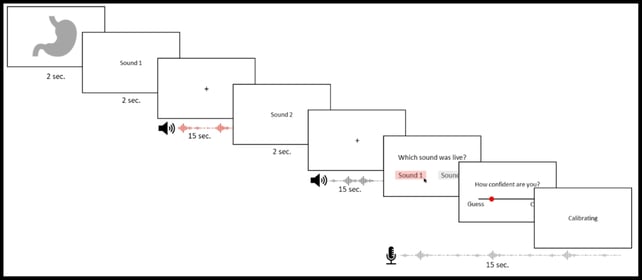
Participants then listened to two 15-second audio clips. One was a live feed from their stomach at that moment, while the other had been recorded a few minutes earlier.
They had to decide which recording was happening in real time and rate how confident they felt about their answer.
Researchers repeated the task in three different digestive states: while fasting, after drinking sparkling water, and again after consuming a high-protein meal-replacement shake.
Overall, people weren’t particularly good at identifying the live recording. Accuracy hovered around 56 to 60 percent – only slightly better than the 50 percent expected by random guessing.
But the test wasn’t a failure because the researchers weren’t expecting most people to be good at this level of interoception. They were looking for meaningful differences between people, and that’s exactly what they found.
Roughly one in five participants performed significantly above chance while fasting, rising to around one in four after drinking either sparkling water or the meal replacement. Some individuals also showed good insight into when they were likely correct, with confidence ratings tracking actual performance.
That suggests that how aware we are of internal digestive signals changes with physiological state. Also, it seems that there are very real differences in how well some people are tuned to digestive signals compared to others.

The authors argue this could eventually help scientists study conditions where gut awareness appears altered, including eating disorders, irritable bowel syndrome, anxiety, and depression.
Better tools for measuring gastrointestinal interoception might also help researchers understand why emotions and digestive symptoms so often travel together.
The work also touches on an intriguing psychological idea: Our interpretation of stomach noises is at least partly learned.
Children learn that a rumbling stomach often means hunger because parents point it out, helping build lifelong associations between bodily sensations and their meanings.
Related: Itching May Have Its Own Sensory Organ
But not all parents teach their kids about the nuances of bodily functions, and some parents might not have strong skills in this area themselves to be able to teach.
“Consequently,” the researchers write, “gastrointestinal states contributing to distinct physical and emotional feeling states are often idiosyncratic, and, in part, socially constructed.”
In addition to its findings, this study introduces a really useful research tool that’s not invasive, cheap, and they have made it open-source – which could make it a lot easier for scientists to do more research into one of the body’s least-understood sensory systems.
Your stomach may have been trying to tell you something all along. The trick is figuring out whether you’re actually listening.
The research has been published in Scientific Reports.
This article was fact-checked by Rachel Garner and edited by Peter Dockrill. While we pride ourselves on our process, we are only human. If you spot a mistake, please let us know.

