Брукхейвений үндэсний лабораторийн физикчид соронзон нэгдлийн доторх бодисын өмнө нь мэдэгдээгүй, “хагас мөс, хагас гал” гэж нэрлэсэн шинэ төлөвийг нээжээ.
Физикчид Weiguo Yin болон Alexei Tsvelik нар 2024 оны арванхоёрдугаар сарын 31-нд Physical Review Letters сэтгүүлд нийтлүүлсэн судалгаагаараа Sr3CuIrO6 хэмээх ферримагнит нэгдлийн доторх электроны спинийн хоёр эсрэг тэсрэг бүлэг зэрэгцэн оршиж байгааг тогтоосон байна. “Хүйтэн” гэж нэрлэгдэх өндөр эрэмбэтэй бүлэг болон “халуун” буюу эмх замбараагүй бүлэг нь температурын маш нарийн хязгаарт өөр хоорондоо байраа сольдог ажээ. Энэхүү үзэгдэл нь бусад бодисын төлөвөөс ялгаатай нь фазын шилжилт маш хурдан явагддаг онцлогтой.
Тус багийнхан 2012 оноос хойш уг нэгдлийг судалж байгаа бөгөөд 2016 онд гадны соронзон орны нөлөөгөөр үүсдэг төстэй төлөвийг анх илрүүлж байв. Гэвч шинээр нээсэн “хагас мөс, хагас гал” төлөв нь гадны нөлөөгүйгээр, тодорхой температурт бодисын дотор далд байдлаар оршдог байна. Энэхүү нээлт нь Изингийн загварт тогтоосон хязгаарлалтыг давж, температурын нарийн хязгаарт фазын шилжилт хийх боломжтойг онолын хувьд баталсан юм.
Энэхүү ололт нь квант тооцоолол, спинтроникс болон хөргөлтийн технологид чухал ач холбогдолтой. Тухайлбал, соронзон энтропийн огцом өөрчлөлт нь үр ашигтай хөргөлтийн системд ашиглагдах боломжтой бол, хоёр өөр төлөв нь квант санах ойн мэдээллийг хадгалах шинэ нэгж болж хувирах боломжтой гэж судлаачид үзэж байна.
Дэлгэрэнгүйг эх сурвалжаас харах
↓Эх сурвалжийг нээх ↓
Physicists at Brookhaven National Laboratory in Upton, New York have identified a previously unknown phase of matter hidden inside a magnetic compound, one with a paradoxical internal structure that switches between states over an extraordinarily narrow temperature range. The findings appear in the December 31, 2024, edition of Physical Review Letters, describing what the researchers call a new direction for understanding and controlling phase transitions in certain materials.
The new phase, dubbed “half ice, half fire,” consists of two opposing populations of electron spins coexisting simultaneously within the same material. One population is highly ordered, referred to as “cold,” while the other is highly disordered, referred to as “hot.” Electron spins are the tiny magnetic moments carried by every electron, oriented either up or down, and their degree of order determines a material’s magnetic and thermal behavior at the quantum level. The nickname captures that contrast directly.
What sets this phase apart from other exotic states of matter is the sharpness of the transition it produces. Most phase changes in real materials are gradual, which limits their usefulness in devices that require fast, precise switching between distinct states. Here, the crossover between phases occurs across an ultranarrow temperature window, a property that connects the discovery directly to questions in quantum computing, spintronics, and refrigeration technology.
A Ferrimagnet at the Center of a Decade-Long Investigation
The material in which the phase was discovered is Sr3CuIrO6, a compound of strontium, copper, iridium, and oxygen belonging to a class of magnets called ferrimagnets. Unlike ordinary magnets, ferrimagnets contain populations of atoms with opposing magnetic moments that do not fully cancel each other out, so some net magnetization always remains. Physicists Weiguo Yin and Alexei Tsvelik at Brookhaven have been studying this specific compound since 2012, when a multi-institutional collaboration led by Brookhaven physicist John Hill produced the first experimental results on its phase behavior.
That investigation produced its first major result in 2016, when the same team discovered a related state inside the same compound called “half fire, half ice.” In that phase, disordered hot spins occupy the copper sites of the atomic lattice while ordered cold spins occupy the iridium sites, with the state induced by applying a critical external magnetic field. It was a significant finding, but Tsvelik later acknowledged that the team lacked the theoretical tools to explain how the state could be put to use. “Despite our extensive research, we still didn’t know how this state could be utilized,” he said. “We were missing pieces of the puzzle.”
The new “half ice, half fire” phase reverses that arrangement entirely. The hot and cold spins swap positions across the two atomic sites, and unlike its predecessor, this reversed state does not require an external magnetic field to appear. It exists within the material at a finite temperature, hidden rather than induced. Identifying it required both fresh theoretical work and a careful re-examination of the compound the team had been studying for more than a decade.
Resolving the discovery also meant working around a long-standing theoretical constraint. For over a century, the standard one-dimensional model of ferromagnetism known as the Ising model had been understood to produce no phase transition at any finite temperature, which seemed to block a path toward practical use of these states. Yin demonstrated that the forbidden transition could be approached through an ultranarrow phase crossover at a fixed finite temperature, providing the theoretical opening that made the current discovery possible.
Two States, One Ultranarrow Switch
The transition between “half fire, half ice” and “half ice, half fire” takes place across an extraordinarily narrow temperature range, a feature that distinguishes it from the gradual crossovers seen in most magnetic materials. Sharp switching between well-defined phases is technically valuable because it produces a clean boundary between two distinct configurations rather than a blurred, ambiguous middle region. The study in Physical Review Letters describes that switching behavior in detail, along with the theoretical framework used to characterize both phases.
Tied to that transition is a large magnetic entropy change. Magnetic entropy measures the degree of disorder carried by the spin arrangement in a material. When that disorder shifts suddenly and substantially across a narrow temperature window, the result is a sharp thermodynamic signal with measurable physical consequences. In Sr3CuIrO6, the combination of a large entropy shift and an ultranarrow crossover temperature gives the transition properties that most conventional magnetic materials do not produce.
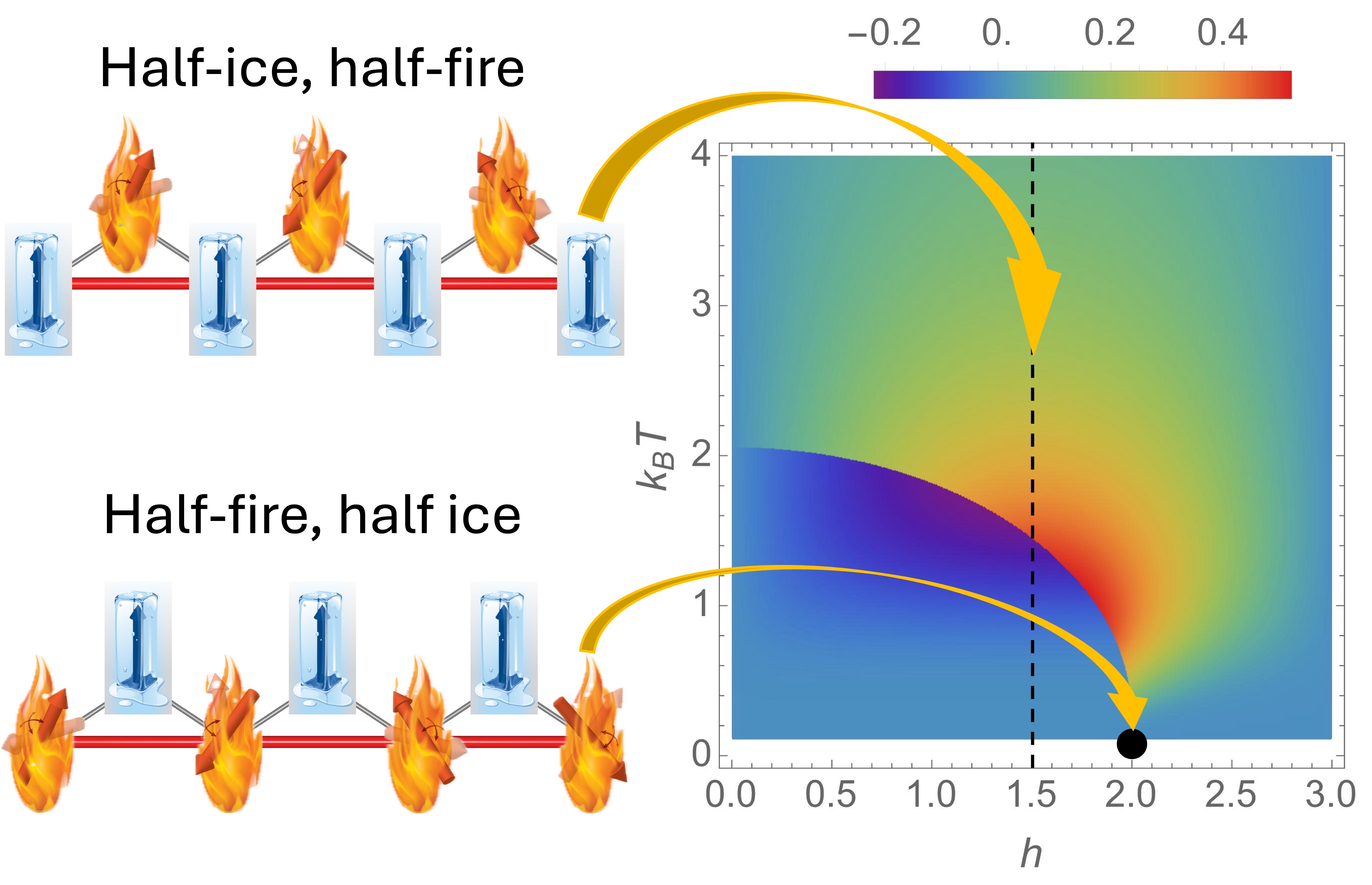
The hidden character of the “half ice, half fire” state was itself part of the challenge. While “half fire, half ice” appears at a specific critical point under an external field, its twin sits along a broader region of the temperature-field phase diagram, concealed within the material rather than visible at a single well-defined point. Locating it required the theoretical insight about ultranarrow crossover behavior and a deliberate search informed by years of prior work on the same compound.
Together, the two phases form a pair of opposite states linked by a single, sharp switching mechanism. Their coexistence within one material, and the clean transition between them, is what the Brookhaven team identifies as the core result of the research.
Quantum Computing, Spintronics, and Refrigeration as Target Applications
Yin and Tsvelik have proposed two categories of application that follow directly from the phase properties they observed. The first involves refrigeration. Magnetic cooling relies on large, rapid shifts in magnetic entropy: when a material’s spin disorder changes sharply over a narrow temperature window, the accompanying thermodynamic effect can drive heat transfer efficiently. The entropy change associated with the “half fire, half ice” transition makes Sr3CuIrO6 a candidate for that kind of cooling mechanism.
The second category involves quantum information storage. The two phases, “half fire, half ice” and “half ice, half fire,” represent two distinguishable and stable configurations within the same material. In principle, those configurations could serve as the two states of a bit in a new form of quantum memory, with the sharp transition between them acting as the switching mechanism. This differs from qubit architectures currently under development by grounding the information states in bulk phase behavior rather than individual particle properties.
Both directions connect to wider research priorities in condensed matter physics and materials science. “Finding new states with exotic physical properties, and being able to understand and control the transitions between those states, are central problems in the fields of condensed matter physics and materials science,” Yin said in the Brookhaven Lab announcement. “Solving those problems could lead to great advances in technologies like quantum computing and spintronics.”
Spintronics uses electron spin rather than electrical charge as the basis for storing and processing information, and has drawn sustained interest as a path beyond conventional silicon-based computing.
Enjoyed this article? Subscribe to our free newsletter for engaging stories, exclusive content, and the latest news.