Эрдэмтэд жоомны бүлэг нь хувь хүний ой санамжаас бус, харин хоорондын харилцан үйлчлэлээс бүрдсэн хамтын шийдвэр гаргадаг болохыг илрүүлжээ.
Бельгийн Брюсселийн чөлөөт их сургуулийн судлаач Мариано Кальво Мартин болон түүний баг Америкийн жоомны (Periplaneta americana) амьдрах орчноо сонгох зан төлөвийг судалжээ. Ойн экосистемд чухал үүрэгтэй эдгээр шавьж нь харанхуй, чийглэг газрыг илүүд үздэг. Туршилтын явцад судлаачид жоомны бүлэг нэгэнт сонгосон байраа орчин нь өөрчлөгдсөн ч орхилгүй үлдэж байгааг ажигласан байна.
Ганцаараа байгаа жоом орчин нь таагүй болоход нэн даруй нүүдэг бол бүлгээрээ амьдарч буй жоомнууд бусадтайгаа хамт байхыг илүүд үзэж, өмнөх сонголтоо баримталдаг. Энэхүү зан үйл нь хувь хүний ой санамжаар бус, харин олон тооны жоом нэг дор цугларах үед үүсдэг нийгмийн таталцал болон бүлгийн бүтэцтэй холбоотой болохыг компьютер загварчлал баталсан байна.
Судлаачдын дүгнэснээр, жоомны энэхүү “хамтын ой санамж” нь тэдний хоорондын энгийн харилцан үйлчлэлээс үүсдэг бөгөөд нийгмийн бүтцэд хадгалагддаг байна. Энэ үзэгдэл нь загасны сүрэг, шувууны сүрэг, шоргоолжны үүр зэрэг хамтаар шийдвэр гаргадаг олон амьтны бүлэгт түгээмэл байж болзошгүйг эрдэмтэд онцолжээ.
Дэлгэрэнгүйг эх сурвалжаас харах
↓Эх сурвалжийг нээх ↓
The collective memory of the tribe can be crucial to survival.
For many animals, safety lies in numbers – and knowledge perseveres across generations, passing on migration routes, hunting techniques, or safe refuges through social learning.
But not all collective memories are created in the same way.
In skittering clans of cockroaches, scientists have found evidence of a collective memory that emerges solely from interactions and is stored only in the group’s social structure.
“Our theoretical approach reveals that social interactions and the group’s structure are sufficient to display a collective memory,” wrote a team led by social ecologist Mariano Calvo Martín of the Université Libre de Bruxelles in Belgium in a 2023 paper.
If you’ve ever overturned a soggy log in a forest and observed the skedaddling that ensues, you’ll know that cockroaches – which play an important role in forest floor ecosystems – love to cluster in dark, dank crevices.
The researchers wanted to know what would happen if that environment changed.
If a dark crevice transforms permanently into a floodlit chamber, the sensible thing to do would be to pack up and find another dark crevice. Yet theories of collective behavior suggest groups can become locked into established decisions, even after the environment changes and the choice is no longer sensible.
A 2015 study found that groups of the American cockroach (Periplaneta americana) are remarkably resilient to temporary disruptions to their living environment.
Calvo Martín and his team wanted to know if that resilience persisted if the changes were permanent.
They conducted their study on American cockroaches, using an experimental habitat with two otherwise identical shelters that differed only in their lighting. One was illuminated with red light, which appears darker to cockroaches and is therefore more attractive to them, while the other was lit green.
As expected, most cockroaches chose the red-lit shelter.
Then, the researchers pulled a switcheroo. They swapped the lighting so that the occupied shelter became green-lit and the previously less attractive shelter became red-lit, then watched to see what the cockroaches would do.
If a cockroach was all by its lonesome, it usually hightailed it out of the newly green habitat and made for the red one.
But for groups of cockroaches, the outcome wasn’t as predictable. If a large enough group had settled in before the lighting situation changed, they simply stayed put. The group had decided where to roost, and they stuck to it.
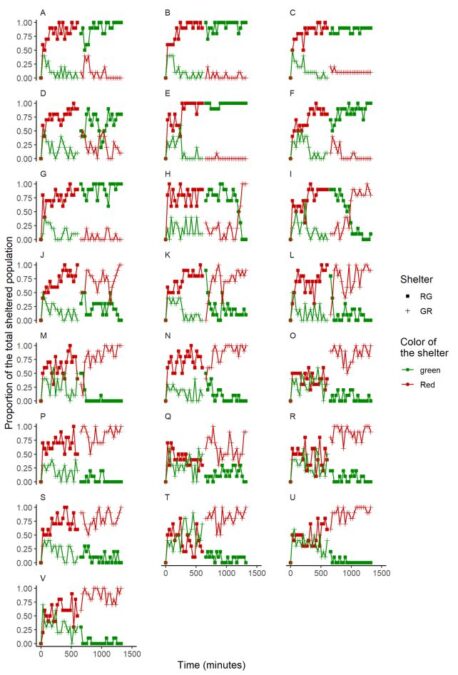
But the researchers didn’t think that the individual cockroaches were remembering where to shelter.
Instead, the ‘memory’ of the shelter emerged from their interactions with one another.
Each cockroach is more likely to stay where other cockroaches are resting. Once enough individuals gather in one place, that social pull can become stronger than the environmental cue telling them to move.
The result is a kind of collective memory. No single cockroach remembers, but the group as a whole behaves as if they do.
In computer simulations, the researchers found the same pattern emerged from a surprisingly simple set of rules.

Virtual cockroaches were programmed to prefer red-lit shelters and to linger where other cockroaches had already gathered. Nothing in the model gave any individual insect a memory of the original shelter.
Yet together, those simple social interactions were enough to make groups cling to their original choice even long after the lighting conditions had changed.
Related: A Wild Parasite Makes Ants Live 10x Longer And Tricks Others Into Worshipping Them
“Collective memory can also emerge solely through the interactions between the individuals and can be stored in the social structure,” the researchers write.
The researchers believe that this dynamic is not likely to be restricted to cockroaches. Many animal groups make decisions collectively, from fish schools and bird flocks to ant colonies and bee swarms – even humans.
Exactly how widespread this kind of collective memory is remains to be seen.
But if the researchers are right, cockroaches might be just one example of a much broader phenomenon that may be found wherever animals make decisions together.
The findings were published in PLOS One.
This article was fact-checked by Clare Watson and edited by Clare Watson. While we pride ourselves on our process, we are only human. If you spot a mistake, please let us know.