Хуучин цагт дуулиан тарьж байсан мэдээллийн аналитикийн компанийн вэбсайт одоо хиймэл оюун ухаанаар ажилладаг контентын ферм болон өөрчлөгдөж, хуурамч мэдээлэл түгээх хэрэгсэл болсон байна.
2018 оны гуравдугаар сард Facebook-ийн хэрэглэгчдийн хувийн мэдээллийг зөвшөөрөлгүй ашигласан гэдгээрээ танигдсан Cambridge Analytica компани үйл ажиллагаагаа зогсоосон ч тус компанийн домэйн хаяг болох CambridgeAnalytica.org өдгөө “CA Privacy Watch” нэрээр дахин ажиллаж байна. Тус сайт нь мэдээллийн аюулгүй байдал, хиймэл оюун ухаан, сэтгэл судлалын чиглэлээр контент бэлтгэдэг гэж мэдэгддэг ч бодит байдал дээр бусад хэвлэл мэдээллийн хэрэгслүүдийн мэдээг хуулбарлах, хиймэл оюун ухаанаар үүсгэсэн хуурамч агуулга нийтлэх үйл ажиллагаа явуулж байгаа нь тогтоогджээ.
Тус вэбсайт нь “Николас Мениер” нэртэй хуурамч зохиогчийн нэрээр 250 орчим өгүүлэл нийтэлсэн бөгөөд уг хүний профайл зураг нь Канадын нэгэн компьютерийн инженерээс хулгайлагдсан болох нь илэрсэн байна. Мөн тус сайт нь хиймэл оюун ухааны тусламжтайгаар бүтээсэн хуурамч дүрслэл, зураг ашигладаг бөгөөд Pangram үйлчилгээгээр шалгахад нийтлэгдсэн материалууд нь бүгд 100 хувь хиймэл оюун ухаанаар үүсгэгдсэн болохыг харуулжээ.
“Vortexlab Digital Marketing” компани нь уг домэйныг дуудлага худалдаагаар худалдан авч, хайлтын системийн оновчлол (SEO)-д зориулсан контентын ферм болгон ашиглаж байна. Энэ нь итгэл хүлээсэн хуучин домэйн нэрсийг худалдан авч, хиймэл оюун ухаанаар бүтээсэн хуурамч контентоор дүүргэн, хайлтын системийн алгоритмыг ашиглан олон сая хэрэглэгчийг татах түгээмэл аргачлал болохыг салбарын шинжээчид анхааруулж байна.
Дэлгэрэнгүйг эх сурвалжаас харах
↓Эх сурвалжийг нээх ↓
It may already feel like a distant memory, but Cambridge Analytica was once implicated in one of the biggest social media scandals in history.
Back in March 2018, journalists at The Observer and The New York Times revealed that the little-known data analytics firm had improperly harvested the Facebook data of tens of millions of users without their consent. Owned by billionaire Robert Mercer and operated by Donald Trump’s die-hard operative Steve Bannon, Cambridge Analytica had used the massive trove of personal data to target voters with attacks against Hillary Clinton, Trump’s rival in the 2016 presidential election. Executives at the company were even caught bragging that their underhanded methods had pushed Trump into office.
The explosive incident forced a mass reckoning over privacy and surveillance in the social media age. Facebook CEO Mark Zuckerberg was called to testify before Congress, and his company’s reputation has never fully recovered. Cambridge Analytica itself shut down just months after the revelations.
Fast forward to today, though, and Cambridge Analytica has somehow returned. And its resurrection comes in an almost comically 2026 way: CambridgeAnalytica.org, the firm’s former website, is now an AI-powered content farm.
Rebranded as CA Privacy Watch, the site’s new owners are using the husk of the defunct data company’s domain to churn out content about data, privacy, AI, and —in a puzzling departure from theme —pop psychology. The articles it publishes are riddled with extensive plagiarism, we found, and it’s used at least one entirely fake writer to byline them.
This zombie version of Cambridge Analytica is designed to look and feel like a news site. On an “About Us” page, it claims to “examine how data, algorithms, and modern technologies shape public life, influence human behavior, and redefine power in the digital age” by way of “in-depth reporting and clear explanations.” It also explicitly promised that “all articles are written and edited by human journalists and researchers,” and that it does “not publish AI-generated or automated articles without full editorial review.” A disclaimer in the site’s footer, meanwhile, notes that the new site is “not affiliated with, endorsed by, or connected to the former Cambridge Analytica Ltd or any of its successors.”
But the closer you look, the more the site’s Potemkin veneer unravels.
The most glaring issue is the obvious plagiarism. Consider an article published July 22, titled “My town just voted for more Flock cameras than cops — and the false arrests nobody’s talking about convinced them anyway.” The piece describes the dystopian fallout that occurred in a South Carolina town after it deployed cameras made by the controversial surveillance company Flock.
There’s a lot that’s weird about this article. The byline attached to it,Miora Danielle Raveloarison, appears to be a real person wholives in Madagascar, not South Carolina; Madagascar has installed zero Flock cameras, and Raveloarison didn’t respond to a request for comment. Though the headline is written in first-person, the body of the piece isn’t. And a quick search showed that the Cambridge Analytica story is, in fact, a clear rip-off of a recent story by 404 Media journalist Matthew Gault. Titled “What Happened When Flock Came to My Town,” Gault’s piece was published on July 22, just hours before CA Privacy Watch pumped out its plagiarized version.
The new Cambridge Analytica has plagiarized other 404 Media articles, in addition to reporting by the New York Times, Engadget, MIT Technology Review, and Wired.
Back in April, for example, the zombie site published an article about how, through companies like LexisNexis and Verisk Analytics, automakers quietly funnel driving data to insurance companies. It never mentions that this information was revealed more than a year earlier in an investigation by the NYT‘s Kashmir Hill.
And earlier this week, the undead Cambridge Analytica published a story about New York’s Madison Square Garden shutting off its invasive, facial recognition-equipped surveillance systems for Taylor Swift’s wedding —information pilfered from a report published days earlier by Wired journalist Noah Shachtman.
Of course, it’s theoretically possible that the new Cambridge Analytica is plagiarizing the old-fashioned way, by hiring humans to do it. But its content is chock-full of oddities that point directly to AI-generated text.
Some articles make loose references to entities like “the startup” and “the government,” but fail to provide any context about which startup or government they’re talking about, giving the coverage a gas leak aura. The site’s imagery is all AI-generated, too, often complete with mangled lettering or other hallmark signs of AI slop. The zombie site has even used AI to generate fake images of real people —including of Christopher Wylie, the data scientist and famed Cambridge Analytica whistleblower. (Reached through representatives, the real Wylie didn’t respond to a request for comment.)
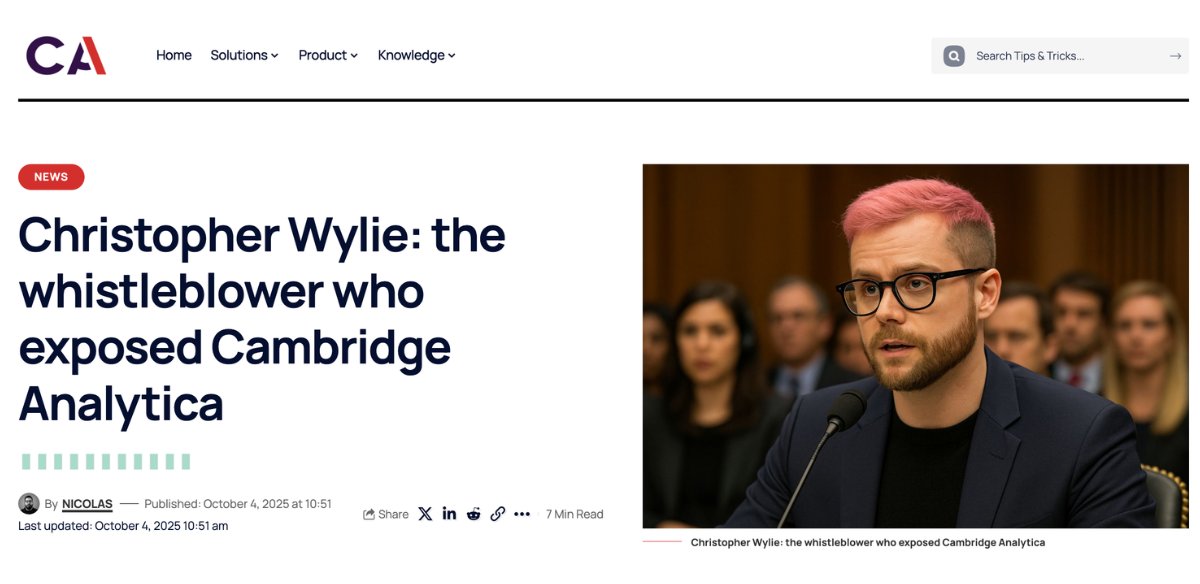
Though AI detectors are imperfect, we also ran ten of the site’s articles through Pangram, a service that analyzes text to ascertain whether it was generated using AI. Every article we tested was deemed 100 percent AI-generated.
In a meta twist, the resurrected site has published many articles about the Cambridge Analytica scandal and various characters involved. It also has the exceedingly weird quirk of taking completely unrelated news items and forcing a connection to the events of the Cambridge Analytica fallout, even where it’s completely nonsensical.
Take one of its many articles about pop psychology, whichin an exceptionally long headline declares that “Most people don’t realize that the people who walk with nothing in their ears aren’t being antisocial — they’re keeping the last stretch of attention no platform has figured out how to sell.” The piece takes great pains to link the existence of humans walking around without headphones to Cambridge Analytica, insisting that “it is worth pausing on the Cambridge Analytica case as a reference point — not because audio platforms operate identically, but because the underlying logic is structurally familiar.” It goes on to devote multiple paragraphs to the alleged connection between what occurred in the Cambridge Analytica scandal and the act of listening to music or podcasts, none of which makes any sense.
There are four writers bylined on the resuscitated Cambridge Analytica site. Three of those writers appear to be real, all of whom are based in Madagascar.
A fourth writer, who goes by the name “Nicolas Menier,” claims to be a “journalist dedicated to science and technology” who “covers how innovation shapes our daily lives, from groundbreaking discoveries to practical tools that make life easier.”
But Menier is almost certainly not a real person. We could find no evidence that a journalist with that name actually exists —and more tellingly, Menier’s headshot appears to have been stolen from the LinkedIn profile of a random computer engineer in Quebec, Canada. (We reached out to the engineer, but haven’t heard back.) Menier’s bio notes that the seemingly fake author has bylined nearly 250 articles.
Despite its many red flags, the new Cambridge Analytica’s content has been cited by news outlets including Esquire and Ars Technica. And back in January, an article published by the refurbished Cambridge Analytica alleging that the web browser Brave is secretly operating a data-tracking “surveillance machine” —which cited both nonexistent research and a fake Harvard Business Review study — caused enough commotion on X-formerly-Twitter that it prompted Brave CEO Brendan Eich to respond, calling the story “fake news.” Which, to be fair, it is.
We made multiple attempts to reach out to the new Cambridge Analytica’s writers, but didn’t hear back. We also tried to contact the site via various contact email addresses it listed, but the emails all bounced.
So we decided to take our questions to the reanimated domain’s apparent owner —and things got even weirder.
***
How Cambridge Analytica transformed from a scandal-ravaged political firm to an AI content farm is hazy and convoluted.
After the original company shuttered in 2018, its website was deactivated. Records on the Internet Archive’s Wayback Machine show late 2019 through mid-2020 as a dead period, returning an error when you tried to load it.
But in July 2020, the site suddenly reemerged, claiming to help clients achieve “data-driven behavior change” and even boasting the names and images of real former executives and employees of the defunct data company.On some pages, it showed Japanese-language ads for a “mail-order and personal import agency for advanced medicines,” as highlighted in a 2024 report by researchers at the Influence Industry Project. It even featured ads for erectile dysfunction drugs, for some reason.
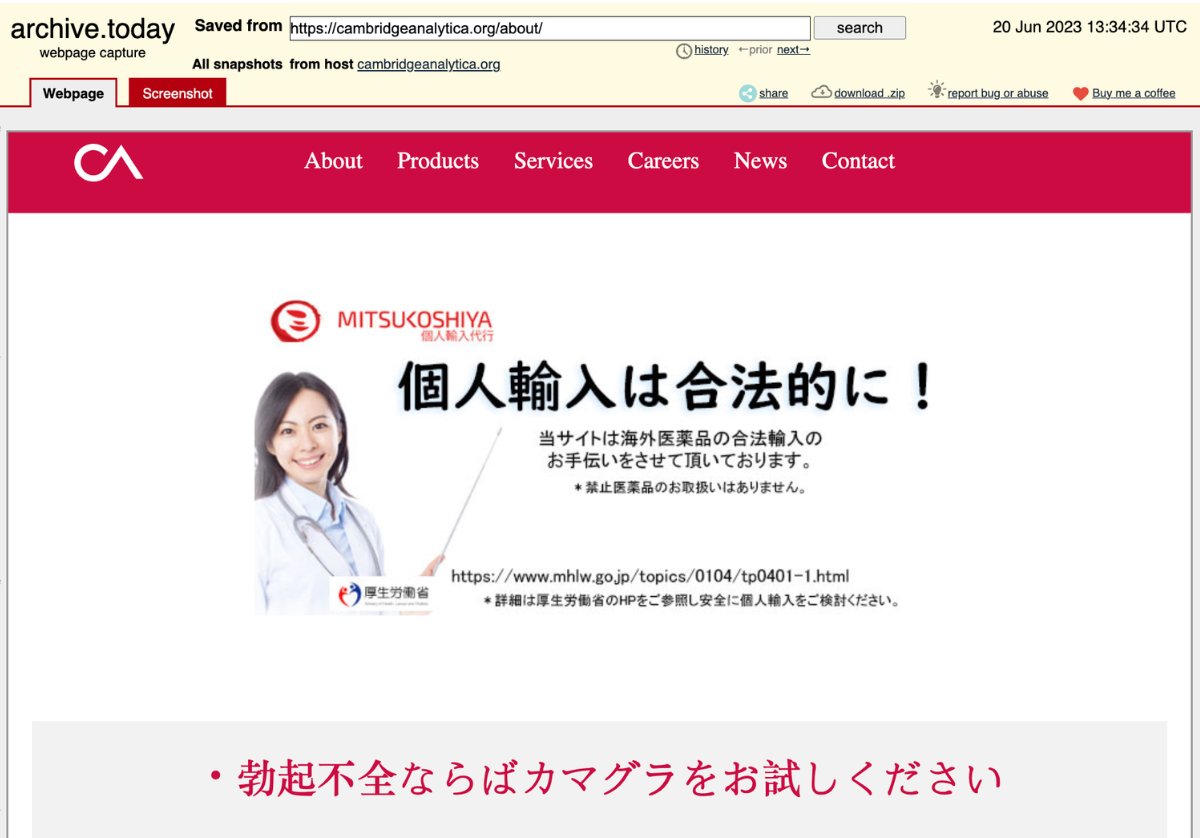
But it seems whoever was behind the ads for Japanese meds wasn’t looking to renew ownership of the domain. Wayback records show that CambridgeAnalytica.org expired around July 2025. It went up for auction on the domain marketplace Dropcatch, selling in September 2025 for what one source claims was $30,500. By November of that year, the current version of Cambridge Analytica was in full swing, churning out content under its fake “Nicolas Menier” persona.
On a “Legal Notice” page, the new Cambridge Analytica states that its owner is a company called “Vortexlab Digital Marketing, a digital media and research-oriented publishing company.” On its LinkedIn profile, Vortexlab, which is said to be registered in Dubai, describes itself as a “full-service digital agency specializing in SEO, Google Search optimization, and website management for the media and e-commerce industries.” A website listed on Vortexlab’s LinkedIn claims that the company’s goal is to be “the most respected Internet marketing agency.”
In addition to the new Cambridge Analytica, we found at least three other websites associated with Vortexlab: Le Ravi, which was a monthly French newspaper that went out of business in 2022; History in Politics, which was formerly the website for a student organization founded in Durham, England; and CMU.fr, which published information about French health insurance.
Vortexlab appears to have purchased all of these domains between July and November 2025, transforming them into SEO-targeted content farms riddled with many of the same problems plaguing the renewed Cambridge Analytica domain.
These issues are perhaps most glaring on Le Ravi, which hosts not one but two fake journalists. There’s Menier again, although this time his bio connects to the LinkedIn page of a real French automotive journalist named “Nicolas Menieur,” who is not the random computer engineer pictured in Menier’s profile and who appears to have no affiliation with Le Ravi or Vortexlab.
Le Ravi has also published content under the byline “Greta Taubert,” who’s described in a site bio as a “climate and environment journalist, driven by curiosity.” The bio links to an Instagram account for a real German journalist named Greta Taubert, seemingly to emphasize that the writer is an actual person.
But the Taubert on Instagram isn’t the same woman pictured in the Le Ravi bio. That woman, we found, is an American lawyer named Greta Peisch, who served as the General Counsel for the Office of the United States Trade Representative under the Biden Administration.
We reached out to Menieur and Peisch, but haven’t heard back. When we got in touch with the real Greta Taubert, though, she confirmed that Le Ravi is indeed impersonating her.
On an “Editorial Team” page, Le Ravi also lists the names of three other alleged writers named “Rhiannon Bates,” “Marcus Elwood,” and “Leila Chen-Okafor.” It claims that all of these writers have authored books, each boasting peculiarly similar titles: Bates apparently wrote “The Quiet Daughter: On Eldest Sisters, Inherited Caretaking, and the Slow Permission to Be Selfish”; Elwood is said to have published “The Late Apology: On Fathers, Forgiveness, and the Conversations That Don’t Happen Until They Do”; and Chen-Okafor, according to Le Ravi, wrote a book titled “In Two Languages: On Diaspora, Sensitivity, and the Psychology of Translating Yourself.”
But none of these writers — who, even more strangely, don’t appear to have actually bylined any of the site’s content —appear to exist beyond Le Ravi‘s site. We also couldn’t find any of their similar-sounding books for sale anywhere.
Vortexlab’s website doesn’t name any staff members, nor does it mention Cambridge Analytica, Le Ravi, History in Politics, or CMU.fr. It does, however, list a slate of clients that it claims are successful “case studies.”
But when we tried to look up Vortexlab’s alleged clients, all we could find were dozens of identical websites belonging to completely different SEO and marketing companies. All of these companies listed the same exact clients, none of which appear to be real companies at all; instead, they’re made-up filler companies that come with the web-building theme that Vortexlab used to construct its website.
When we sent an email to the contact address listed on Vortexlab’s website, it once again failed to deliver. As with the new Cambridge Analytica and the other sites in its stewardship, everything about Vortexlab seems to be fake.
We did notice, though, that an earlier version of Vortexlab’s website listed a United Arab Emirates phone number. We plugged it into WhatsApp and sent a text, which — to our surprise, at this point — actually delivered. But the person on the other end insisted they’d never heard of Vortexlab Digital Marketing.
“I don’t have any company,” they told us. “I don’t know any Vortexlab company.”
Shortly after we got in touch, though, the undead Cambridge Analytica changed its website. It scrubbed the language from its “About” page claiming that it doesn’t publish any AI-generated content; the page now declares that “our articles are developed and reviewed by our editorial team, with the support of digital and AI-assisted tools where appropriate for research, analysis, and drafting.”
“Every article undergoes human editorial review, fact-checking against credible sources, and verification before publication,” the altered page now reads. “We are committed to accuracy, responsible sourcing, and correcting errors transparently.”
***
As we tried to untangle the reanimated Cambridge Analytica domain, we reached out to Gisele Navarro, the managing editor of HouseFresh and a search engine optimization expert who’s closely watched the rise of AI content and its impact on independent websites.
Data from the analytics service SimilarWeb, Navarro noted, suggests that Vortexlab has been fairly successful in certain cases. The company takes over a website, then pumps it with SEO-targeted content; in the cases of Le Ravi and CMU.fr, this has resulted in brief floods of traffic as millions of users visit the site.
“It’s clear that their strategy has been to pick up expired, once-highly-trusted domains to quickly spin them into clickbait content farms,” Navarro said. “Whoever is behind these websites has developed a repeatable operation that starts with purchasing a once-trusted web domain in order to fill it up with AI-generated clickbait content before turning on the tap and driving millions of users through paid amplification — as well as organically while Google’s antispam systems play catch up.”
“This type of operation, where a third party acquires a once-trusted domain to take advantage of its authority (in the eyes of search engines and the public) is unfortunately very common,” she added, “especially in certain corners of the web.”
Interestingly, Navarro noted, Vortexlab appears to have been far less successful with the Cambridge Analytica domain than it has with other sites in its portfolio. Maybe the domain is too diseased to rehabilitate for clicks, even under its supposedly privacy-forward rebrand. In our testing, it seemed to be barely indexed by Google.
There’s something darkly fitting about Cambridge Analytica’s latest evolution, and perhaps uncanny. In its original form, the company was at the heart of arguably the defining scandal of the social media era, an event that laid bare the sheer amount of information about ourselves that we’d offered up to social media giants, and how that information could be tracked and exploited by political operatives attempting to wield it for purposes that users never anticipated.
Now, as the rapid influx of generative AI into the digital world threatens to turn the whole internet into an AI-fueled zombie shell of itself, scrambling the information ecosystem and making the web both more personalized and less real than ever, it somehow feels only right to see CambridgeAnalytica.org reemerge among the legions of undead.
More on AI: Journalist Alarmed When He’s Fired, But Company Keeps Posting AI Slop Under His Name
The post Cambridge Analytica’s Website Is Now an AI Slop Farm appeared first on Futurism.