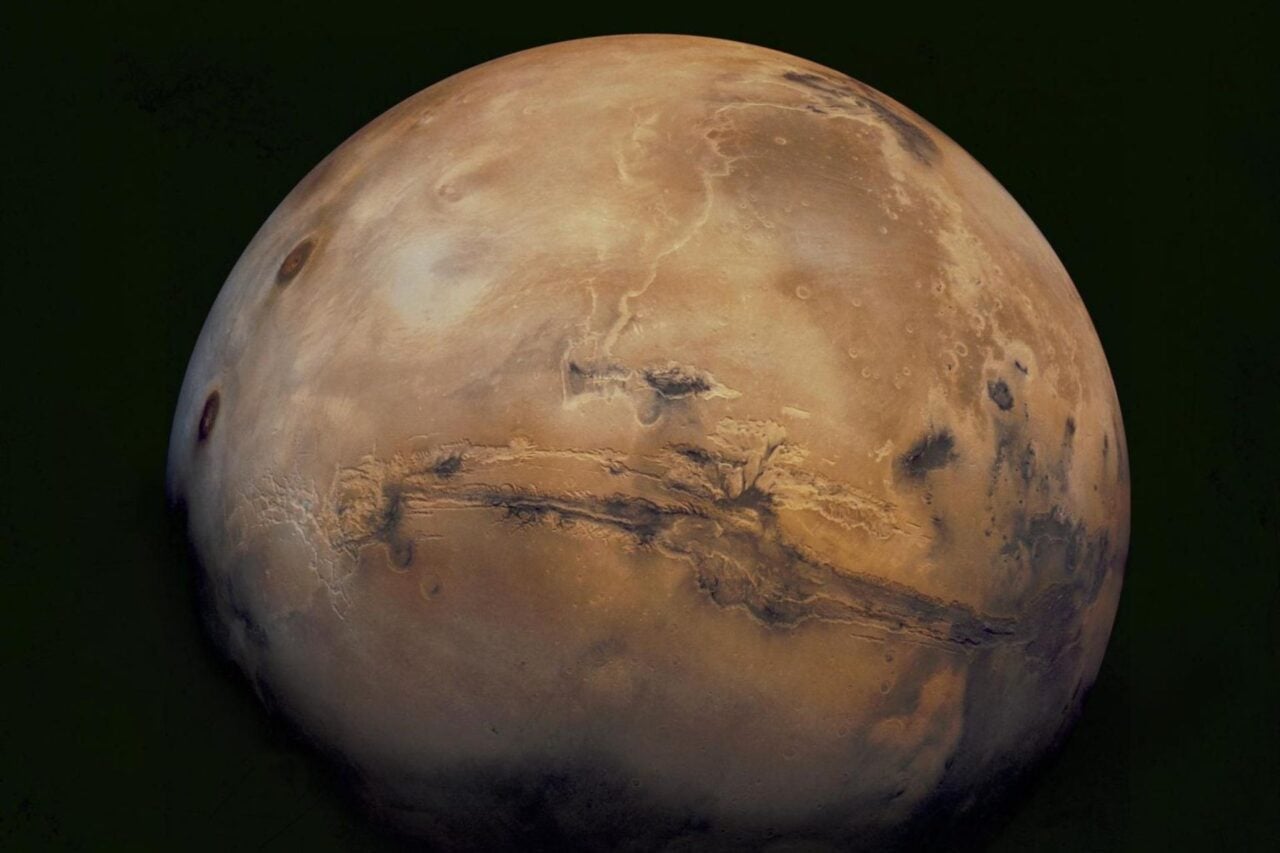
Нарны салхи Ангараг гарагийн дээд агаар мандлыг хийсгэж, сансар руу хий алдагдахад хүргэдэг аварга том долги үүсгэдэг болохыг эрдэмтэд тогтоожээ.
Өнөөдөр хүйтэн, зочломтгой бус дэлхий мэт харагддаг Ангараг гараг өнгөрсөн цагт амьдрал тээхүйц орчинтой, зузаан агаар мандал болон шингэн устай байсан гэж үздэг. Гэвч Дэлхийг бодвол хүчтэй соронзон орон байхгүйн улмаас нарны цахилгаан цэнэгтэй хэсгүүдийн урсгал болох нарны салхи түүний агаар мандлыг аажмаар хийсгэжээ. “Science Advances” сэтгүүлд нийтлэгдсэн шинэ судалгаагаар нарны салхи Ангарагийн агаар мандлын зах хэсгийг эргүүлж, сансар руу бөөмс зөөвөрлөх аварга том долги үүсгэдэг болохыг харуулсан байна.
https://www.science.org/doi/10.1126/sciadv.aed9072
Энэхүү үзэгдлийг судлахад тулгардаг гол бэрхшээл нь нэг сансрын аппарат Ангарагийн дээд хэсгийн нарны салхийг ажиглахын зэрэгцээ зугтаж буй ионуудыг давхар хэмжих боломжгүй байдагт оршино. Энэхүү сорилтыг даван туулахын тулд судлаачид NASA-гийн MAVEN болон Хятадын Tianwen-1 гэсэн хоёр сансрын аппаратын хэмжилтийг хослуулан ашиглажээ. Tianwen-1 нарны салхийг хянаж байхад MAVEN Ангарагийн ойролцоогоос зугтаж буй агаар мандлын ионуудыг ажигласан байна.
https://gizmodo.com/wild-video-shows-solar-winds-spiraling-millions-of-miles-from-the-sun-2000580999
Бостон их сургуулийн Сансрын физикийн төвийн судлаач Чи Жан тэргүүтэй эрдэмтэд хоёр аппаратын хэмжилтийг нэгтгэснээр Кельвин-Гельмгольцын долгион хэмээх шингэн маягийн долгион бүтцүүд плазмын үүлсийг үүсгэж буйг тогтоожээ. Дэлхий дээр салхи усны гадаргуугаар өнгөрөхөд ижил төстэй давалгаа үүсдэг шиг нарны салхи Ангарагийн агаар мандлын захыг хутгаж ийм хил хязгаарын долгион үүсгэдэг байна. Тус судалгаагаар энэхүү агаар мандлын алдагдал нь гараг даяар жигд бус явагдаж, нарны салхины цахилгаан оронгийн чиглэлээс шалтгаалан гарагийн аль нэг талд голчлон ажиглагддаг болохыг тогтоожээ.
https://phys.org/news/2026-07-solar-mars-upper-atmosphere-boosting.html
Ангараг яагаад ийм хуурай цөл болж хувирсныг ойлгох нь бусад гараг эрхтний орчин хувьсан өөрчлөгдөх процессыг танихад чухал ач холбогдолтой юм. Цаашид судлаачид Кельвин-Гельмгольцын долгион үүсэх таатай нөхцөлийг тодорхойлж, Ангарагийн агаар мандлын алдагдалд хэр зэрэг хувь нэмэр оруулж байгааг нарийвчлан судлахаар төлөвлөж байна. Энэхүү процесс нь хүчтэй соронзон орон байхгүй бусад гарагуудад ч мөн адил тохиолдох магадлалтай ажээ.
https://gizmodo.com/ancient-mars-may-have-been-more-habitable-than-we-thoug-1668711727
Дэлгэрэнгүйг эх сурвалжаас харах
Эх сурвалжийг нээх ↓
Although Mars is a frigid and hostile world today, the Red Planet may have once been capable of hosting some form of life. Unlike Earth, Mars lacks a strong magnetic field to protect it against incoming solar wind. As a result, the Sun’s stream of charged particles may have gradually stripped Mars of its atmosphere similar to how wind blows across the surface of water, according to a new study.
In a new paper published in Science Advances, researchers describe how solar wind on Mars can stir the edges of the planet’s atmosphere, creating giant, rippling waves that carry its atmospheric particles into space. The new findings provide new clues as to how Mars lost its atmosphere, and how the same process could cause other planets to evolve over time.
Riding the wave
The Sun releases a constant outflow of charged particles in the form of solar wind, which directly interact with Mars’ atmosphere. Previous research has shown that large clouds of plasma in Mars’ upper atmosphere are the main culprit behind the bulk escape of atmospheric ions to space, but scientists have not been able to track down their origin.
“Mars is thought to have once been potentially habitable, with a thicker atmosphere and surface liquid water. Understanding how it became the cold, dry planet we see today is important for understanding how planetary environments evolve over time,” Chi Zhang, a research scientist at Boston University’s Center for Space Physics and lead author of the new study, said in a statement.
The main obstacle behind studying how these clouds of plasma form is that no single spacecraft can observe the undisturbed solar wind upstream on Mars while also measuring the atmospheric ions escaping into space. To help overcome this challenge, the researchers behind the new study relied on observations by two spacecraft: NASA’s MAVEN and China’s Tianwen-1.
Tianwen-1 monitored solar wind while MAVEN observed atmospheric ions escaping near Mars. Using simultaneous measurements from MAVEN and Tianwen-1, the researchers could connect changes in the incoming solar wind with conditions around Mars. They found that the plasma clouds are generated by Kelvin–Helmholtz waves: fluid, wave-like structures that form in the atmosphere due to wind shear.
On Earth, a similar process occurs when wind generates rolling waves and vortices as it sweeps across the surface of water. In the case of Mars’ atmosphere, solar wind stirs the edge of the planet’s atmosphere and generates large boundary waves.
Uneven loss
The new study not only revealed Kelvin-Helmholtz waves as the key mechanism behind bulk atmospheric escape on Mars, it also showed that the process does not occur evenly around the planet.
“Instead, it is mainly observed on one side of the planet, depending on the direction of the solar wind electric field,” Zhang said. “Future research will focus on identifying the conditions that favor the formation and growth of Kelvin-Helmholtz waves and determining how much they contribute to atmospheric escape from Mars.”
Understanding how Mars lost its thick atmosphere could help explain the drastic transformation that the planet endured to become the dry, arid desert it is today. The researchers believe a similar process may also occur on other planets without a strong magnetic field to shield them from incoming charged particles from the Sun.

