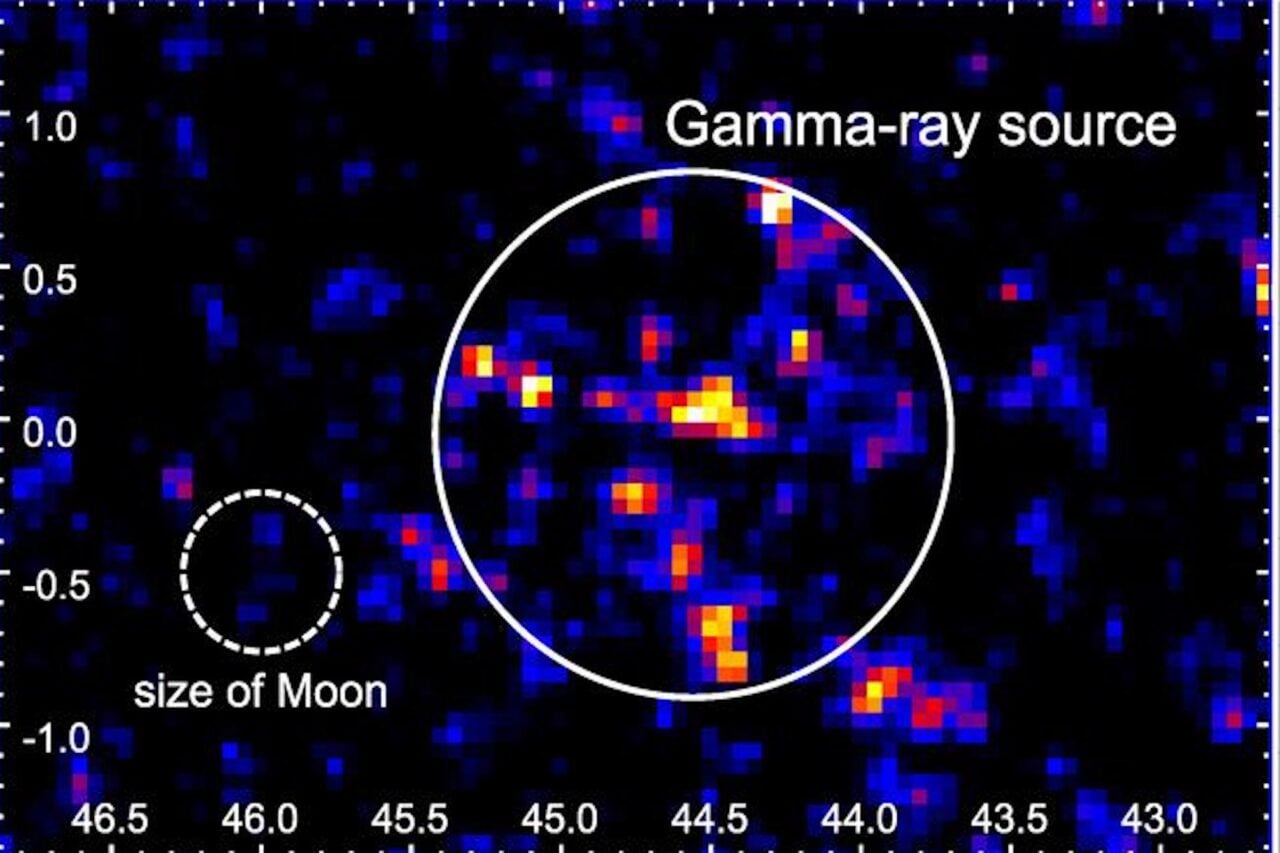
LHAASO J1912+1014u хэмээх нууцлаг биет протроныг нэг квадриллион электрон вольтоос дээш хурдасгаж байгааг эрдэмтэд илрүүлсэн нь галактик дахь өндөр энергийн бөөмсийн гарал үүслийг тайлбарлахад туслах юм.
Хойд тэнгэрийн Бүргэд ордны чиглэлд орших хүчирхэг сансрын хурдасгуур манай галактик дахь хамгийн өндөр энергийн хурдтай бөөмсийг царж байгааг эрдэмтэд илрүүлжээ. LHAASO J1912+1014u гэж нэрлэсэн энэхүү нууцлаг биет нь протроныг нэг квадриллион электрон вольтоос дээш хурдасгах чадвартай болохыг The Astrophysical Journal сэтгүүлд нийтэлсэн судалгаа харуулсан байна. Энэхүү нээлт нь сансар огторгуйгаар гэрлийн хурдтай шахам хөдөлж, галактик даяарх үйл явцад нөлөөлдөг өндөр энергийн бөөмсийн эх үүсвэрийг танихад чухал хувь нэмэр оруулна.
Одон орон судлаачид уг биетийг анх 2024 онд шөнийн тэнгэрийн хамгийн тод оддын нэг болох Альтаир одны орчимд олж илрүүлсэн бөгөөд анх супернова дэлбэрэлтийн үлдэгдэл хэмээн ангилж байжээ. Гэвч тус объектоос цацрах гамма туяаны урсгалыг ажигласнаар эрдэмтэд уг биет нь протроныг певатрон буюу певаэлектрон вольтын энерги хүртэл хурдасгадаг байгалийн сансрын хурдасгуур байж болзошгүй гэж сэжиглэсэн байна. Гэвч протрон үүссэн эх үүсвэр рүүгээ чиглэдэггүй бөгөөд бага энергийн гамма туяаг хурдан хөдөлгөөнтэй электронууд ялгаруулж болзошгүй тул анхны ажиглалтаар тэдгээрийг ялгаж таних боломжгүй байжээ.
Энэхүү нууцыг тайлахын тулд судлаачид NASA-гийн Fermi Large Area Telescope, Японы FUGIN телескоп болон NASA-гийн Chandra X-ray Observatory гэсэн гурван өөр обсерваторийн өгөгдлийг нэгтгэн дүн шинжилгээ хийсэн байна. Хирошимагийн их сургуулийн Астрофизикийн шинжлэх ухааны төвийн дэд профессор Цүнэгүми Мизүно тэргүүтэй эрдэмтэд олон долларын уртын нарийвчилсан загварчлал ашиглан электронуудыг гамма туяаны эх үүсвэр биш болохыг тогтоожээ. Улмаар уг объектын цаана ямар биет нуугдаж байгаа нь одоогоор тодорхойгүй хэвээр байгаа ч уг эх үүсвэр нь протроныг дээд зэргийн энерги хүртэл хурдасгаж байгааг эрдэмтэд албан ёсоор баталсан байна.
Нэг певаэлектрон вольт (PeV) буюу нэг квадриллион электрон вольтын энерги нь дэлхийн хамгийн том бөгөөд хүчирхэг бөөм хурдасгуур болох Large Hadron Collider-ийн хамгийн их мөргөлдөөний хурднаас олон мянган дахин хүчтэй болохыг эрдэмтэд онцолжээ. Ийм асар их энергийн түвшин нь галактикийн сансрын туяаг одон орон болон астрофизикийн хувьд маш чухал болгодог байна. LHAASO J1912+1014u биетээс гадна манай галактик даяар тархсан хэдэн арван сансрын хурдасгуур байж болох бөгөөд шинэ судалгаа нь одон орон судлаачдад тэдгээрийг хэрхэн олж илрүүлэх арга замыг нээж өгч байна.
Дэлгэрэнгүйг эх сурвалжаас харах
Эх сурвалжийг нээх ↓
Within the constellation Aquila in the northern skies, a powerful cosmic accelerator has been pumping out fast-moving particles at the some of the highest known energies in our galaxy, far outdoing human-made colliders on Earth.
Scientists have identified a mysterious object in the Milky Way that can accelerate protons beyond one quadrillion electron volts. The object, named LHAASO J1912+1014u, can provide clues to the origin of high-energy particles that move through space at nearly the speed of light and influence events throughout the galaxy.
The recent findings are detailed in a study published in The Astrophysical Journal.
A hidden source
Astronomers first spotted LHAASO J1912+1014u in 2024 near the star Altair, one of the brightest in the night skies. It was originally classified as a supernova remnant until observatories picked up on a stream of gamma-ray emissions bursting from the object.
Gamma rays are often an indication of accelerated particles colliding with surrounding gas, so scientists suspected that the object could be a natural cosmic accelerator that boosts protons up to petaelectronvolt (PeV) energies, also known as a PeVatron.
PeVatrons are hard to detect because protons rarely point back to their source. Additionally, lower-energy gamma rays could be produced by fast-moving electrons, and the original observations of the object couldn’t tell the two apart.
To help better identify the object, the team behind the new study gathered data from three different observatories, each sensitive to a different part of the electromagnetic spectrum: NASA’s Fermi Large Area Telescope, Japan’s FUGIN telescope, and NASA’s Chandra X-ray Observatory.
In doing so, the researchers were able to build a detailed multi-wavelength model of the source and rule out electrons as the source behind the gamma-ray emissions. “There is an old Japanese saying: ‘One arrow is easy to break, but three arrows bundled together are not,’” Tsunefumi Mizuno, associate professor at Hiroshima University’s Astrophysical Science Center and corresponding author of the study, said in a statement. “In this study, three arrows—Fermi-LAT GeV gamma-ray data, FUGIN radio data and Chandra X-ray data—are bundled together through a detailed multiwavelength modeling, revealing that our target, LHAASO J1912+1014u, is a cosmic-ray proton PeVatron.”
To be clear, the researchers were able to confirm that this source is accelerating protons to record-breaking energies but the object behind this acceleration remains a mystery to astronomers.
Nature’s accelerator
The recent discovery could help scientists better understand the source of the Milky Way’s most energetic cosmic rays that travel through the space between stars.
Cosmic rays are fast-moving, high-energy particles that are mostly made up of protons. Their energies are measured in electron volts, with a unit describing the energy an electron gains when its electrical potential increases by one volt.
“The highest energy of galactic cosmic rays can reach and exceed one quadrillion (1015) electron volts, or a peta electron volt (PeV),” Mizuno said. “This immense energy makes cosmic rays important in astronomy and astrophysics.”
To put that in perspective, one PeV is thousands of times more energetic than the maximum collision energy of the Large Hadron Collider, the world’s largest and most powerful particle accelerator. PeVatrons, with their unmatched particle accelerating capabilities, are nature’s far more powerful colliders.
Aside from LHAASO J1912+1014u, there could be dozens of cosmic accelerators scattered throughout the galaxy and astronomers now know how to look for them.

