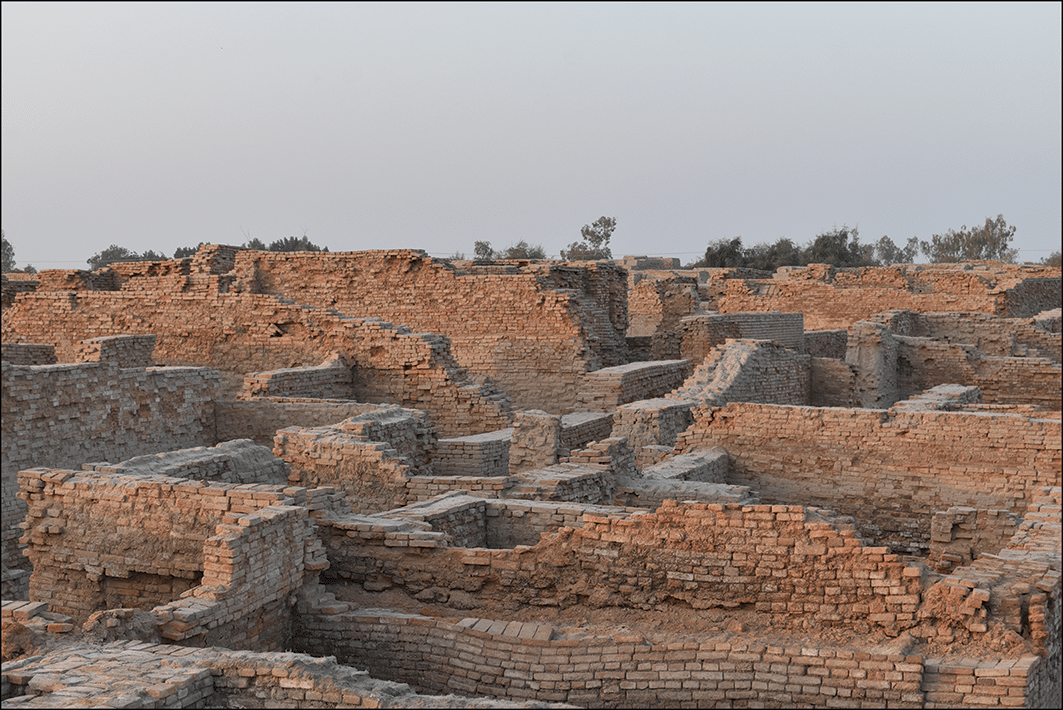
Бронзын үеийн уг хотод өрхүүдийн амьдрах орон зайн ялгаа багасч байсан нь эртний хотжилтын үед эдийн засгийн тэгш бус байдал улам бүр өсдөг гэсэн таамаглалыг үгүйсгэж байна.
Йоркийн их сургуулийн судлаач Адам С. Грийн болон Кембрижийн их сургуулийн эрдэмтдийн удирдсан баг Мохенжо-Даро хотын 309 суурьшлын бүсийг судалжээ. 2026 оны тавдугаар сарын 18-нд Antiquity сэтгүүлд хэвлэгдсэн уг судалгаанд байшингийн талбайг өрхийн баялгийг хэмжих үзүүлэлт болгон ашигласан байна. Судалгааны үр дүнгээс үзэхэд, МЭӨ 2500 оны үед 0.39 байсан эдийн засгийн тэгш бус байдлын индекс (Gini coefficient) МЭӨ 2100 он гэхэд 0.23 болж буурчээ.
Судлаачид эртний малтлагын бүртгэлд үндэслэн газар зүйн мэдээллийн систем боловсруулж, хотын барилга байгууламжийн хэмжээг тооцоолсон байна. Мохенжо-Даро хотын нийт эдийн засгийн тэгш бус байдлын үзүүлэлт 0.44 байсан нь Кноссос, Паленке, Ур зэрэг тухайн үеийн бусад эртний хотуудтай харьцуулахад харьцангуй бага байгаа юм.
Эдийн засгийн тэгш бус байдал буурах үйл явц нь хотын төлөвлөлт, гудамж болон ус зайлуулах системийн хөгжилтэй давхцаж байна. Эртний Индусын соёл иргэншлийн энэхүү хотод эрх мэдэл төвлөрснийг илтгэх хаант улсын ордон, сүм хийд болон үнэтэй булш бунхан олддоггүй нь онцлог юм.
Гэсэн хэдий ч судлаачид энэхүү үр дүнг бүрэн баттай гэж үзэхээс болгоомжилж байна. Малтлагын эртний бүртгэлүүд нарийвчлал багатай, мөн байшингийн талбай нь эдийн засгийн байдлыг илэрхийлэх бүрэн төгс үзүүлэлт биш тул ирээдүйн судалгаагаар илүү өргөн хүрээний баримт нотолгоог цуглуулах шаардлагатай гэж дүгнэжээ.
Дэлгэрэнгүйг эх сурвалжаас харах
↓Эх сурвалжийг нээх ↓
A study of 309 residence areas at Mohenjo-daro found that differences in household space declined as the Bronze Age city developed, challenging the assumption that early urban growth necessarily brought greater economic inequality.
The research, published online in Antiquity on May 18, 2026, used the size of residences as an indirect measure of household wealth. In the part of the city where researchers could distinguish building phases over time, the measure of residential inequality fell from about 0.39 around 2500 BC to 0.23 around 2100 BC.
Mohenjo-daro was a major city of the Indus Civilisation, which flourished in South Asia from about 2600 to 1900 BC. The archaeological site lies in what is now Sindh, Pakistan.
The study was led by Adam S. Green of the University of York, with Iqtedar Alam and Cameron Petrie of the University of Cambridge. A University of York report said the findings indicate that the city became more equal as it prospered.
House Sizes Became More Equal Over Time
The researchers created a geographic information system from early excavation records, converting plans of residences into measurable areas. They then calculated Gini coefficients for different parts and periods of Mohenjo-daro.
A Gini coefficient measures how unevenly something is distributed, ranging from zero for complete equality to one for complete inequality. Archaeologists can apply it to house sizes as a proxy for differences in access to wealth, labour and resources, although the study stresses that residential space cannot capture every form of social inequality.
Across Mohenjo-daro as a whole, the residential Gini coefficient was 0.44. That was lower than figures in the same database for several other ancient cities. Knossos had a coefficient of 0.86 and Palenque 0.75, while the contemporaneous West Asian cities of Ur and Ugarit both exceeded 0.6.
The researchers cautioned against simply describing Mohenjo-daro’s overall figure as egalitarian. Some Neolithic settlements regarded by archaeologists as relatively equal have residential Gini coefficients around 0.2 or lower.
The clearest evidence of change came from DK-G South, where early excavators had recorded enough information about the depth of structures for researchers to reconstruct a rough sequence through time. The earliest large residences there, dating to around 2500 BC, produced a Gini coefficient of 0.39. By about 2100 BC, it had fallen to 0.23.
The median residence area in the earliest period was 161.39 square metres. It later fell to 98.02 square metres around 2200 BC before rebounding to 141.13 square metres when the Gini coefficient reached 0.23. The authors said the apparent relationship between greater productivity and lower inequality was not statistically robust, because it depended on a very small number of data points.
Streets and Public Infrastructure Developed Alongside Lower Inequality
The decline in residential disparity coincided with changes in Mohenjo-daro’s built environment. Residences became more uniform and increasingly aligned with the city’s streets over time, while the wider archaeological record includes planned streets, drainage infrastructure and other civic amenities.
The authors suggest that governance may have played a role. As residential differences narrowed, more buildings were constructed in alignment with the street system. The study treats that relationship as an association rather than proof that one development caused the other.
Other evidence also distinguishes Mohenjo-daro from ancient cities built around highly visible elite institutions. Indus cities lacked the palaces, ostentatious tombs, exclusionary temples and ruler-focused art that archaeologists often use as material evidence of concentrated power.

Mohenjo-daro instead had planned streets and drainage systems, while Indus communities used standardized weights and measures. Small stone seals that probably helped facilitate exchange were typically recovered from residences at Mohenjo-daro rather than from temples or palaces, according to the study. The researchers propose that such arrangements may have limited the concentration of control over resources, though they do not claim to know exactly how the city was governed.
Early Excavation Records Limit What the Study Can Show
The findings depend heavily on archaeological records produced during early excavations. The researchers note that the standing architecture is complex and that early 20th-century methods did not document buildings as precisely as modern excavation techniques would.
The chronological evidence is particularly important. Researchers could separate periods in DK-G South, but excavated structures from different eras are mixed together in other parts of the site. The authors therefore say it can only be presumed that the decline found in DK-G South extended across Mohenjo-daro as a whole.
House size also remains an imperfect substitute for wealth. People with greater resources did not necessarily build bigger homes, and residential measurements cannot fully represent inequalities connected with factors such as gender, kinship or ethnicity. The researchers similarly caution that changes in residence size provide only an indirect measure of economic productivity.
The study concludes that Mohenjo-daro had lower measured economic inequality than comparable early cities and that residential inequality declined over time as intensive development continued along its streets. Future work could test the pattern more widely by reconstructing the chronology of buildings outside DK-G South and incorporating additional measures of wellbeing and inequality.
Enjoyed this article? Subscribe to our free newsletter for engaging stories, exclusive content, and the latest news.

