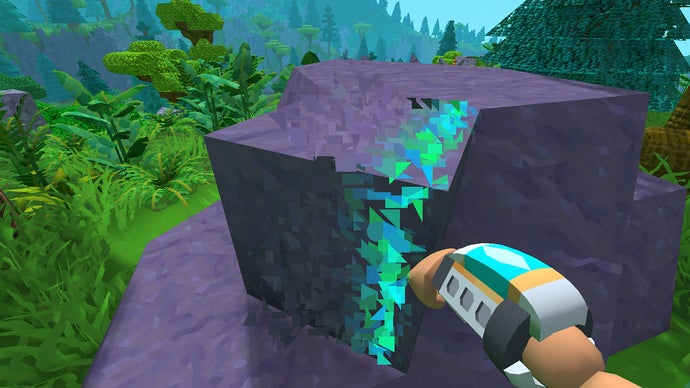
Reforj тоглоомыг хөгжүүлэгч 4J Studios компани дүрслэлийн чанарыг алдагдуулахгүйгээр санах ойн ачааллыг эрс багасгах шинэ технологи танилцууллаа.
4J Studios компанийн хөгжүүлсэн Rixels буюу Reforj Pixels технологи нь вектор дүрслэлийн зарчимд суурилсан бөгөөд 23 төрлийн вектор хэлбэрийг ашиглан текстурын багтаамжийг хэмнэдэг байна. Тус компанийн тэргүүн Крис ван дер Кул-ын тайлбарласнаар, 512×512 хэмжээтэй энгийн текстур 4MB санах ой шаарддаг байсан бол Rixels технологийн тусламжтайгаар үүнийг 20×20 хэмжээтэй квадратаар сольж, ердөө 72KB санах ойгоор орлуулах боломжтой болжээ. Энэ нь санах ойн хэрэглээг 98 гаруй хувиар бууруулж, тоглоомын явцад дүрслэл томруулах үед бүдгэрэх асуудлыг бүрэн шийдвэрлэж байгаа юм.
Энэхүү шинэлэг технологийг 4J Studios-ын өөрийн бүтээсэн Elements Engine хөдөлгүүрт ашиглаж байгаа бөгөөд тоглоомын гүйцэтгэлийг тогтвортой 60FPS-д барих зорилготой аж. Технологийн бүтээгч, CTO Ричард Рийви энэ аргыг математик томьёонд суурилсан тул ямар ч хэмжээтэйгээр дүрсэлсэн тохиолдолд пикселүүд харагдахгүй, өндөр нарийвчлалтай хэвээр үлдэнэ гэдгийг онцоллоо.
Одоогоор 4J Studios уг технологио патентлахаар ажиллаж байгаа бөгөөд үүнийг зөвхөн өөрсдийн тоглоомд төдийгүй график дизайны хэрэгсэл зэрэг өөр салбарт ашиглах боломжтой эсэхийг судлахад нээлттэй байгаагаа илэрхийлжээ. Хэдийгээр уг технологи нь бүх төрлийн тоглоомд тохиромжгүй байж болох ч, ялангуяа стилист хэв маягтай тоглоомуудын хувьд гүйцэтгэлийн томоохон дэвшил авчрах боломжтой юм.
Дэлгэрэнгүйг эх сурвалжаас харах
↓Эх сурвалжийг нээх ↓
Reforj developer 4J Studios has debuted a technology called Rixels that offer an alternative way to provide textures using a fraction of the memory requirements. The Dundee-based studio has applied to patent the technology.
Rixels, short for Reforj Pixels, are modified pixels that each contain a vector shape – and because they use vector graphics, they retain their sharpness even when viewed close up.
“The Rixel was our response to a problem with texture size,” 4J Studios chairman Chris van der Kuyl tells GamesIndustry.biz. “We were using 512×512 normal textures, so a pixel grid with square pixels in it, but as [the game] got bigger and bigger and bigger, we realised that we were going to run ourselves into a wall with space.”
Van der Kuyl challenged CTO Richard Reavy to come up with a solution, and Reavy designed Rixels, which each contain one of 23 vector shapes. Vector graphics are images built from mathematical formulas, “so no matter what size you render, it’s not pixelated,” says van der Kuyl.
Initially, the 512×512 pixel grids in 4J’s Minecraft-like game Reforj required 4MB of memory. But with Rixels, the same sized grid can be made from 20×20 squares, using only 72KB of memory – a reduction of over 98%.
“Now, when you zoom in, it doesn’t get fuzzy anymore,” says Van der Kuyl. “You start to see these beautiful little vector shapes that exist at perfect resolution. There’s not a game in the world that does this at the moment other than Reforj. The latest Bond game, whatever it is, you’ll go into a texture, and it’ll still get fuzzy at some point. In Reforj, it doesn’t at all.”
4J has applied for a patent for Rixels, and van der Kuyl is surprised the technology hasn’t been used already. “It’s deceptively simple,” he says. “[We thought] surely somebody’s done this before. And nobody’s ever done it the way we’ve done it.”
Rixels are being used in 4J’s proprietary Elements Engine. As creative director Brian Gomez recently explained to GamesIndustry.biz, the engine was developed to in order for the studio to create its own sandbox games after spending years porting Minecraft to consoles and handhelds.
The memory saved by using Rixels means that Reforj can avoid performance dips, says van der Kuyl. “Generally, when you get these block building games, or voxel-based games, they start to get performance restrictive quite early. So we asked ourselves, could we build an engine that gave you persistent 60-frames-per-second in this kind of game? It may be a geeky thing to say, but for a player it would transform their experience.”
Regarding potential licensing, van der Kuyl is interested in exploring how the technology could be applied across different mediums.
“Because we genuinely have invented something brand new, if someone came to us and said, ‘Wow, we could use this in a graphic design tool’, we’d love to license it and see it used elsewhere. But we’ve built it to make this super efficient [game].”
He acknowledges the technology might not be right for every title. “It may matter less to photorealistic games than it does to a stylised game,” he says. But he’s keen to see how it will be used elsewhere. “It’d be interesting to see what people would do with it in other contexts.”

