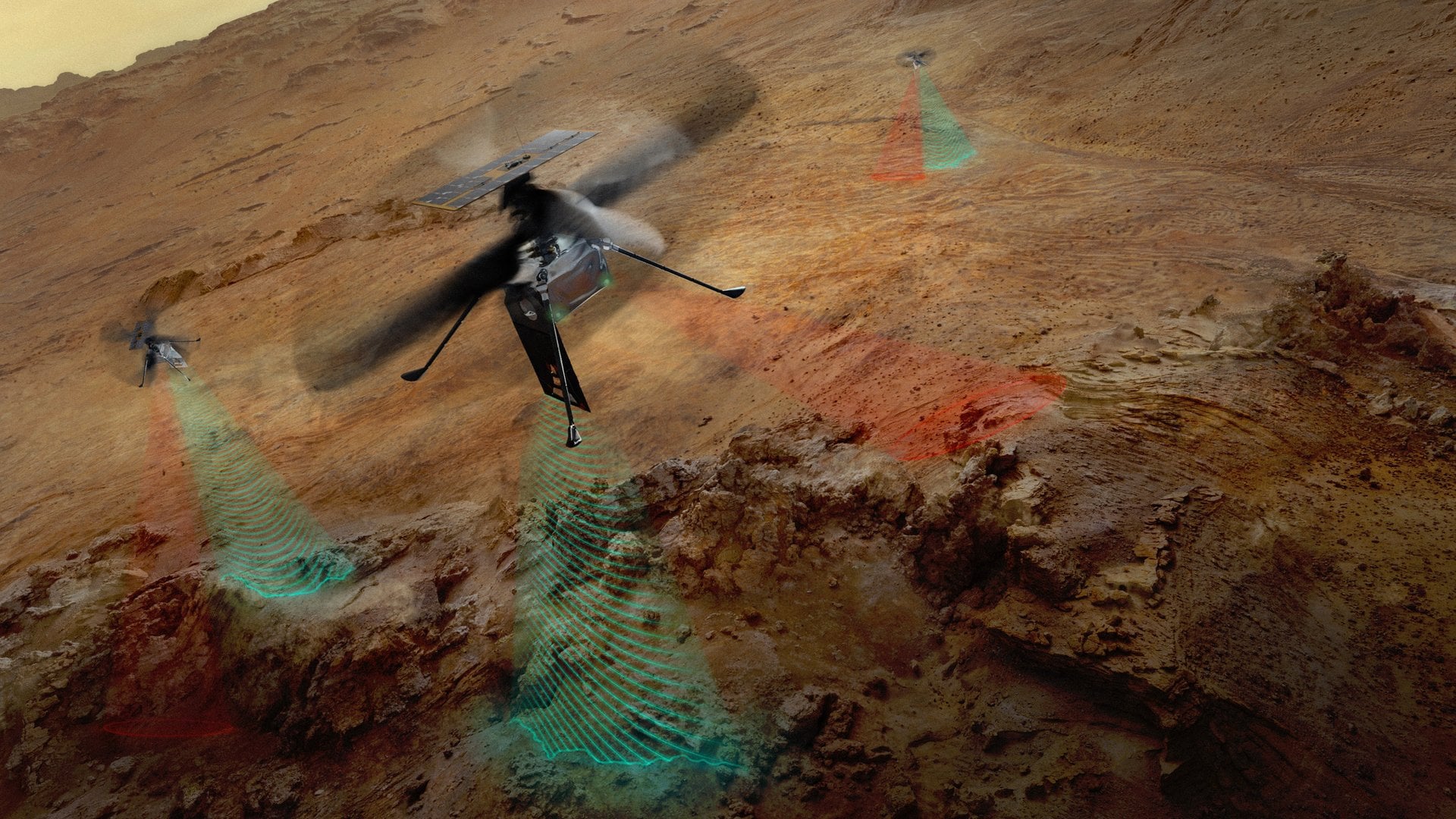
NASA-гийн мэргэжилтнүүд Ангараг гарагийн гадаргуу дээрх гүехэн хэсгийн мөсийг илрүүлэх чадвартай, уян хатан бүтэцтэй шинэ төрлийн антенныг амжилттай туршлаа.
NASA-гийн Ingenuity нисдэг тэрэгний амжилтын дараа тус агентлаг SkyFall нэртэй гурван нисдэг тэргийг Ангараг гараг руу илгээхээр бэлтгэж байна. Эдгээр төхөөрөмж нь гарагийн хөрсөн доорх хэдхэн метрийн гүнд орших мөсөн ордуудыг газрын гүн нэвтлэх радараар илрүүлэх зорилготой юм. Ингэхдээ 500-2500 мегагерцийн давтамжийн өргөн хүрээг ашиглан гадаргуугийн нарийвчилсан зураглалыг гаргах ажээ.
Нисдэг тэрэгний газардах болон хөөрөх үйл ажиллагаанд саад учруулахгүйн тулд судлаачид Vivaldi хэмээх хавтгай, муруй иртэй антенныг сонгосон байна. Энэхүү антенныг полиэстр, Vectran материал болон шилэн эслэг ашиглан бүтээсэн нь түүнийг бат бөх, уян хатан байлгахын зэрэгцээ газардах үед үүсэх даралтыг тэсвэрлэх боломжийг олгожээ. Жэт Пропулшн Лабораторид хийсэн туршилтаар уг антенн нь төлөвлөсөн үндсэн даалгавраас хоёр дахин олон буюу 200 гаруй удаагийн газардалтыг дохионы чанар алдалгүйгээр даван туулж чадсаныг баталсан байна.
Ангараг гарагийн гадаргуугийн 5 метр хүртэлх гүехэн хэсгийн мөсөн орд нь ирээдүйн сансрын нисгэгчдийн усны хэрэгцээг хангах нэн чухал нөөц болох юм. Одоогийн байдлаар сансрын аппаратууд илүү гүнд орших мөсийг илрүүлэх чадвартай ч гадаргуугийн ойролцоох нөөцийг олж илрүүлэхэд хүндрэлтэй байдаг аж. SkyFall төсөл нь эдгээр асуудлыг шийдвэрлэхээр төлөвлөгдөж буй бөгөөд 2028 оны сүүлээр цөмийн эрчим хүчээр ажиллах Space Reactor-1 Freedom номлолын хүрээнд хөөргөхөөр зэхэж байна.
Дэлгэрэнгүйг эх сурвалжаас харах
Эх сурвалжийг нээх ↓
From 2021 to 2024, NASA’s Ingenuity helicopter became the first vehicle of its kind to explore the Martian atmosphere and surface. With that proof of concept complete, NASA is preparing to send a trio of helicopters to search for the most precious resource for future astronaut missions: water. Known as the SkyFall trio, these helicopters will detect frozen water within the top few meters of Martian regolith. To find possible water sources, each helicopter will use ground-penetrating radar that utilizes a flexible, fabric-based antenna extended beneath the spacecraft.
The antennas are specially designed for this mission so they will not interfere with landings or break upon contact with the surface. They also recently cleared a round of testing at NASA’s Jet Propulsion Laboratory. When deployed, these three helicopters (one larger and two smaller) will fly over the Martian landscape and project ground-penetrating radar in an ultra-wide frequency range – 500 to 2,500 megahertz (MHz) – at depths of several meters beneath the surface.
While the longer wavelengths in this range can penetrate several yards below the surface, the shorter wavelengths provide finer detail about the uppermost surface layers. Even though satellites can map large ice deposits a few dozen meters (tens of yards) beneath the surface, they are effectively blind to shallow deposits (5 m; 16 feet). These deposits are crucial to future crewed missions, as astronauts will need easily accessible water sources.
“The only way to detect shallow subsurface ice remotely is to fly close to the ground,” said Adrian Tang, SkyFall’s ground-penetrating radar lead instrument scientist at JPL in a NASA press release, “By flying low and slow, a SkyFall helicopter could capture radar images that resolve the fine layering where dry soil gives way to ice, detecting its presence and mapping its extent.”
Each SkyFall helicopter will be equipped with four instruments each, similar to NASA’s Ingenuity Mars Helicopter. During its three years in operation, the helicopter showed that controlled flight in Mars’ rarefied atmosphere is possible and also demonstrated that an aerial perspective can provide valuable data for surface missions (such as possible travel routes and research site selection). However, radio communications remain a challenge for SkyFall’s mission profile.
Traditional antennas would need to be about 48 cm (19 inches) and have a clear view of the ground to operate in this part of the electromagnetic spectrum. However, this isn’t practical, since the minimum clearance between the helicopter and the Martian surface will be only about 15 cm (6 inches). After considering multiple potential designs, the SkyFall team selected the Vivaldi antenna: a flat, curvilinear design that can cover a large, continuous range of radio frequencies and resembles curved blades placed back to back.
Because of its flat, lightweight profile, it can be easily built using sheet metal, printed circuit boards, or metalized fabrics. While the standard design was still too large to allow 15 cm of clearance, the team was able to miniaturize it further because it was specifically designed for shallow surveying in dry Martian regolith (which blocks radio waves far less than Earth’s soil). Said Christine Gebara, SkyFall ground-penetrating radar mechanical lead at JPL, the team developed additional techniques to miniaturize it even further:
Although we managed to shrink the antenna quite a bit, it is about 1½ times longer than the helicopter’s legs. That means during landing, the Vivaldi has to bend out of the way — and if it lands on a rock, it bends even further. But when the helicopter takes off again, the antenna must spring back into place for data collection. Because SkyFall is expected to make dozens of flights exploring Mars, we needed an antenna that could repeatedly handle those pressures without losing its shape in flight.
The team also took great care to ensure their antenna could survive flying around in Mars’ atmosphere and maintain its shape while airborne. To this end, the team sheathed it in polyester and layers of Vectran – the same material used for the landing airbags that protected the Spirit and Opportunity rovers – and flexible fiberglass tape springs and a lightweight magnesium mounting structure.
The testing initially consisted of paper designs and mathematical models, but the real trials occurred at JPL’s Environmental Test Laboratory . Here, engineers bent and flexed the antenna prototype to simulate different orientations after a flight and to simulate it experiencing multiple landings (respectively). They then ran it through dramatic temperature changes to simulate day-night fluctuations on Mars. In between, they placed the hardware into an electromagnetic test chamber to verify that its ability to beam and receive signals was unaffected.
The team also inverted the antenna, which subjected it to much more stress than Martian gravity, while testing radio-frequency performance. Their tests showed that the antenna could withstand twice as many landings as required for its primary mission (200) with no loss of signal performance. “This test checked every box it was supposed to and answered our biggest technical questions,” said Tang. “While we still have work ahead of us before the antenna is fully flight-qualified, this was a major milestone, and the hardware performed exactly as expected.”
With the antenna’s first big test campaign complete, the team developing the ground-penetrating radar is creating an engineering model that can endure vibration testing, deployment in a simulated Martian environment, signal testing, and outdoor trials at JPL’s Mars Yard. SkyFall is expected to launch aboard NASA’s Space Reactor-1 Freedom, humanity’s first nuclear-powered interplanetary mission, in late 2028.
Further Reading: NASA


