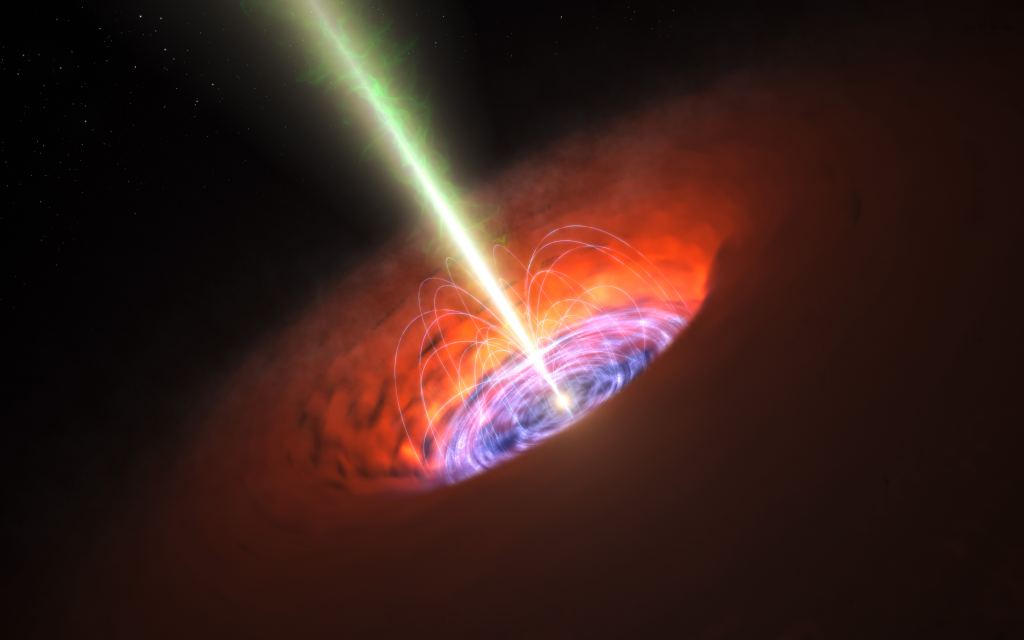
Шинэ судалгаагаар галактикийн төвийн идэвхтэй хар нүхнүүдийн эргэн тойрон дахь хийн мандал нь олон сая гариг үүсэх таатай орчин байж болохыг тогтоожээ.
“The Astrophysical Journal” сэтгүүлд нийтлэгдсэн судалгаагаар супермассив хар нүхнүүдийг тойрсон аккрецийн дискүүд нь зөвхөн матери залгидаг бус, харин гариг үүсэх боломжтой бүс нутаг болохыг илрүүлжээ. Нью-Мексикогийн их сургуулийн одон орон судлаач Владимир Лира болон түүний багийнхан дискний гаднах хүйтэн хэсэгт тоосны бөөгнөрөл үүсэж, улмаар Бархасбадь гаригаас ч том хэмжээтэй гаригууд төлжих нөхцөл бүрддэг болохыг онолын хувьд баталсан байна.
Энэхүү үйл явц нь оддын эргэн тойронд гариг үүсдэгтэй ижил зарчмаар буюу “урсгалын тогтворгүй байдал” (streaming instability) хэмээх үзэгдлээр явагддаг аж. Дискний соронзон орон тогтвортой байдлыг хангаж, үймээнт хөдөлгөөнийг сааруулснаар тоосны ширхгүүд бөөгнөрч, улмаар Дэлхийгээс эхлээд супер-Бархасбадь хүртэлх хэмжээний биетүүдийг үүсгэдэг байна. Эдгээр гариг нь ердийн экзопланетуудаас ялгаатай нь зөвхөн тоосны хуримтлалаас бүрдэх бөгөөд дотоод бүтэц нь хайлсан магма болон агаар мандалтай байх магадлалтай гэж судлаачид таамаглаж байна.
Судалгааны үр дүнд эдгээр аварга том гаригууд цаашид хөгжин од болон хувирах, эсвэл бүр хар нүх болж өсөх боломжтойг тогтоожээ. Ялангуяа 300 нарны масстай тэнцэх хэмжээний материал хуримтлагдвал дунд оврын хар нүх (IMBH) үүсэх боломжтой гэж үзэж байна. Гэсэн хэдий ч эдгээр биетүүдийн динамик харилцан үйлчлэлээс шалтгаалан тэдгээр нь хар нүх рүүгээ татагдан орох хандлагатай байдаг тул ажиглалт хийхэд хүндрэлтэй байх ажээ.
Дэлгэрэнгүйг эх сурвалжаас харах
Эх сурвалжийг нээх ↓
You’ve read it, heard it in casual conversations, and seen it in TV shows and movies: black holes are massive objects that suck in everything around them. Nothing can escape their inexorable draw, not even light itself. Black holes are destroyers of everything that strays too close, including massive stars themselves.
But this picture is inaccurate. There’s a lot going on around supermassive black holes (SMBH), where competing forces mean that while black holes do indeed swallow matter, much of it remains in their accretion disks.
New research shows that in certain circumstances, accretion disks around SMBHs can form giant planets. For that to happen, the disk has to be strongly magnetized, which keeps the disk stable and counters turbulence. The research is published in The Astrophysical Journal and is titled “Active Galactic Nucleus Tori: Potential Birthplace to Millions of Planets.” The lead author is Wladimir Lyra, an associate professor of astronomy at New Mexico State University.
When material gathers in an accretion disk around a SMBH, the material heats up and emits light. But these disks can be huge, up 20,000 astronomical units are larger, depending on how the disk is defined. So the outer regions of the disk have lower temperatures, and that’s at the heart of this research.
“The outer regions of AGN disks have temperatures similar to those of circumstellar disks, permitting dust condensation,” the authors write. “Therefore, planet formation and growth could be active in these dust tori through similar mechanisms.”
The authors say that the unique environment in outer AGN disks can foster the formation of giant planets.
“We find that the outer AGN disk environment can support dust coagulation and formation of planetesimals with masses exceeding that of Jupiter, up to and above the hydrogen-burning limit, driven by the streaming instability,” the authors write.
Streaming instability is the leading theory that explains how dust and pebbles in circumstellar disks coagulates into planetesimals. Gas in these disks drags on pebbles and dust particles, causing them to spiral into the star where they’re destroyed and unavailable for planet formation. Streaming instability happens when solid matter is concentrated enough in one region that it drags the gas along with it. This removes the headwind that would otherwise drag on the material and send it spiralling into the star. The main difference in this case is that there’s not a star, but a SMBH instead.
Streaming instability only works if the dust grains are large enough to drag gas with it. “We find that the dust grain sizes required for streaming instability are easily attained through coagulation; the dust filaments it produces can contain solar masses, collapsing into tens of millions of “planetesimals” ranging from Earth to super-Jupiter masses,” the authors explain.
This artist’s illustration shows the massive exoplanet J2126. This new research says that super-Jupiter’s like it could form under the right conditions in AGN disks. Image Credit: Neil Cook / University of Hertfordshire
Stellar mass objects can also form in this process because of crossover mass. This is when the mass of the forming planetesimal equals that of the remainder of the disk, allowing a gaseous envelope to form. “Gas accretion occurs concurrently, and crossover mass can be attained while still in the planetary mass range. As a result, vigorous accretion can occur, leading to objects with stellar masses—defining a core accretion channel for star formation,” the authors write.
But it’s the planets that can form here that attract attention.
The nature of the exoplanets formed in these circumstance is different than in protoplanetary disks. They’re not differentiated like other planets. Instead, they’re made solely of accumulated dust. The authors “predict a population of exotic objects directly formed above the hydrogen-burning limit, yet of pure dust,” they write.
The researchers point out that the structure and evolution of these dust planets is beyond the scope of this work, but they have a few things to say about them, including that they probably have degenerate cores. “Their outer layers are likely heated by the radioactive decay of 26Al, 60Fe, and other short-lived radionuclides produced by massive evolved stars in the disk, so silicates would melt throughout, and the objects would have a magma ocean with an outgassed atmosphere,” they explain. They describe them as “degenerate lava drops” that orbit the AGN.
These objects could eventually transition into stars, or even into black holes, given the right conditions.
“Massive seed planets in the AGN disk can accrete enough material to exceed thermal and isolation masses of ∼104M⊙, potentially transitioning into stars and eventually BHs. Very massive stars (about 100 solar masses) are likely to last < 1 Myr, triggering core-collapse SNe, which should leave behind BHs,” the authors write.
AGN disks could also form the elusive intermediate mass black holes, too.
“For accreted masses above ∼300 M⊙, direct collapse into IMBHs becomes a viable outcome), suggesting AGN disks as plausible birthplaces for such remnants,” the researchers add.
But actually finding and observing these objects would be challenging. They’re so massive that they would work their way inward to the SMBH. “Dynamical interactions among the population should drive a mass segregation effect via equipartition, where the more massive population tends to sink inward and the less massive component sinks outward. Thus, IMBH and massive stars may sink inward toward the inner disk,” the authors explain.
“In conclusion, AGN disks are favorable sites for the growth and formation of many astrophysically interesting objects from Jupiter-mass planets to stars, as well as stellar- or intermediate-mass BHs,” the researchers write. “The outer regions, governed by dust dynamics, turbulence suppression, and efficient accretion mechanisms, appear to be a compelling physical analog to protostellar disks, albeit on vastly larger dynamical and thermal timescales.”
“This work presents strong theoretical support for the existence of up to tens of million Jupiters-mass planets and a potential IMBH formation channel in AGN disks, directly bridging the fields of planet formation and BH growth,” the authors conclude.


