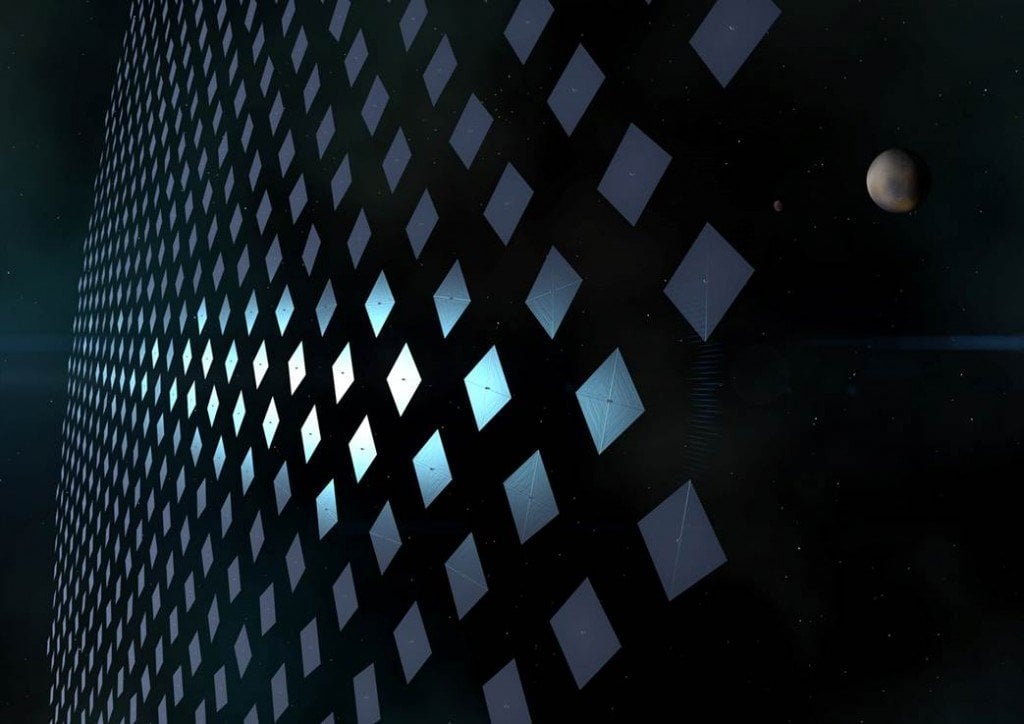
Нарны болон соронзон далбаат хөдөлгүүр нь сансрын уудмыг судлахад түлш шаарддаггүй хэмнэлттэй шийдэл боловч од хоорондын аялалд лазерын эрчим хүчээр ажиллах далбаат төхөөрөмжүүд илүү боломжит хувилбар болж байна.
Нарны гэрлийн даралт болон соронзон орныг ашиглан сансрын хөлгийг хөдөлгөх санааг 1861-1864 онд Жэймс Клерк Максвеллийн цахилгаан соронзон үзэгдлийн судалгаа үндэслэжээ. Үүний дараа Константин Циолковский болон Фридрих Зандер нар нарны гэрлийн даралтыг ашиглан сансрын хурд авах онолыг дэвшүүлсэн бол 1988 онд Дана Эндрюс, Роберт Зубрин нар соронзон далбаат (magsail) хөдөлгүүрийн анхны загварыг танилцуулсан юм. Сүүлийн үед JAXA-ийн IKAROS төсөл болон NASA-ийн ACS3 зэрэг хөтөлбөрүүд нь нарны далбаат хөдөлгүүрийн ажиллагааг сансарт амжилттай туршаад байна.
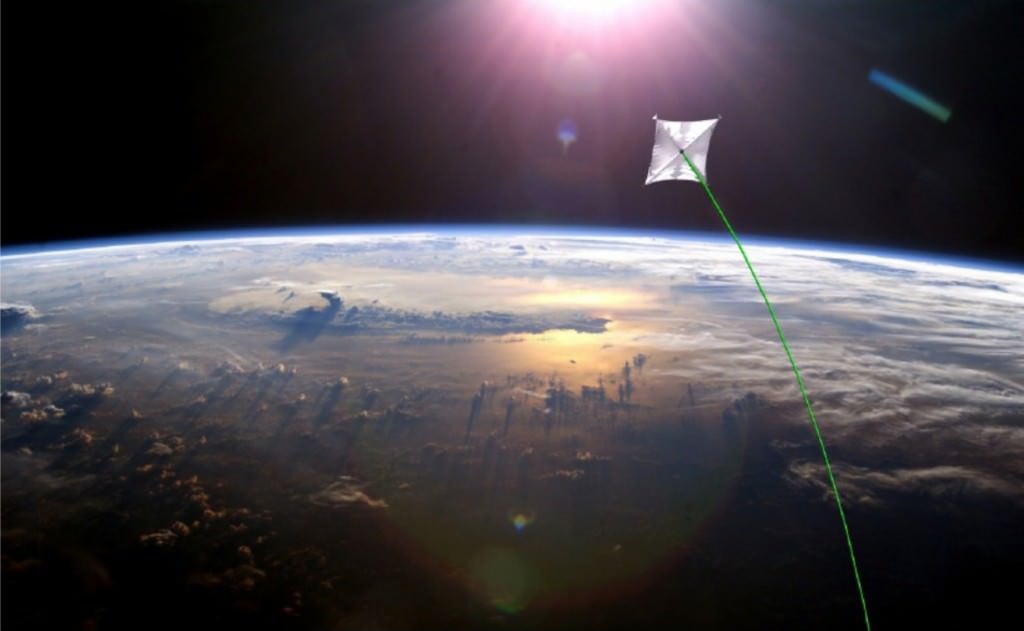
Гэвч нарны болон соронзон далбаат хөдөлгүүрүүд нь сансрын хөлгийг од хоорондын аялалд шаардлагатай өндөр хурдад хүргэх боломж хязгаарлагдмал тул зөвхөн манай нарны аймаг доторх нислэгт тохиромжтой байдаг. Иймд эрдэмтэд лазерын чиглүүлэгч эрчим хүчийг ашиглан сансрын хөлгийг гэрлийн хурдны тодорхой хувьд хүргэх “Breakthrough Starshot” зэрэг төслүүдийг боловсруулж байна. Энэхүү технологи нь жижиг хэмжээний “вафер” хөлгүүдийг ашиглан 20 жилийн дотор ойрын одны системд хүрэх боломжийг бүрдүүлж болзошгүй юм.
Энэ төрлийн төслүүдийн гол сорилт нь асар их хэмжээний эрчим хүч шаардагдах явдал юм. Тооцооллоор, сансрын хөлгийг релятивист хурдад хүргэхийн тулд 100 гигаваттаас 17,000 тераватт хүртэлх эрчим хүч шаардлагатай бөгөөд энэ нь дэлхийн жилийн нийт хэрэглээнээс олон зуу дахин их үзүүлэлт юм. Тиймээс од хоорондын аялал хийхэд технологийн томоохон дэвшил, эдийн засгийн хувьд үр ашигтай шийдлүүд нэн шаардлагатай хэвээр байна.
Дэлгэрэнгүйг эх сурвалжаас харах
Эх сурвалжийг нээх ↓
Welcome back to our series on Interstellar Travel! In our first installment, we examined attempts to realize nuclear propulsion and how the technology could be used to reach the nearest star. In our second, we examined how fusion power has also been considered a means of propelling spacecraft to relativistic speeds (a fraction of the speed of light). In both cases, these proposals paralleled Cold War developments in rocketry and nuclear armaments, as they did for most Space Age advancements.
In our third installment, we looked at a truly exotic set of proposals that leveraged the discovery (and creation) of positively charged electrons (positrons) and antiprotons, also known as antimatter propulsion. In our latest installment, we’ll look at more practical proposals that seek to use radiation pressure and electromagnetism to create interstellar spacecraft. This includes solar sails, magnetic sails, and laser-driven lightsails.
Solar sails have long been considered a cost-effective way of exploring the Solar System. In addition to being relatively easy and cheap to manufacture, solar sails have the added bonus of requiring no fuel. Rather than using rockets that require propellant (which accounts for the largest share of a spacecraft’s mass), solar sails, magnetic sails, and lightsails rely on reflective or magnetized structures and radiation pressure from the Sun (solar wind) or lasers to reach high speeds.
Compared to nuclear fission, fusion, and antimatter concepts, these concepts offer the prospect of achieving interstellar flight within a human lifetime and in the near future.
Artist concept of a solar sail demonstration mission that will use lasers for navigation. Credit: NASA.
Conceptual Development
Scottish Physicist James Clerk Maxwell’s research into electromagnetic phenomena (1861 to 1864) showed that light has momentum and can exert pressure on objects, providing the theoretical foundation for lightsails. Russian physicist Pyotr Lebedev conducted the first experiment using a torsional balance in 1899, which was supported by a similar, independent experiment by Ernest Nichols and Gordon Hull in 1901.
This was followed by Konstantin Tsiolkovsky, who first proposed using sunlight to propel a spacecraft in 1921. He also suggested that interstellar flight could be realized by “using tremendous mirrors of very thin sheets to utilize the pressure of sunlight to attain cosmic velocities.” In 1925, Latvian physicist Friedrich Zander published a technical paper that included an analysis of solar sailing, writing “applying small forces [using] light pressure or transmission of light energy to distances by means of very thin mirrors”.
In 1972, JBS Haldane wrote that “wings of metallic foil of a square kilometer or more in area are spread out to catch the Sun’s radiation pressure” could propel a tubular spacecraft. Similarly, Carl Sagan popularized the idea of solar sails through his lectures, books, and television shows (like Cosmos), describing how a spacecraft launched in the near future could rendezvous with Halley’s Comet.
In 1988, Dana G. Andrews and Robert Zubrin proposed the earliest method for a magnetic sail (dubbed the magsail) in a paper titled “Magnetic Sails and Interplanetary Travel.” As they described it, the magsail would require a superconducting loop with a 50-100 km (31-62 mi) radius and a mass of about 100 metric tons (110 U.S. tons). It would launch either by thrusting against Earth’s ionosphere or magnetosphere to escape from LEO, or by being accelerated by a fusion rocket to achieve relativistic speed. Subsequent designs generally called for significantly reduced mass and achieving thrust mainly from solar wind.
In 2000, a team led by University of Washington Professor Robert M. Winglee proposed a Mini-Magnetospheric Plasma Propulsion (M2P2) design that would inject low-energy plasma into a much smaller and lighter coil that required less power.
Beginning in 2003, scientists at the Japan Aerospace Exploration Agency (JAXA), in collaboration with Japanese universities, produced a series of studies on the Magneto-Plasma Sail (MPS). Their research inspired many studies that advanced the understanding of the physical principles of magnetic sails, revealing that the best performance came when the injected plasma had a lower density and velocity than in previous designs.
A 2012 study by Helion Energy CEO David Kirtley and Prof. John Slough proposed a concept called the Plasma Magnetoshell, which would employ plasma magnet technology to turn planetary ionospheres as a braking mechanism. Simulations made between 2012 and 2021 evaluated the technology for missions to Mars, Jupiter, Neptune, and Uranus, showing that a multi-turn coil held more promise than the plasma magnet design.
In 2021, a team of researchers from the Xi’an Aerospace Propulsion Institute
published a study on a propulsion system called an electromagnetic sail, which combined a magnetic and an electric sail. The study also detailed how a superconducting magsail coil, augmented by an electron gun at the coil’s center, would generate an electric field that would deflect positive ions in solar plasma, thereby providing additional thrust.
Mission Studies
Robert Forward, a physicist at Hughes Aircraft‘s research laboratories at the time, proposed the first formal interstellar concept in 1984. In a paper titled “Roundtrip interstellar travel using laser-pushed lightsails,” he described how directed energy (lasers) could accelerate a lightsail to relativistic speeds. This spacecraft would benefit from the fact that it would require no propellant, and that laser energy does not dissipate with distance nearly as much as solar radiation. As he wrote:
It is a form of beamed-power propulsion in that the ‘engines’ of the vehicle are left behind in the Solar System and the power and reaction mass are transmitted out to the rest of the vehicle that carries the payload… these systems can be designed so that the outward thrust of the Solar System-based lasers not only an push the lightsails up to relativistic velocities but also can be used to bring the lightsails to a stop in the target system.
In 1989, Geoffrey A. Landis wrote a paper, “Optics and Materials Considerations for a Laser-Propelled Lightsail,” in which he proposed a laser-light-beam-concentrator photoelectric ion propulsion system. He also investigated the best materials for the lightsail that would balance reflectivity and durability with low mass.
This was followed in 2000 by a technical study by Robert Frisbee, a senior member of the technical staff in the Advanced Propulsion Technology Group at NASA JPL. In it, he argued that a laser sail measuring about 965 km (600 miles) could be accelerated to half the speed of light in less than a decade, and would arrive at Proxima Centauri in just under 9 years. He also calculated that a sail measuring about 320 km (200 miles) in diameter could reach Proxima Centauri in just over 12 years.
However, this would require a steady flow of 17,000 terawatts (TW) of power for nearly a decade, and the sail would have to be built from advanced composites to avoid melting.
Testing & Deployment
The first formal effort to realize a solar sail began in 1976 at NASA’s Jet Propulsion Laboratory. Led by NASA engineer Carl Berglund, the mission aimed to rendezvous with Halley’s Comet. However, the first deployment tests of solar sails in space did not begin until the turn of the century. In the early 2000s, A team from NASA’s Marshall Space Flight Center and Ames Research Center developed a solar sail mission called NanoSail-D, the prototype of which was lost in a launch failure in August 2008,
Luckily, a backup version was launched with the FASTSat (Fast, Affordable, Science and Technology Satellite) in November 2010, becoming NASA’s first solar sail deployment in Low Earth Orbit (LEO). The structure was composed of aluminum and plastic, measuring about 9.3 square meters (100 square feet) and weighing less than 4.5 kg (10 lbs).
In 2009, the Planetary Society launched the Lightsail program, a crowdfunded project to demonstrate solar sailing as a viable means of propulsion for CubeSats. LightSail-1 launched in May 2015 and tested all the satellite’s systems in preparation for LightSail-2, which launched in June 2019. While the first was not deployed to a high enough altitude, LightSail-2 was sent to a much higher LEO and successfully demonstrated solar sail propulsion by using radiation pressure alone to change its orbit.
In addition to deployment tests, the first propulsive test occurred in 2010, when the Japan Aerospace Exploration Agency (JAXA) launched the Interplanetary Kite-craft Accelerated by Radiation Of the Sun (IKAROS) to Venus. This was the world’s first attempt at an interplanetary solar sail spacecraft and the first to succeed in solar sail flight.
IKAROS had a diagonal spinning square sail measuring 14 x 14 m (46 x 46 ft), made of a 7.5-micrometer-thick polyimide sheet weighing just 10 grams (0.35 oz) per square meter. A thin-film solar array was embedded in the sail, along with eight liquid-crystal device (LCD) panels, whose reflectance could be adjusted for attitude control. IKAROS spent six months traveling to Venus, and then began a three-year journey to the far side of the Sun.
In 2015, NASA announced it had selected the Near-Earth Asteroid Scout (NEA Scout) mission, jointly developed by NASA Marshall and JPL, to accompany the Artemis 1 mission in 2022. It consisted of a CubeSat with four 7 m (23 ft) booms supporting aluminized polymide solar sails measuring 83 m2 (890 sq ft). The spacecraft was designed to encounter near-Earth asteroids (NEAs), but was considered lost when communications were lost shortly after deployment.
In April 2024, the NASA Advanced Composite Solar Sail System (ACS3) technology demonstrator successfully launched atop an Electron rocket. The mission consisted of a 12U CubeSat with a quadratic 80 m2 (860 sq ft) solar sail deployed by a system of four 7 m (23 ft) booms made of carbon fiber-reinforced polymer booms. The sail was made of polyethylene naphthalate film on one side with aluminum and chromium on the other. ACS3 operated successfully until October 2025, when a bent support arm caused it to lose control.
Going Interstellar
By the end of the 20th century, advancements in electronics and miniaturization led to the creation of small satellites known as CubeSats. In addition to miniature satellites, scientists began contemplating how the same technology could lead to lightweight, autonomous spacecraft that could be accelerated to a fraction of the speed of light. This was paralleled by research into Directed Energy Propulsion (DEP), much of which was conducted by Professor Philip Lubin and the Experimental Cosmology Group at UC Santa Barbara.
In 2009, Lubin and his colleagues launched a NASA-supported program called Starlight, which was also known as the Directed Energy Propulsion for Interstellar Exploration (DEEP-IN). NASA also partnered with the ECG to launch the Directed Energy Interstellar Studies (DEIS) program, both of which aimed to leverage Lubin’s work with directed energy to build large-scale lasers that could propel small spacecraft to relativistic speeds.
By 2014, this led to a proposal sponsored by the NASA Innovative Advanced Concepts (NIAC) program, which was awarded Phase I funding in April 2015 and Phase II funding by May 2016. Similarly, the UCSB Experimental Cosmology Group’s Electronic and Advanced Systems Laboratory (UCSB Deepspace EAS) launched the Wafer Scale Spacecraft Development program (WSSD). NASA also sponsored these efforts through the NIAC program, aiming to create gram-scale “wafercraft” packed with sensors, cameras, and other components that, when paired with lightsails, could study nearby exoplanets.
In 2014, the Initiative for Interstellar Studies (i4is) hosted a feasibility study called Project Dragonfly, where participants were tasked with designing sailcraft capable of reaching a target star system within a century. The top two concepts matured into Project Lyra and Breakthrough Starshot, projects overseen by i4is and Breakthrough Initiatives, respectively. The former envisioned lightsails capable of achieving velocities of up to 26 km/s (16 mi/s), allowing them to rendezvous with interstellar objects like ‘Oumuamua, 2I/Borisov, and 3I/ATLAS.
Breakthrough Starshot, on the other hand, envisioned lightsails paired with small wafercraft (Starchips) and a 100 Gigawatt (GW) laser array to accelerate them. Based on their estimates, these spacecraft could reach velocities of about 60,000 km/s (37,256.5 mi/s), or 20% the speed of light (0.2 c), making the trip to Alpha Centauri (or Proxima Centauri) possible within 20 years.
In 2022, a study was published proposing how a swarm of disk-shaped spacecraft equipped with swarm intelligence could reach Proxima Centauri within a human lifetime. This was known as Swarming Proxima Centauri, a collaborative effort between i4is and Space Initiative Inc.‘s chief scientist Marshall Eubanks. Their proposal called for a 100-gigawatt (GW) laser to boost thousands of gram-scale space probes with laser sails, one at a time, to speeds of about 10-20% of light.
They also proposed a series of terrestrial light buckets measuring a square kilometer (0.386 mi2) in diameter to catch the light signals from the probes once they were well on their way toward Proxima Centauri (and communications become more difficult). The mission concept, they estimate, could be ready around 2050 and could reach Proxima Centauri and begin studying Proxima b by 2075 or later.
In summary, solar sails, magnetic sails, and lightsails all present the same benefit of requiring no propellant, which accounts for the largest share of a spacecraft’s mass. However, solar and magnetic sails cannot provide the acceleration needed to reach escape velocity, restricting them to interplanetary missions. Laser-driven lightsails are therefore the only feasible method for interstellar travel, though they come with their own drawbacks, not the least of which is the massive laser arrays required.
Based on the many proposals, a directed energy system would require between 100 gigawatts and 17,000 terawatts to accelerate a spacecraft to relativistic velocities. This amount of electricity is equivalent to the output of 80 to 100 nuclear power plants or 850 to 1133 times the annual consumption of the entire planet (respectively)! So while laser-driven sailcraft may be the only means of achieving interstellar travel at present, it also requires that significant advancements be made before it can be done practically and affordably
Further Reading:
Sources:
- Solar sail mission applications – Wright, J. L. & Warmke, J. M. American Institute of Aeronautics and Astronautics (1976)
- The Physics of Solar Sails – Hollerman, W.A. NASA MSFC (2002)
- Magneto-Plasma Sail (MPS) – Yamakawa, H., et al. Acta Astronautica, vol. 59, no. 8-11 (2006)
- Interstellar Propulsion Concepts Assessment – Forward, R. NASA MSFC (2000)
- Optics and Materials Considerations for a Laser-Propelled Lightsail – Landis, G. NASA Lewis Research Center (1989)
- Magnetic Sails and Interplanetary Travel – Zubrin, R. & Andrews, D. Journal of Spacecraft and Rockets, vol. 28, no. 2 (1989)

