Украины нийслэлд баллистик пуужингийн довтолгоо ойр ойрхон давтагдах болсон нь иргэдийн сэтгэл зүйд хүндээр тусч, улс орны агаарын довтолгооноос хамгаалах чадавхид сорилт үүсгэж байна.
ОХУ-ын зүгээс Киевийг чиглүүлэн баллистик пуужингаар тасралтгүй цохилт өгч байгаатай холбоотойгоор хотын оршин суугчдын дунд түгшүүр нэмэгдлээ. Украины цэргийн хүчин агаарын довтолгооноос хамгаалах АНУ-ын Patriot системд ашигладаг пуужингийн нөөц дууссаны улмаас эдгээр өндөр хурдны баллистик пуужингуудыг саатуулахад хүндрэлтэй тулгарч байна. НҮБ-ын мэдээллээр долдугаар сард Украин даяар 437 энгийн иргэн амиа алдаж, 2,610 хүн шархадсан нь 2022 оны тавдугаар сараас хойших хамгийн өндөр үзүүлэлт болжээ.
Оросын тал өмнө нь зөвхөн шөнийн цагаар цохилт өгдөг байсан тактикаа өөрчилж, өдрийн аль ч цагт, давтамжтайгаар довтолж байна. Энэхүү довтолгооны улмаас орон сууцны хороолол, агуулах болон дэд бүтцийн байгууламжууд ихээхэн хохирол амсаж байгаа юм. Тухайлбал, наймдугаар сарын 4-5-нд шилжих шөнө болсон цохилтын улмаас Бровари хотын ойролцоох томоохон түгээлтийн төв бүрэн сүйджээ.
Украины тал хариу арга хэмжээ болгон ОХУ-ын газрын тос боловсруулах үйлдвэрүүд болон цэргийн ложистикийн агуулахуудыг алсын тусгалт зэвсгээр онилон цохилт өгч байна. Хэдийгээр ийм аргаар өөрийгөө хамгаалахыг эрмэлзэж байгаа ч нийслэлийн дэд бүтэц, ялангуяа өвлийн улирал ойртож буй энэ үед цахилгаан болон дулааны хангамжийн асуудал иргэдийн хамгийн том санаа зовоосон сэдэв болоод байна. Киевийн эрх баригчид хоргодох байрны хүрэлцээг нэмэгдүүлэх шаардлагатай тулгарч байгаа ч одоогийн нөхцөл байдалд иргэд метроны буудлуудыг хоргодох байр болгон ашигласаар байна.
Дэлгэрэнгүйг эх сурвалжаас харах
↓Эх сурвалжийг нээх ↓
Viktor, 23, Sofiia, 18, and their dog, Teddy, were bedding down for the night on Thursday at the Dorohozhychi metro station three stops from Kyiv’s city centre. The couple have sheltered here “every night for the past three weeks”, Viktor said, as the missile threat to the city worsened; the dog, only three months old, has been with them a fortnight. Teddy lies quietly, knowing no different a life.
The atmosphere in the Ukrainian capital has shifted in the past couple of months as the war has returned more sharply to the home front. Russian high-speed ballistic missiles are routinely targeting the city and Ukraine’s military have run out of the interceptors from the only weapon system that can stop them, US-made Patriots. The anxiety that hangs over the wartime city has intensified.
“Before, if you heard an air-raid warning you still had time to pack your stuff and get to the shelter. Now you have a warning and then in 30 seconds you have explosions, so you have no time,” Sofiia said. A night earlier, a wave of missiles targeted the city within minutes of the first warning, at 11.51pm. Sixteen people were reported killed after the missiles struck locations including residential blocks in the suburbs. Warnings of drone attacks followed for several more hours, fraying nerves after the opening hits.
City dwellers had been fearing a big attack on Wednesday night. It had been a few days since the last one – and there were also reports that Russian Tu-160 strategic bombers were flying to the war zone. They launch cruise missiles, but their presence in the air heralds a wider missile and drone attack. The lower hall at Dorohozhychi metro was packed by 10pm that night, Viktor said, with tents or people lying on ground sheets, almost no space left for the couple as they arrived.
Earlier on Thursday, in the morning, the grim aftermath of the missile strikes on residential areaswas clearly visible. Two missiles struck the Solomianskyi district west of the centre, one shearing off the top floor of a 10-storey apartment block, killing two people, the second crashing into a disused building in the centre of a car park, reducing it to a scatter of rubble, while local people tried to see if there was any hope for their cars – the ones that were not completely burnt out.
The rear end of Vitalii’s car was smashed in by the blast, and it appears to be a write-off. The 42-year-old said he works for an insurance company, yet admitted he had not insured his own vehicle. After a while, however, the car started, remarkably, its engine having faced away from the blast. At first the impact of the overnight attack may be financial, but Vitalii said its real effect will be psychological. “We are alive, our arms and legs whole. We will go on. But now it will be more scary.”
-
Vitalii, a Kyiv resident, checks his damaged car; a woman rests and checks her phone the day after the Russian attack.
Kyiv’s mayor, the former champion heavyweight Vitali Klitschko, arrived on the scene. “These attacks on the city have one aim – to drive people into depression,” he said. He is pressed about how many new bomb shelters the city has built, which might avoid people having to sleep in metro stations that reopen at 6am. He could offer no figure to one questioner.
Ukraine’s military no longer announces how many ballistics come in because it cannot stop them, though hits can easily heard from bedrooms right across the capital. In July, the last full month for which figures are available, 437 civilians were killed across Ukraine and 2,610 injured according to UN figures – the highest number recorded killed since May 2022.
Though it is August and the daily temperatures are frequently in the 30s, much of the talk is about the winter to come, when people expect to lose central heating and electricity as so many homes did last year when apartment temperatures in the worst-affected districts dropped to 4-5C. Kyiv’s infrastructure appears defenceless and those who can have long bought generators, batteries, electric radiators and anything else for emergency heating, but worries linger.
“We are prepared to cope without electricity and without central heating – we did our homework, prepared the apartment and lasted last dreadful winter,” said Maria Hlazunova, who lives in the centre of the city. “But water … I’m afraid of lacking the opportunity to wash hands and food properly. Not to mention the toilet,” which she acknowledges is a particular source of anxiety. Residents know the city has only one wastewater treatment site, at Bortnychi. It has not yet been hit.
Ukraine has defended itself by stepping up its attacks on Russia, long-range targeting first of the country’s oil refineries, leading to queues at petrol stations, and more recently by targeting warehouses, e-commerce sites that Kyiv says are also used by the military for logistics. It has been effective, though Russia has responded in kind – bombing and destroying warehouses just outside Kyiv, the medium-term economic consequences from the destruction uncertain.
Early on Thursday, a food distribution warehouse near Ukraine’s unused Boryspil commercial airport was completely destroyed by a missile attack. The fire spread because a succession of drone warnings – Shaheds were flying above – meant that emergency workers could not safely attend at first. When the Guardian visited in the afternoon, parts of the burnt-out site were still smouldering, and there were a handful of employees who recognised their jobs had disappeared in the wreckage.
Viktoriia Ruban, the spokesperson for Ukraine’s state emergency services in Kyiv region, the area just outside the city, described a change in Russian military tactics. “Previously, the Russians would strike the Kyiv region at night. Now it’s three or four hours, then a strike; another three or four hours, then another strike. Whether it’s morning or daytime – it makes no difference now,” she said, and the observation applies also to the capital city where daytime alerts have become more common.
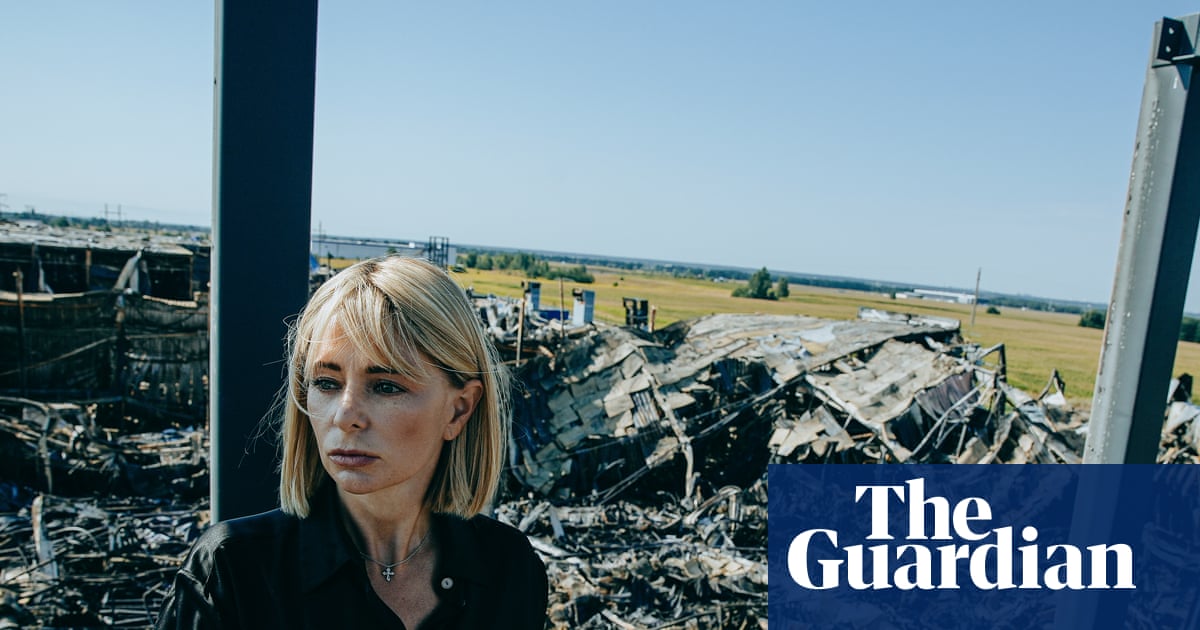
Iryna Chechotkina, the co-founder of Rozetka, Ukraine’s most successful e-commerce distributor, showed a few journalists around the ruins of what was her company’s largest distribution hub near Brovary, north-east of Kyiv. It was a modern automated facility, built for $70m, capable of sending 100,000 parcels a day, and employing 1,000. But it was totally destroyed by three missiles on the night of August 4-5, the inferno so great that in places only bent-over cranes can be made out.
-
Iryna Chechotkina, the co-founder of Rozetka, inside her company’s burnt-out distribution hub in Brovary, Kyiv region.
It was a clearly difficult visit for the businesswoman, amid worries that more of the company’s warehouses could be struck, affecting Rozetka and the 50,000 vendors who rely on its service. But the wider military reality is fragile.
“How can a country defend itself against ballistic threats if we have nothing with which to shoot them down?” she asked. “It’s very hard for me; I’m a mother of four and I’ve sacrificed time with them to build this place. It’s my life’s work.” Breaking into English, she added: “This is not easy.”


