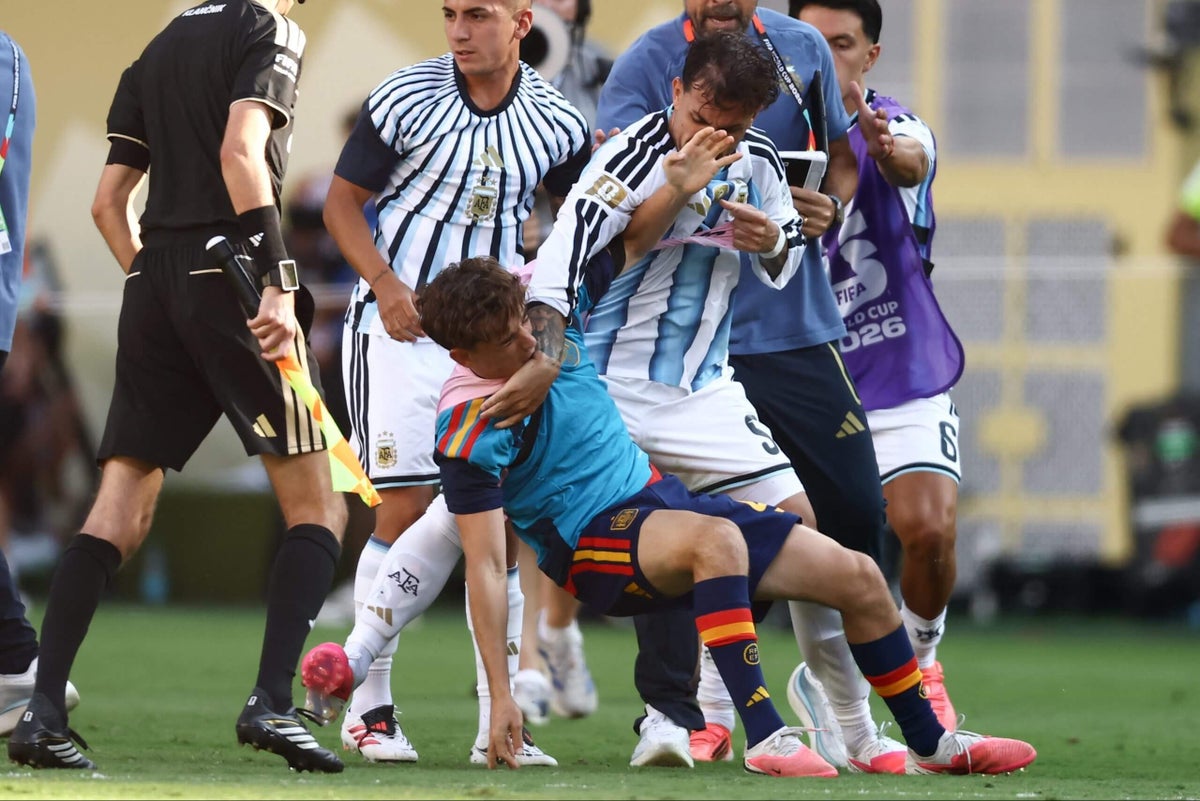
Дэлхийн аваргын финалд Испанид хожигдсоны дараа гарсан үймээнтэй холбоотойгоор ФИФА Аргентины тоглогчид болон албаны хүмүүст нийт 21 тоглолтын эрх хасах шийтгэл ногдууллаа.
МетЛайф цэнгэлдэх хүрээлэнд болсон тоглолтын дараах үймээнд оролцсон хагас хамгаалагч Леандро Паредес 10 тоглолтын эрхээ хасуулж, 90,000 ам.доллараар торгуулсан бол хамгаалагч Науэль Молина долоон тоглолтын шийтгэл хүлээж, ижил хэмжээний мөнгөн торгууль төлөхөөр болжээ. Мөн Тиаго Алмада нэг тоглолтын, багийн ажилтан Роберто Айяла гурван тоглолтын эрхээ хасуулж, тус бүр 30,000 ам.долларын торгууль хүлээв. Испанийн Гави болон Аргентины тоглогчдын хооронд үүссэн энэхүү зөрчил нь нэмэлт цагт Испани 1-0 харьцаагаар хожсоны дараа гарсан юм.
Түүнчлэн Аргентины хөлбөмбөгийн холбоог хөгжөөн дэмжигчдийн зохисгүй байдал, улс төрийн шинжтэй жагсаал болон арьс өнгөөр ялгаварлан гадуурхсан үйлдлүүдийн улмаас 310,000 ам.доллараар торгож, дараагийн гэрийн тоглолтыг цэнгэлдэх хүрээлэнгийн 50 хувийн дүүргэлттэйгээр зохион байгуулах шийдвэр гаргалаа. Өмнө нь Английн эсрэг хийсэн хагас шигшээ тоглолтын дараа Аргентины тоглогчид “Лас Мальвинас бол Аргентиных” гэсэн бичигтэй туг барьж талбай дээр гарсан нь ФИФА-гийн анхаарлыг татсан билээ.
Леандро Паредесийн авсан 10 тоглолтын торгууль нь 2014 оны Дэлхийн аваргаар Италийн Жоржо Кьеллиниг хазсаны улмаас дөрвөн сарын турш хөлбөмбөгөөс хөндийрч, есөн тоглолтын эрхээ хасуулсан Луис Суаресийн шийтгэлтэй дүйцэхүйц хүнд арга хэмжээ болж байна. ФИФА-гийн түүхэнд Роберто Рохас, Мурсид Эффенди нарт ногдуулсан бүх насаар нь эрх хасах шийтгэл, Диего Марадонад ногдуулсан 15 сарын хориг, Жосип Шимуничийн 10 тоглолтын шийтгэл зэрэг нь сахилгын хүнд арга хэмжээнүүдийн жишээ болдог. Саяхан Бенфикагийн жигүүрийн тоглогч Жанлука Престианниг Аваргуудын лигийн тоглолтын үеэр гаргасан үйлдлийнх нь төлөө ФИФА-гаас олон улсын хэмжээнд эрхийг нь хассан бол Ассим Мадибо өрсөлдөгчөө гэмтээснийхээ төлөө таван тоглолтын шийтгэл хүлээсэн байдаг.
Дэлгэрэнгүйг эх сурвалжаас харах
↓Эх сурвалжийг нээх ↓
The bans for Argentina’s players and staff were as striking as the unsavoury scenes themselves.
FIFA handed out sanctions totalling a combined 21 games to those involved in the mass altercation that unfolded at MetLife Stadium following Argentina’s World Cup final defeat by Spain.
Following an investigation into the scenes that shocked those watching on, the midfielder Leandro Paredes received a 10-game ban and $90,000 ($A125,000) fine while defender Nahuel Molina was given a seven-match suspension and fined the same amount.
Argentina attacking midfielder Thiago Almada also received a one-match ban for unsporting behaviour, while team official Roberto Ayala was handed a three-game suspension for one count of assault. The pair were also fined $30,000 each.
The Athletic takes a look at what led to the bans — and how they compare to other long-term suspensions handed out by FIFA.
What happened?
These bans have come on the back of a scuffle that followed the final whistle as Spain celebrated their 1-0 extra-time win over Argentina. The fiery Paredes appeared to throw Spain’s Gavi to the floor.
Paredes faced three counts of assault under FIFA’s rules while Molina faced two. Almada and Gavi faced one count each of unsporting behaviour, while Ayala faced one assault count.
FIFA also confirmed the Argentine Football Association (AFA) had been fined a total of $310,000 and ordered to play its next home match with a 50 per cent stadium closure, with a second one-game partial stadium closure suspended for an unspecified probationary period, in relation to fan behaviour.
These sanctions were in relation to “using a sports event for demonstrations of a non-sporting nature”, “discrimination and racist abuse” and “order and security at matches”.
Following Argentina’s 2-1 semi-final victory over England, their players celebrated with a banner reading “Las Malvinas son Argentinas,” which translates to “The Malvinas are Argentine” on the pitch at Atlanta’s Mercedes-Benz Stadium.
Where do the individual player bans rank in comparison to others?
The ban for Paredes is up there with the most severe ever and has been compared to the high-profile suspension of Luis Suarez in 2014. He was punished after biting Italy defender Giorgio Chiellini in a World Cup group stage game in Brazil.
Suarez, who moved from Liverpool to Barcelona around the time of the incident, was banned from all football for four months, and nine competitive games for Uruguay.
While Paredes’ actions were ugly but perhaps not as eye-catching as the Suarez incident, the fact he was accused of multiple separate actions instead of one isolated incident clearly made a difference in his 10-game ban.
The scuffle also brought back memories of the fracas in 2006 between Turkey and Switzerland after a World Cup playoff in Istanbul, where Switzerland’s Benjamin Huggel and Turkey’s Alpay Ozalan and Emre Belozoglu were banned for six games for their part in a similarly ill-tempered incident.
Luis Suarez holds his teeth after the incident with Giorgio Chiellini (Daniel Garcia/AFP via Getty Images)
Which other players have been banned by FIFA for a long period of time?
Lifetime bans
Plenty of players have received lifetime bans from FIFA for a whole host of reasons ranging from match fixing to acts of violence. Two that really stand out, though, are both bizarre and barely believable.
The first was for Chilean goalkeeper Roberto Rojas, who was suspended in 1989 for an incident that involved faking an injury during a World Cup qualifying game against Brazil in the Maracana. Chile needed to beat Brazil and were 1-0 down. Rojas fell in the penalty area and suggested he had been hurt by a flare, which led to his team-mates walking off.
Subsequent investigations, however, showed that he had deliberately cut himself after hiding a razor blade in his gloves. The game was awarded to Brazil and Rojas was banned for life. His ban was eventually lifted in 2001.
The second isn’t quite as strange but still as eye-catching. In 1998, the Indonesian defender Mursyid Effendi deliberately scored an own goal in their group stage match of the Tiger Cup against Thailand in order to avoid Vietnam in the semi-finals. Indonesia were beaten by Singapore in the next game anyway, but Effendi never played again.
Maradona’s 15-month ban
Diego Maradona was banned from all competitions for 15 months in 1994 after failing a random drugs test following Argentina’s group stage victory against Nigeria. He used the banned stimulant ephedrine during the World Cup finals in the United States and never played for Argentina again.
Josip Simunic’s 10-game ban
In December 2013, Croatia defender Josip Simunic was sanctioned for leading supporters in a chant that was reported by the BBC as having pro-fascist connotations following a play-off win over Iceland.
He shouted, “For the homeland” over a microphone in a chant that has associations with the Ustaše, a fascist movement which was dissolved in 1945, but denied any political intent.
Gianluca Prestianni’s UEFA ban and FIFA extension
Benfica winger Gianluca Prestianni was given a six-game ban by UEFA for homophobic conduct during a Champions League match against Real Madrid in February 2026.
This was then extended worldwide by FIFA. It meant that if he was selected by Argentina for the recent World Cup, he would have missed the first two games as part of the suspension.
Assim Madibo’s five-game ban
The 29-year-old was sent off for the foul, which resulted in a broken left leg for Kone and FIFA were quick to impose a strict punishment thereafter.


