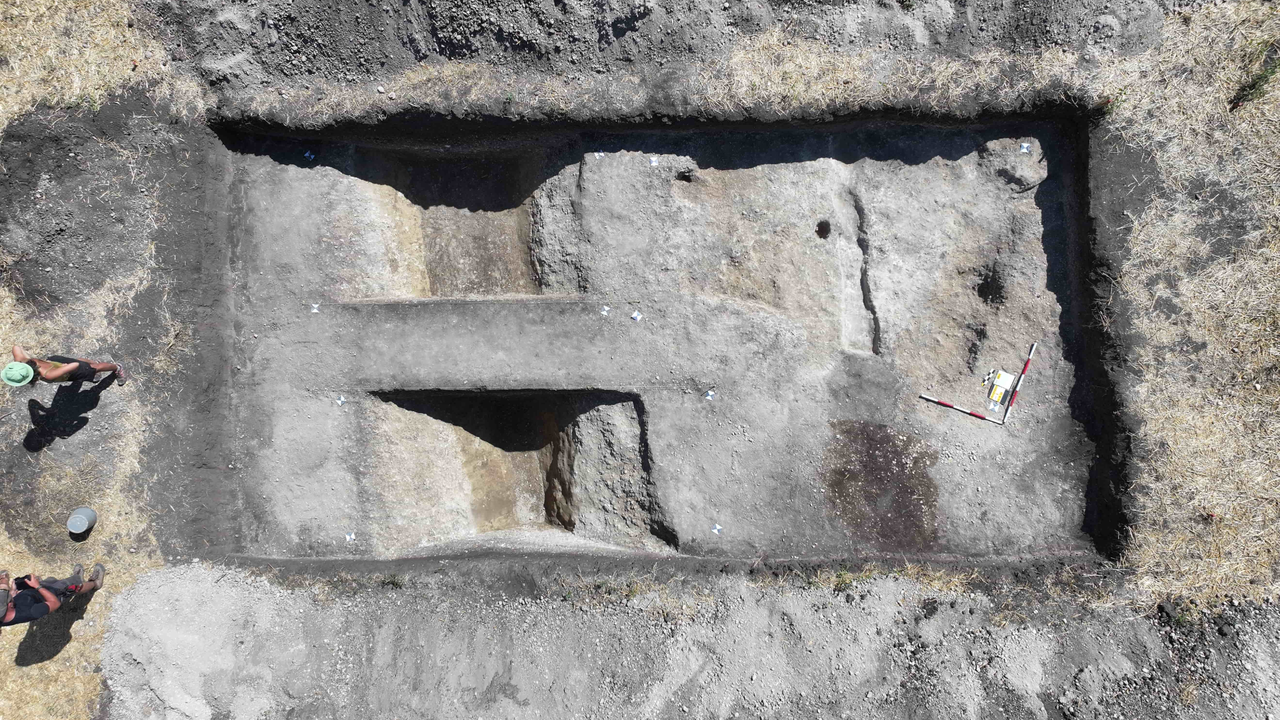
Археологичид Чехийн төв хэсэгт нар, сарны хөдөлгөөнтэй холбоотой 6500 жилийн настай зан үйлийн төв байж болзошгүй дугуй хэлбэрийн байгууламжийг малтан илрүүлжээ.
Чехийн Хлеби тосгоны орчмоос олдсон энэхүү дугуй хашлага нь 230 метр диаметртэй, 2.5 метр гүн суваг бүхий бүтэцтэй юм. Уг байгууламж нь төв рүүгээ чиглэсэн 12 орцтой бөгөөд археологичид эдгээр орцыг бухын гавлын яс, эврээр чимэглэсэн байсан гэж таамаглаж байна. Тухайн үеийн тариаланчдын хувьд бух нь хүч чадал, үржил шимийн бэлгэдэл байсан нь Европын олон оронд хийсэн судалгаагаар тогтоогджээ.
Баруун Чехийн их сургуулийн профессор Петр Криштуфын удирдсан судалгааны баг орцуудын байршил санамсаргүй бус, тодорхой геометрийн системтэй болохыг тогтоосон байна. Эдгээр орц нь зуны болон өвлийн туйлын өдрүүд дэх нарны мандах, жаргах цэгүүд, мөн сарны 18.6 жилийн мөчлөгийн хамгийн туйлын байрлалыг ажиглах боломжийг олгодог ажээ. Энэ нь тус байгууламжийг тэнгэрийн эрхэсийн хөдөлгөөнийг хянадаг эртний ажиглалтын төв байсныг илтгэж байна.
Хожим нь хүрэл зэвсгийн үед тус байгууламжийг оршуулгын зориулалтаар ашиглаж байсан 18 хүний шарил олдсон бол төмрийн зэвсгийн үед уг газар нь энгийн суурин болон хувирчээ. Судлаачид тухайн үеийн хүмүүсийн амьдралын хэв маягийг илүү нарийвчлан тодорхойлохын тулд хөрсний химийн найрлагад шинжилгээ хийхээр төлөвлөж байна.
Дэлгэрэнгүйг эх сурвалжаас харах
↓Эх сурвалжийг нээх ↓
Archaeologists in the Czech Republic have discovered a prehistoric structure they believe was a ritual center linked to the movements of the sun and moon. The center is around 6,500 years old — about 1,000 years older than Stonehenge.
The structure was discovered at Chleby in the Central Bohemian Region. Archaeologists found a circular enclosure consisting of a ditch that was about 750 feet (230 meters) in diameter and 8 feet (2.5 m) deep. Twelve entrances that led to the center of the enclosure were located in different spots around the ditch, the team said in an Aug. 18 statement.
Archaeologists suspect that wooden posts likely created the walls of the enclosure. Based on animal bones found in the ditch, experts think that the entryways were decorated with bull skulls and horns.
“The cult of the bull was an important religious symbol among the first farming communities and is known from many parts of prehistoric Europe,” Jan Turek, an archaeologist at Charles University in Prague who is involved in the research, said in the statement. Bulls in these Neolithic cultures were likely symbols of strength and fertility.
Sun and moon
The shape and orientation of the mysterious structure are unusual for a Stone Age site, the archaeologists noted.
“Circular enclosures are completely unknown in our region for this period, which already makes the site exceptional,” Petr Krištuf, an archaeology professor at the University of West Bohemia in the Czech Republic who is leading the research team, said in the statement. “But when we began to analyze the positioning of the entrances in detail, it became clear that their arrangement was not random. Their geometry creates a system that made it possible to observe the most significant moments of the solar and lunar cycles.”
Specifically, the 12 entrances were oriented so that people inside the enclosure could observe important astronomical events, such as the moon’s most extreme position on the horizon during its 18.6-year cycle. People could also observe sunrise on the summer solstice, the longest day of the year, and sunset on the winter solstice, the shortest day of the year, through the structure’s entrances.
“For prehistoric farming communities, the connection between sunrise and the summer solstice symbolized a beginning, while sunset and the winter solstice represented an ending,” Krištuf said. “The same principle can be seen along Stonehenge’s main axis. We can now see that [this site] was designed similarly.”
In later times, the ritual purpose of the Chleby structure seems to have changed or been lost entirely. Previous excavations at the site found burials of 18 people from the Bronze Age Únětice culture (circa 2300 to 1600 B.C.), a culture which had unique burials and artifacts, including the Nebra Sky Disc. The site may have still maintained a ritual purpose at this time. But in the Iron Age (circa 800 B.C. to 1 B.C.), a settlement was built over the Chleby site.
- 30,000-year-old ‘personal toolkit’ found in the Czech Republic provides ‘very rare’ glimpse into the life of a Stone Age hunter-gatherer
- See ‘hyperrealistic’ reconstructions of 2 Stone Age sisters who worked in brutal mine in the Czech Republic 6,000 years ago
- 6,000-year-old burial mound in Czech Republic may be one of earliest funeral monuments ever found in Europe
“By the Iron Age, the monument appears to have definitively lost its original significance. The ditch was gradually filled in, and an ordinary settlement was established on the site of the former sanctuary,” Krištuf said.
Research is ongoing, and archaeologists plan to analyze the site’s soil to learn more about the people who once lived there.
“In addition to artifacts and the remains of the dead, people leave chemical traces in the soil. These can help us understand how this exceptional site was used during different periods of prehistory,” Jan Fišer, an archaeologist at the University of Hradec Králové in the Czech Republic who is involved in the research, said in the statement.
What do you know about the Paleolithic, Mesolithic and Neolithic eras? Find out with our Stone Age quiz!

