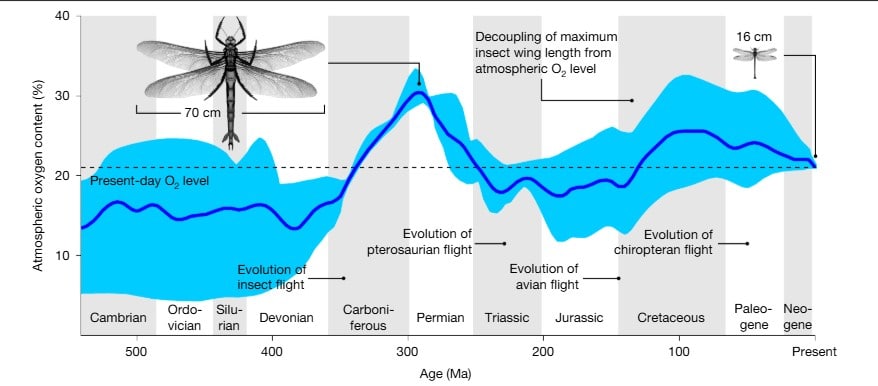
Шинэ судалгаагаар 300 сая жилийн тэртээх аварга шавьжнуудын өсөлтөд хүчилтөрөгчийн нөлөө хязгаарлагдмал байсныг тогтоов.
Одоогоос 300 сая жилийн өмнөх нүүрстөрөгчийн галавын үед далавчны урт нь 70 сантиметр хүрдэг Meganeura monyi зэрэг аварга шавьжнууд амьдарч байжээ. Эрдэмтэд олон жилийн турш тухайн үеийн агаар мандал дахь хүчилтөрөгчийн өндөр түвшин нь эдгээр шавьжны амьсгалын тогтолцооны хязгаарлалтыг даван туулж, аварга том болоход нь тусалсан гэж таамаглаж ирсэн юм. Шавьж нь уушгигүй бөгөөд биеийн гадаргуу дахь нүхээр дамжуулан хүчилтөрөгчийг эд эсэд шууд хүргэдэг тул биеийн хэмжээ томрох тусам энэ систем үр ашиггүй болдог гэж үздэг.
Преторийн их сургуулийн судлаач Эдвард Снэллинээр удирдуулсан баг 44 зүйлийн 1320 микроскопийн дүрслэлд шинжилгээ хийж, хүчилтөрөгчийг эд эсэд зөөвөрлөдөг “трахеол” хэмээх жижиг гуурсуудыг судалжээ. Судалгаагаар шавьжны биеийн жин 10,000 дахин нэмэгдэхэд трахеолын эзлэх хувь ердөө 1.8 дахин л өсөж байгаа нь тогтоогдсон байна. Энэ нь агаар мандал дахь хүчилтөрөгчийн хэмжээ нь шавьжны биеийн дээд хэмжээг тогтоодог гол хүчин зүйл биш байж болзошгүйг харуулж байна.
Эрдэмтдийн үзэж буйгаар аварга шавьжнуудын үүсэл болон мөхөлд хүчилтөрөгчөөс гадна гаднын олон хүчин зүйл нөлөөлсөн байх магадлалтай. Тухайлбал, шавьжны гаднах скелетийн бат бөх чанар, нислэгийн механик болон авгалдай үеийн амьдрах орчин нь чухал үүрэг гүйцэтгэсэн байж болно. Түүнчлэн шувууд үүсэж хөгжсөний дараа нислэгийн хурд, шаламгай байдлыг нэмэгдүүлэх шаардлагаар шавьжнуудын биеийн хэмжээ жижгэрсэн байх талтай гэж судлаачид таамаглаж байна.
Дэлгэрэнгүйг эх сурвалжаас харах
↓Эх сурвалжийг нээх ↓
Some 300 million years ago, giant insects soared over Earth’s wetlands, with wings stretching almost 70 centimetres wide. A new study challenges the long-held idea that abundant atmospheric oxygen alone allowed these creatures to grow to such extraordinary sizes.
The best-known example is Meganeura monyi, one of the largest flying insects ever discovered. It looked like a giant dragonfly, although it was not a true dragonfly. It belonged to an extinct group called Meganisoptera, also known as griffinflies.
For years, scientists have tried to understand how these insects became so large. The main idea was that the oxygen-rich atmosphere of the Carboniferous period helped them overcome the limits of their unusual breathing system.
Unlike mammals, they do not use lungs. They breathe through openings in their bodies connected to tubes that deliver oxygen directly to their tissues. As insects get bigger, this system becomes harder to scale up, which made the size of griffinflies a long-standing mystery.
Giant Insects in a World Full of Oxygen
When Meganeura monyi lived, Earth was covered with large wetlands and forests. The insect was an aerial predator, flying above these landscapes with a wingspan close to 70 centimetres. Its size made it one of the most impressive arthropods known from the fossil record. Modern ones are much smaller, and researchers have often connected this difference to changes in Earth’s atmosphere.
During the Carboniferous period, oxygen levels were higher than today, reaching more than 30 percent of the atmosphere compared with about 21 percent now. Huge forests produced large amounts of organic material, and some of that carbon was buried instead of returning to the atmosphere.
This led scientists to propose that richer oxygen levels allowed insects to grow larger. Research from the University of California, Santa Cruz pointed out that giant insects appeared during times of high oxygen, although scientists have also noted that the fossil record makes it difficult to prove a direct cause.
A Decades-Old Theory Falls Into Question
A 2026 study published in Nature looked at a key part of the oxygen theory: whether insect flight muscles needed much more oxygen-delivery space as bodies became larger. The team, led by Edward Snelling from the University of Pretoria, analysed 1,320 micrographs from 44 insect species across ten insect orders. They focused on tracheoles, the tiny tubes that carry oxygen to insect tissues.
The results were unexpected. Tracheoles usually occupied around 1 percent or less of flight muscle tissue. Across the species studied, body mass increased by 10,000 times, but the relative amount of tracheole space increased only 1.8 times.

The researchers found that larger insects do make some changes to their respiratory systems, but the difference was limited. Snelling explained that:
“If atmospheric oxygen really sets a limit on the maximum body size of insects, then there ought to be evidence of compensation at the level of the tracheoles. There is some compensation occurring in larger insects, but it is trivial in the grand scheme of things.”
Why Did Giant Insects Disappear?
Scientists are still looking at other possible reasons behind the rise and fall of giant insects. The strength of the exoskeleton, the challenges of flight and environmental conditions may all have influenced their evolution. Another idea focuses on the young stages of these insects. Researcher Wilco Verberk suggested that high oxygen levels may have affected aquatic larvae differently.
“So a larval perspective might lead to a better understanding of why these animals existed in the first place,” heargued as reported by National Geographic, “and maybe why they disappeared.”

There is also evidence that changes in the skies may have played a role. Fossil patterns indicate that insects became smaller after birds evolved, even when oxygen levels were still relatively high. Smaller bodies may have helped the creatures become more agile flyers in a world with new aerial predators.
The story of Meganeura shows that the largest insects in Earth’s history were shaped by more than one factor. Oxygen may have helped create the right conditions, but scientists are still piecing together the full explanation behind these prehistoric giants.
Enjoyed this article? Subscribe to our free newsletter for engaging stories, exclusive content, and the latest news.


