Солирын 75 тохиолдлыг судалснаар сансрын биетүүд агаар мандалд орохдоо шатаж алга болохоос илүүтэй хайлж, бутарсны улмаас масс алддаг болохыг тогтоожээ.
SETI Institute болон NASA Ames Research Center-ийн одон орон судлаач, доктор Питер Женнискенсээр ахлуулсан баг солирын 75 уналтын дүрс бичлэг болон гэрэл зургийн ажиглалтад дүн шинжилгээ хийжээ. Судлаачид сансрын биет дэлхийн агаар мандалд нэвтрэх явцыг долоон үндсэн үе шатанд хуваан тодорхойлсон байна. Энэхүү судалгаа нь солир дэлхийн гадаргуу дээр хүрэх хүртлээ хэрхэн хурдаа алдаж, биет хэмжээгээ өөрчилдөг талаарх уламжлалт ойлголтыг өөрчилж байна.
Өмнө нь эрдэмтэд сансрын чулуулгийг агаар мандалтай мөргөлдөх үеийн асар их дулааны нөлөөгөөр ууршиж алга болдог гэж үздэг байсан бол шинэ судалгаагаар гадаргуугийн хайлалт болон дараа нь үүсэх бутралт нь гол хүчин зүйл болохыг баталжээ. Агаар мандлын нягт давхаргад орох үед үүсэх даралт нь чулуулгийг хагарах, бутрахад хүргэдэг бөгөөд энэ үйл явц нь солирын хурдыг огцом сааруулдаг байна. Энэхүү бутралт нь ихэвчлэн солирын дотоод бүтэц дэх өмнөх мөргөлдөөнөөс үүдэлтэй цууралттай холбоотой байж болзошгүйг судалгааны баг дурджээ.
Судалгааны үр дүн нь зөвхөн солирын уналтыг тайлбарлаад зогсохгүй астероидын агаар мандал дахь зан төлөвийг илүү нарийвчлалтай загварчлахад чухал ач холбогдолтой юм. Тухайлбал, 2013 онд ОХУ-ын Челябинск хотын дээр тохиолдсон астероидын дэлбэрэлт нь эдгээр үе шаттай ижил төстэй үйл явцыг дамжсан болохыг судлаачид онцолсон байна. Энэхүү нээлт нь сансрын биетүүдийн дэлхий рүү чиглэсэн аюултай үзэгдлүүдийг урьдчилан таамаглах, гариг эрхсийн хамгаалалтын загваруудыг боловсронгуй болгоход шинэ суурь болж байна.
Дэлгэрэнгүйг эх сурвалжаас харах
↓Эх сурвалжийг нээх ↓
A study of 75 meteorite falls has revealed how space rocks survive their violent passage through Earth’s atmosphere, showing that melting and fragmentation shape their journey more than simple burning or evaporation. Published in the journal Meteoritics & Planetary Science, the research provides a new view of how meteoroids lose mass, slow down, and deliver meteorites to the surface.
Researchers Rebuild The Journey From Meteor To Meteorite
Scientists analyzed video recordings and photographic observations of 75 meteorite falls to understand the physical changes that occur during atmospheric entry.
The research team identified seven distinct phases that describe the transformation from a fast-moving space rock into a meteorite recovered on Earth.
Each phase is controlled by different interactions between the incoming object and the atmosphere surrounding the planet.
The findings challenge the traditional idea that space rocks mainly disappear because of extreme heating and evaporation during their descent.
Instead, researchers found that surface melting followed by fragmentation determines how these objects lose material.
Credit: Meteoritics & Planetary Science
The observations provide a clearer picture of why some rocks survive entry while others break apart before reaching the ground.
The work was published in Meteoritics & Planetary Science, a journal focused on research involving meteorites, planetary materials, and related fields.
Dr. Peter Jenniskens, a meteor astronomer from the SETI Institute and NASA Ames Research Center, led the study.
“We used to think that solid rocks would evaporate from the enormous heat and brilliant light generated in collisions with air,” said Jenniskens. “We found instead that first melting and then fragmentation control how a rock loses mass.”
The discovery offers scientists a more accurate framework for studying both ordinary meteorite falls and larger objects entering Earth’s atmosphere.

Credit: Meteoritics & Planetary Science
Fireballs Begin With Heating, Brightness, And Surface Melting
The first stages of atmospheric entry begin high above Earth when a space rock moves quickly enough through the atmosphere to create a powerful shock wave.
Air molecules collide with the surface of the object, producing intense heating that causes both the surrounding gas and the rock itself to glow.
This glowing trail is what observers identify as a meteor, often called a shooting star.
As the object moves deeper into denser layers of the atmosphere, the pressure and heating conditions change rapidly.
During the second phase, some meteors reveal their rotation through repeated changes in brightness.
The fastest-spinning objects studied by researchers completed a full rotation between every 0.5 and 5 seconds.
The third phase begins when the meteor becomes a fireball, with melting becoming the main process removing material from the surface.
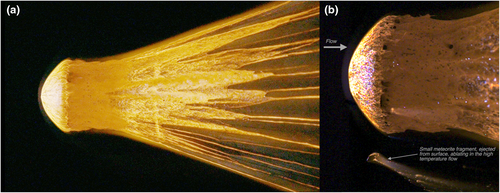
Liquid material is stripped away by the airflow, forming droplets that continue to heat and evaporate behind the main object.
Eric Stern, formerly at NASA Ames and now chief scientist at Hyperspace Technologies Inc., explained why laboratory tests cannot fully reproduce these conditions.
“In the laboratory, we cannot generate the amount of radiation that occurs in a natural atmospheric entry at those speeds,” said Stern. “A rock could aggressively fragment and erode instead, but then we would not expect the observed systematics in how fireballs brighten.”
Fragmentation Determines How Meteorites Reach The Ground
As a fireball descends to around 60 kilometers above Earth, it enters a phase where melting reaches a balance and brightness becomes stable or rises gradually.
During this period, a space rock can lose up to 40% of its original mass through melting alone.
The next major transition occurs deeper in the atmosphere, where rising pressure causes the object to crack and break apart.
The researchers discovered that fragmentation begins when atmospheric pressure reaches only about one-fifth of the strength measured in meteorites found on Earth.
They suggest that damage from earlier collisions in space and internal cracks caused by heating help explain why these objects fail sooner than expected.
The breakup process also changes how quickly the object slows down during its descent.
“When a rock fragments, the pieces interact differently with the atmosphere, causing a rapid loss of speed,” researchers found through comparisons with earlier mathematical models.
“We were able to tie that slowdown from fragmentation to the previous mathematical descriptions based on ablation,” said co-author Stu Pilorz of the SETI Institute.
The shape and structure of the remaining main mass also influence where fragments land after the breakup.
“Our modeling shows that as long as the back of the space rock remains intact, that rock pulls a vacuum in its wake into which fragments tend to flow,” said co-author Darrel Robertson of NASA Ames Research Center. “Those small meteorites fall in a narrow strip on the ground.”
The Final Breakup Reveals The Origins Of Recovered Meteorites
The final stages of atmospheric entry occur when the remaining structure of the space rock can no longer withstand the pressure and heating forces.
During this sixth phase, the object can produce a final bright flare as its remaining sections separate.
The fragments may spread outward at higher relative speeds because the original object has already slowed considerably.
Researchers observed that these later flashes often appear red rather than the green colors seen earlier in a fireball’s path.
The difference comes from changes in speed, temperature, and the materials involved during the final breakup.
“That final disruption sends fragments flying at higher relative speeds,” said Jenniskens. “In past falls, we noticed that meteorites larger than about 20 g tended to be scattered wider, and many came from close to the surface of the original space rock, which must have been its backside.”
After fragmentation, the remaining pieces continue losing heat and slowing until they stop glowing.
A thin fusion crust forms on the surface as melting ends, creating the dark outer layer commonly seen on recovered meteorites.
Wind can then influence the final path of these cooled fragments before they reach the ground.
The study shows that meteorites collected on Earth are survivors of a complex sequence of physical changes rather than simple remains of objects that passed through fire.
Meteorite Research Helps Explain Dangerous Asteroid Events
The findings also provide new information about larger objects that enter Earth’s atmosphere, including asteroids capable of producing airbursts.
The researchers compared different meteorite types to determine how their materials behave during each atmospheric phase.
This approach helps scientists understand why some larger solid objects break apart while others continue deeper into the atmosphere.
Small asteroids measuring several meters to tens of meters across can experience similar processes during entry.
“Asteroids up to tens of meters in size are also solid rocks because they tend to spin faster than do the larger rubble-pile asteroids,” said Jenniskens.
“The 20-m-diameter asteroid that caused the airburst over Chelyabinsk, Russia, in 2013 went through the same phases.”
The Chelyabinsk event demonstrated how a relatively small asteroid can release enormous energy during atmospheric entry without reaching the surface as a single object.
Understanding these phases improves models used to predict how incoming space rocks behave before they arrive above populated regions.
The research connects the study of meteorite samples found on Earth with broader questions about planetary defense and asteroid behavior.
By tracing the complete journey of space rocks, scientists can better interpret both ancient meteorites and future atmospheric events.
Enjoyed this article? Subscribe to our free newsletter for engaging stories, exclusive content, and the latest news.


