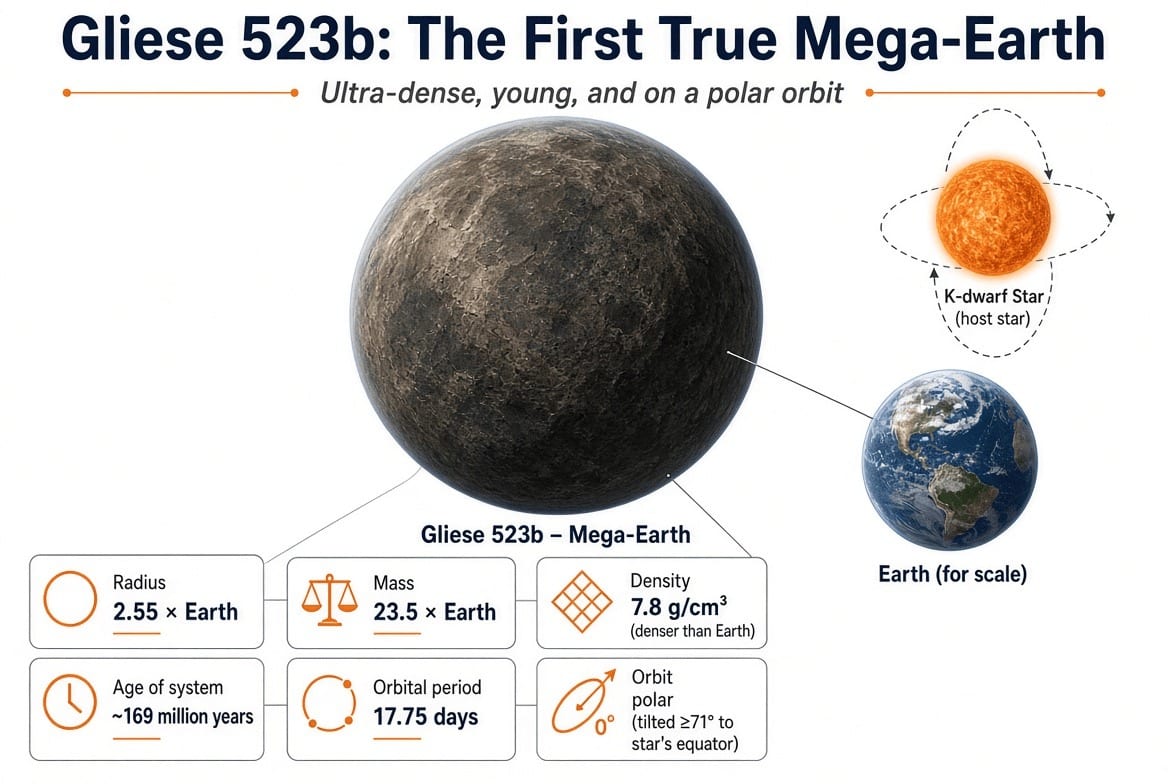
Эрдэмтэд одоогийн гариг бүрэлдэх онолоор тайлбарлахад бэрх, ер бусын нягтрал болон орбитын замналтай Gliese 523b гаригийг нээжээ.
Висконсин-Мэдисоны их сургуулийн судлаачид NASA-гийн TESS номлол болон WIYN дурангийн NEID спектрографийн тусламжтайгаар Gliese 523 одны эргэн тойронд 17.75 хоногт нэг удаа эргэдэг энэхүү гаригийг илрүүлсэн байна. Дэлхийгээс 2.55 дахин том, 23.5 дахин их масстай энэхүү биет нь куб сантиметр тутамд 7.8 грамм нягттай буюу хэмжээнийхээ хувьд хүлээгдэж байснаас хамаагүй илүү нягтралтай байгаа нь эрдэмтдийн анхаарлыг татаж байна. Ихэвчлэн ийм хэмжээтэй гаригууд гаднаа хийн зузаан давхаргатай байдаг бол Gliese 523b нь хатуу гадаргуутай “мега-Дэлхий” ангилалд багтахаар байна.
Судалгаагаар тус гаригийн орбитын замнал нь эхийн одны экватортой харьцуулахад дор хаяж 71 хэмийн хазайлттай, туйлуудын дээгүүр болон доогуур эргэдэг болохыг тогтоожээ. Дөнгөж 169 сая жилийн настай гэж тооцоолсон энэхүү залуу системд ийм хазайлттай гариг байгаа нь түүний үүсэл хөгжлийн түүх ердийн үйл явцаас өөр байсныг илтгэж байна.
Эрдэмтэд энэхүү гаригийн өвөрмөц шинж чанарыг тайлбарлахдаа түүнийг өнгөрсөн хугацаанд гариг хоорондын хүчтэй мөргөлдөөнд өртөж агаар мандлаа алдсан байх, эсвэл одны хэт халууны улмаас агаар мандал нь хийсч алга болсон гэх таамаглалуудыг дэвшүүлж байна. Энэхүү нээлт нь гариг бүрэлдэх үйл явц болон мега-Дэлхий ангиллын гаригуудын шинж чанарыг ойлгоход чухал ач холбогдолтой юм.
Дэлгэрэнгүйг эх сурвалжаас харах
↓Эх сурвалжийг нээх ↓
Astronomers have found Gliese 523b, a bizarre exoplanet that combines a huge size, extreme density and a highly unusual orbit around its star. Located about 87 light-years from Earth, this young world does not fit easily into current ideas about how planets form.
The planet, also known as GJ 523b, circles the small K-type star Gliese 523 and completes one trip around it every 17.75 days. With a size about 2.55 times larger than Earth and a mass of 23.5 Earth masses, it could become one of the clearest examples of a mega-Earth ever found.
According to researchers from the University of Wisconsin-Madison, the planet stands out because it is far denser than expected for a world of this size. Its density reaches 7.8 grams per cubic centimeter, meaning it contains an unusually large amount of heavy material compared with many larger exoplanets.
The discovery was made by combining observations from NASA’s TESS mission with measurements from the NEID spectrograph on the WIYN Telescope at Kitt Peak National Observatory. Together, these instruments helped scientists determine the planet’s size, mass and strange orbital behavior.
A Giant Planet That Shouldn’t Be Rocky
The biggest surprise about Gliese 523b is that it is both large and extremely dense. Most planets measuring more than twice Earth’s size are expected to hold thick layers of gas around a smaller rocky core. This planet appears to follow a very different path.
“People have been using the phrase mega-Earth for more than a decade, but we’ve never had a planet that let us say concretely what one is,” said Thomas Beatty, an astronomer at the University of Wisconsin-Madison.
The discovery gives scientists a rare chance to study a planet that sits between familiar categories. Smaller rocky planets such as Earth and Mercury can be very dense, while larger planets often become dominated by gas.
This one does not clearly belong to either group. Researchers first spotted the planet through the tiny drop in brightness caused when it passed in front of its star. The size of this signal revealed the planet’s radius, while the time between transits showed that it orbits its star every 17.75 days. The team then used radial velocity measurements to determine the planet’s mass.
“This isn’t what we expected at all,” said Max Kroft, a graduate student at the University of Wisconsin-Madison. “Dense planets like this aren’t uncommon, but they’re usually small rocky planets similar to Earth or Mercury. This planet is two and a half times bigger than the Earth.”
A Young Planet Moving Along A Strange Path
The mystery surrounding Gliese 523b is not only about what the planet is made of. Scientists also discovered that its orbit is unlike those of most planets. The planet’s orbit is tilted by at least 71 degrees compared with the equator of its star. Instead of moving around the star in a similar direction to its rotation, it may travel above and below the star’s poles.
The research team estimated that the Gliese 523 system is only around 169 million years old. According to the study, this age was calculated by comparing the rotation of the star with several companion stars moving through space together.
A young system with such a strongly tilted planet raises questions about how this world reached its current position. A normal planetary formation process does not easily explain a massive, dense planet traveling on such an unusual orbit.

Scientists are now examining several possible explanations, including changes caused by another unseen planet or a planet-forming disk that was already tilted when the system was created.
A Planet That May Have Survived a Violent Past
One of the possibilities explored by researchers is that Gliese 523b went through a major collision during its history. A giant impact between two planets could have removed much of the atmosphere and left behind a dense rocky body.
Kroft explained that another possibility is that the planet once moved close enough to its star to lose its atmosphere because of extreme heat. “It kind of blows away,” he said, explaining how a planet can lose its atmosphere under harsh conditions.
The strange properties of Gliese 523b could point to an unusual formation history, with processes that may have limited the planet’s ability to build a thick atmosphere. The research, published in the Astronomical Journal, investigates how this rare mega-Earth came to exist.
Enjoyed this article? Subscribe to our free newsletter for engaging stories, exclusive content, and the latest news.


Мэдээний энэ шинэ нээлт үнэхээр сонирхолтой байна, ийм нягтралтай гаригийг бид одоогоор төсөөлж чадаагүй юм шиг. Та энэ гаригийн үзүүлж буй шинж чанаруудыг харуулаад, орчлон ертөнцөд ямар нөлөөтэй байж магадгүй гэж бодож байна?