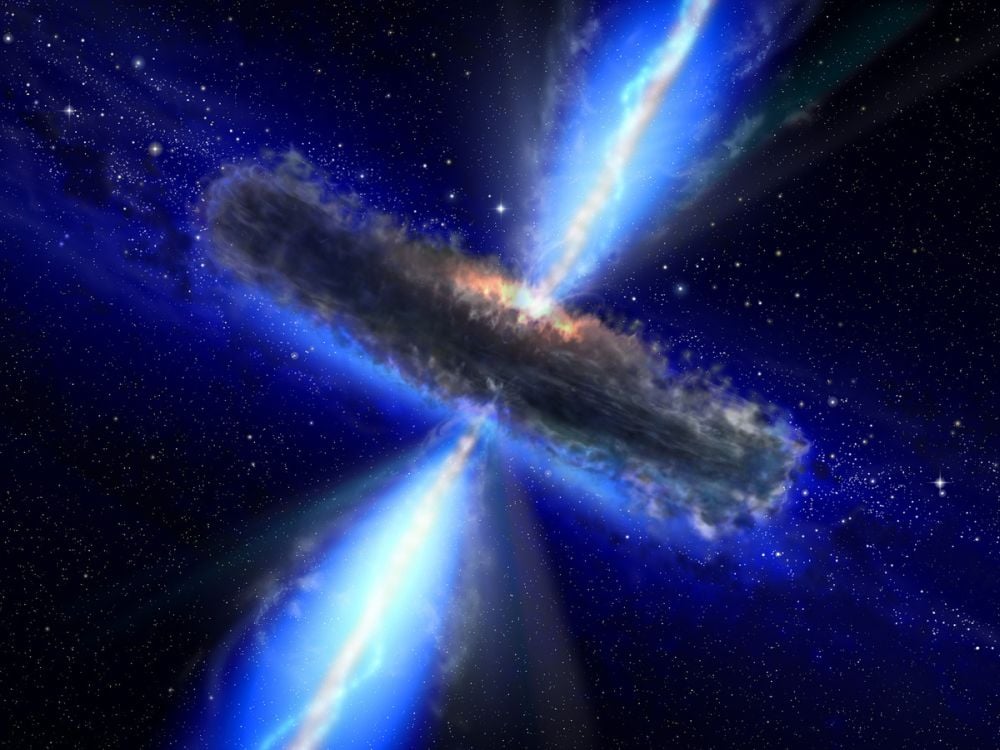
Жэймс Вэбб сансрын дуран авайг ашиглан залуу оддыг хүрээлсэн хийн дискнүүд хэрхэн сарниж, гараг үүсэх боломжийг хязгаарладгийг эрдэмтэд тогтоожээ.
Аризоны их сургуулийн судлаач Наман Бажаж тэргүүтэй баг Жэймс Вэбб сансрын дуран авайны MIRI багажийн өгөгдлийг ашиглан 72 залуу одны системийн хийн дискний хувьслыг судалсан байна. “The Astronomical Journal” сэтгүүлд нийтлэгдсэн энэхүү судалгаагаар оддын эргэн тойрон дахь хий нь соронзон орон болон фото-ууршилтын нөлөөгөөр хэрхэн алга болдгийг тодорхойлжээ. Гараг үүсэхэд шаардлагатай хийн нөөц нь тодорхой хугацааны дараа сарнидаг тул Бархасбадь шиг хийн аварга гарагууд энэ хугацаанд амжиж бүрэлдэх ёстой аж.
Судалгааны үр дүнгээс үзэхэд, оддын хөгжлийн эхний 1-10 сая жилийн хугацаанд соронзон орны нөлөөгөөр үүссэн хүчтэй тийрэлтэт урсгалууд хийг гадагшлуулдаг байна. Од залуу бөгөөд идэвхтэй байх үедээ их хэмжээний бодис хуримтлуулж, соронзон орны тусламжтайгаар хийг дискнээс гадагшлуулдаг аж. Гэвч од боловсрох тусам соронзон идэвхжил буурч, улмаар одны ялгаруулж буй өндөр энергитэй хэт ягаан болон рентген туяаны нөлөөгөөр фото-ууршилтын процесс давамгайлж эхэлдэг байна.
Энэхүү фото-ууршилт нь хийн дискийг бүрмөсөн сарниулж, гараг үүсэх үйл явцыг зогсоодог болохыг тогтоосон нь шинжлэх ухааны чухал ач холбогдолтой юм. Судлаачид молекулын устөрөгч болон ионжсон неон хийн шинж тэмдгийг ажигласнаар хий алдагдах механизмыг ялгаж чаджээ. Цаашид эдгээр механизмын хийг зайлуулах хурдыг нарийвчлан тодорхойлох нь гараг үүсэх замуудыг илүү тодорхой ойлгоход тус дөхөм болох юм.
Дэлгэрэнгүйг эх сурвалжаас харах
Эх сурвалжийг нээх ↓
One of the JWST’s main jobs is studying planets forming in the disks around young stars. These disks don’t last forever and the way their gas is dispersed affects planet formation.
There are two broad types of jets and winds that work to disperse protoplanetary disks. One type is driven by powerful magnetic fields, and the other is atomic winds, including photoevaporative winds. Planets have only so much time to form before these winds remove material from the disks.
New research in The Astronomical Journal used JWST data to understand how the different winds disperse the gas in planet-forming disks. It’s titled “JWST/MIRI Reveals the Evolution from Molecular to Atomic Disk Winds.” The lead author is Naman Bajaj, from the Lunar and Planetary Laboratory at the University of Arizona.
“The evolution and dispersal of protoplanetary disks—governed by accretion, magnetically launched jets and winds, and photoevaporative winds—fundamentally shape planetary systems,” the authors write. “Determining how these mass-loss processes coevolve is crucial for constraining planet formation pathways.”
Our Solar System is mature at about 4.5 billion years old. It’s mostly empty space now, but was once surrounded by a protoplanetary disk. This thick disk was dominated by gas, and held about 100 times more gas than dust. While some of the gas was taken up by planet formation, most of it was just dispersed. Knowing how and when this gas dispersed is an important part of understanding how planets, especially gas giants, form. If disk gas is dispersed too soon, the formation of these planets suffers.
“What is exciting about this study is that we can now see, across a large sample of young systems, how the mechanisms that remove gas from planet-forming disks change with time,” said study co-author and SETI scientist Uma Gorti. “Disk dispersal sets a fundamental clock for planet formation: once the gas is gone, the opportunity to build gas-rich planets is essentially over,” Gorti said in a press release.
In this work, the researchers used JWST MIRI archival data from 72 young solar systems featuring Sun-like stars. They used molecular hydrogen, which dissociates at higher temperatures, to trace fast jets and material further from the star. They used ionized neon to trace the photoevaporative wind. The combined observations let them differentiate between wind mechanisms.
Molecular hydrogen could come from a jet, a slow disk wind, or disk surface, so its source is ambiguous. But ionized hydrogen isn’t ambiguous. It requires energetic photons in UV and X-ray to ionize, so it’s a pretty unambiguous signature of photoevaporation.
They found that at a certain point, photoevaporative winds take over from magnetically-induced winds as the main drivers of disk dispersion.
For the first ~1-10 million years, magnetically launched jets and winds are responsible for removing gas. Magnetic field lines thread through the disk, and gas is funneled out of the disk along these lines.
There’s been a growing understanding that magnetic fields at young stars launch and shape powerful jets that help dissipate gas in protoplanetary disks. This artist’s illustration is based on ALMA’s observations of a young star embedded in its thick disk. Image Credit: NSF/AUI/NSF NRAO/M. Weiss
Closer to the young star, magnetic interactions between the star and the disk launch collimated jets from the star’s axis of rotation. These are narrower and faster jets, and they’re responsible for creating Herbig-Haro objects, nebular regions of gas lit up by the jets.
These mechanisms dominate in the first few million years precisely because the star is young and highly active. It’s still accreting material itself, and that drives the outflows and jets.
“At earlier stages of Class I/II disk evolution, when accretion rates are high, an atomic jet ([O I], [Ne II] High-Velocity Component) is driven alongside a hot, inner atomic ([O I] LVC) and molecular (H2, predominantly hot, wind. We argue that these flows are MHD disk winds and are likely dense enough to shield the outer disk from high-energy stellar photons,” the authors summarize. This suppresses photoevaporation at greater distances from the star.
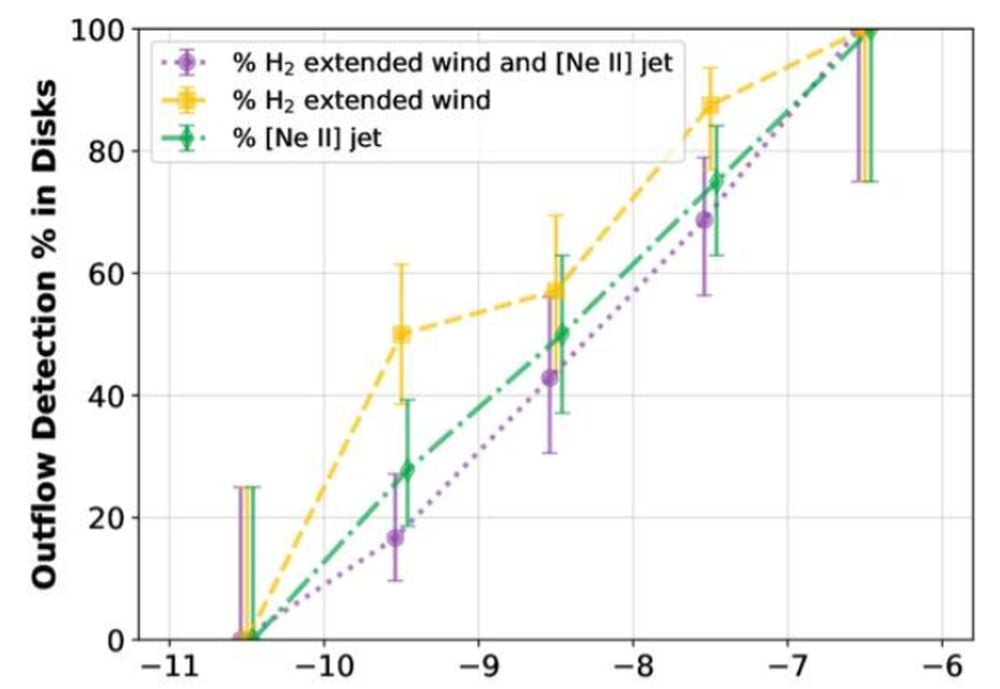 This figure shows how the percentage of stars emitting winds, jets, or both increases with the stellar accretion rate. (Note: the x-axis shows a logarithmic expression of the rate of mass accreted by stars.) Image Credit: Bajaj et al. 2026. AnJ
But eventually, the star begins to mature. Accretion slows and stops, its magnetic activity calms, and that changes the nature of its outflows and their effect on the planet-forming disk. Instead of magnetically-launched jets and winds, photoevaporative winds take over.
“As disks evolve toward lower accretion rates, the atomic jets fade and the hot inner molecular winds weaken below detection thresholds,” the authors explain. “The resulting tenuous inner flows could allow high-energy stellar photons to penetrate farther into the disk, heating its surface.”
A star’s high-energy photons, UV and X-rays, heat up the surface areas of the protoplanetary disks. At a certain point, this heat and thermal velocity overpowers the disk’s local escape velocity. This is a thermally-driven wind with no need for magnetic fields. It’s sometimes called an ‘atomic wind’ because the same UV and X-rays that heat up the disk also dissociate molecules, meaning the wind is made of atoms.
The second stage of disk-dissipating winds aren’t just because of slowing accretion and weakening magnetism in the maturing star. The disk itself also gets thinner, meaning that more surface area of the disk is subjected to photoevaporation. Photoevaporation can also carve an opening into the disk, letting the outer disk gases escape more easily. This is sometimes called ‘disk-clearing’ and it’s a runaway process that hastens the disk’s dispersion.
Astronomers have studied disk dissipation for decades, trying to understand the mechanisms and timelines involved. Now the JWST has provided an observational connection to what was at one time mostly theoretical. The result is a new understanding of planet formation, one that highlights how time can run out for the formation of gas giants.
“Planet formation is therefore a race against time,” lead author Bajaj said. “Gas giants like Jupiter must assemble their massive atmospheres while the disk is still substantial enough to supply them, before winds and jets carry that raw material away into space.”
These results show that the contribution of winds and jets that disperse disks changes over time as the star ages. The next step is to determine how much gas the different dispersal mechanisms remove over time. That will generate an even clearer picture of planet formation, showing how long gas giants have to form before time runs out.


Энэ судалгаа оддын эргэн тойрон дахь хийн дискнүүдийн амьдралын хугацааг ойлгоход их тус болж дээ. Тэгэхээр гараг үүсэхэд хамгийн их цаг хугацаа хязгаарлагддаг гэдгийг бодоод үзээрэй, та ямар гараг үүсэхэд хамгийн амжиж чаддаг гэж бодож байна?