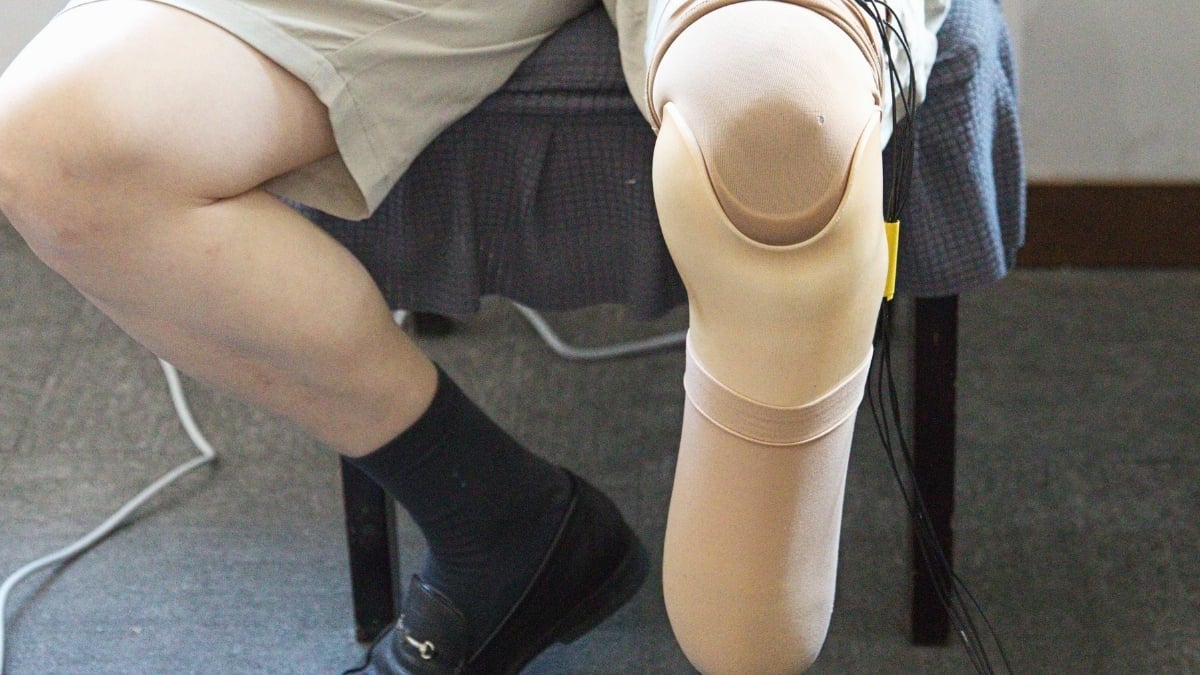
Хятадын эрдэмтэд хиймэл эрхтний улмаас арьсанд ирэх даралтыг хянаж, гэмтэл үүсэх эрсдэлийг эрт илрүүлэх био-мэдрэгчийг бүтээсэн байна.
“Cyborg and Bionic Systems” сэтгүүлд нийтлэгдсэн судалгааны дагуу уг төхөөрөмж нь протезийн хавтас болон хүний арьсны хооронд байрлах “хиймэл арьс” юм. Уг мэдрэгч нь даралтын байршил, хүч болон үргэлжлэх хугацааг хянадаг бөгөөд хоёр төрлийн дохиоллын системтэй. Эхнийх нь даралтын хүч болон байршлыг шууд мэдээлэх бол, хоёр дахь нь даралт хуримтлагдан арьсанд гэмтэл учруулах эрсдэлтэй үед анхааруулга өгөх зарчмаар ажилладаг.
Судлаачид уг төхөөрөмжийг робот гар болон доод мөчөө тайруулсан цөөн тооны оролцогчдын дунд туршжээ. Туршилтын явцад мэдрэгч нь богино хугацааны таагүй мэдрэмжийг 86.4 хувь, удаан хугацааны даралтыг 90.9 хувийн нарийвчлалтайгаар зөв таньсан байна. Мөн гүйх үед үүсэх буруу ачааллыг илрүүлснээр оролцогчид алхаагаа засаж, арьсанд ирэх ачааллыг бууруулах боломжтой болжээ.
Zhejiang University of Technology-ийн механик инженер Huaping Wu-ийн тайлбарласнаар, уг төхөөрөмж нь өвдөлтийг мэдрэх биш, харин өвдөлттэй холбоотой мэдээлэл боловсруулах, даралтын босго тогтоох, санах ойн функц ашиглан гэмтлээс сэргийлэх үүрэгтэй. Гэсэн хэдий ч энэ нь одоогоор утастай прототип бөгөөд цаашид жижигрүүлж, утасгүй систем болгох шаардлагатай байна. Түүнчлэн хөлс, температур болон дахин давтагдах ачааллын үед төхөөрөмжийн тогтвортой байдлыг хангах, илүү өргөн хүрээтэй судалгаа хийх шаардлагатай байгааг судлаачид онцолжээ.
Дэлгэрэнгүйг эх сурвалжаас харах
↓Эх сурвалжийг нээх ↓
A prosthetic limb can help people to stand, walk, or run again. But it cannot always warn them when its socket is pressing too hard against the skin of their residual limb.
That matters because excessive or uneven pressure where a prosthesis meets the body can cause discomfort, inflammation, and ulcers. It can also affect balance and movement.
Scientists in China have now developed a bioinspired sensor that locates pressure and identifies patterns that could signal harm.
Described in a study published in Cyborg and Bionic Systems, the device was tested on a robotic hand and in a small feasibility study involving people with lower-limb amputations.
The prototype is not a complete prosthetic limb. It is a sensor layer designed to sit inside the socket, between the prosthesis and the residual limb. Acting like an artificial skin, it monitors where the socket presses, how hard, and for how long.
Brief, ‘harmless’ pressure is processed as ordinary touch.
But pressure that continues, repeats, or builds across several locations can trigger an early warning that tissue may be at risk.
The sensor uses two complementary pathways. A haptic pathway rapidly reports the location and intensity of pressure. A pain-inspired pathway combines signals over time and across sensing points.
It uses a pressure-sensitive material and synapse-like transistors – electronic components whose responses can change according to signals received previously.
This gives the system a simple form of memory. Following an injury-like input, its warning response becomes more sensitive, so weaker pressure can provoke a stronger response later.
“The device neither feels pain nor creates pain in the user,” senior author Huaping Wu, a mechanical engineer at Zhejiang University of Technology, told ScienceAlert.
“Instead, it reproduces selected information-processing features associated with nociception, including stimulus thresholds, temporal and spatial summation, memory, and sensitization.”
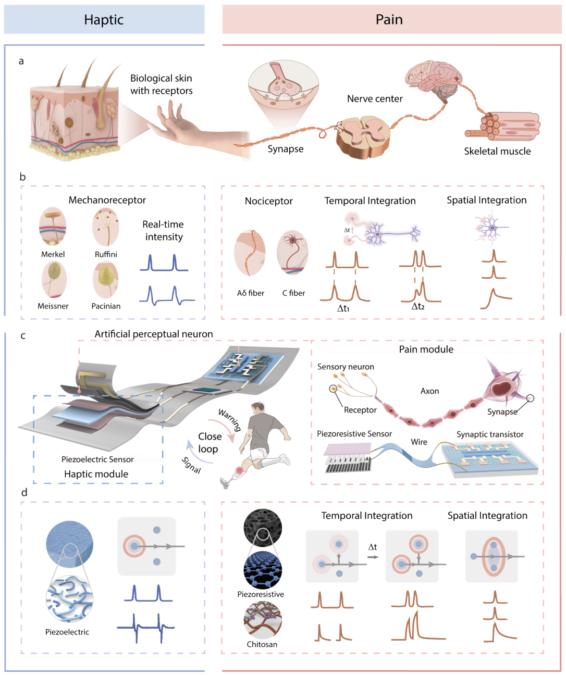
Biological pain is far more complex, involving nerves, the spinal cord, the brain, emotions, and conscious experience. The device produces a functional warning, not pain.
The researchers first placed a four-sensor array on a robotic hand. The system treated 10 kilopascals of pressure applied for 0.21 seconds as harmless. When the same pressure lasted 0.49 seconds, however, the signal accumulated, crossed the warning threshold, and made the hand withdraw.
After this injury-like event, the same pressure caused withdrawal in 0.06 seconds. This imitated the body’s heightened sensitivity after injury, but did not mean the robot remembered consciously or felt pain. Its faster response came from an engineered change in the warning threshold.
The team then fitted sensors inside three participants’ below-the-knee prosthetic sockets and recorded pressure as they sat, walked, climbed stairs, jumped, and ran.
Four sensing points were placed at pressure-prone locations, selected using anatomy and participants’ reports of everyday discomfort.
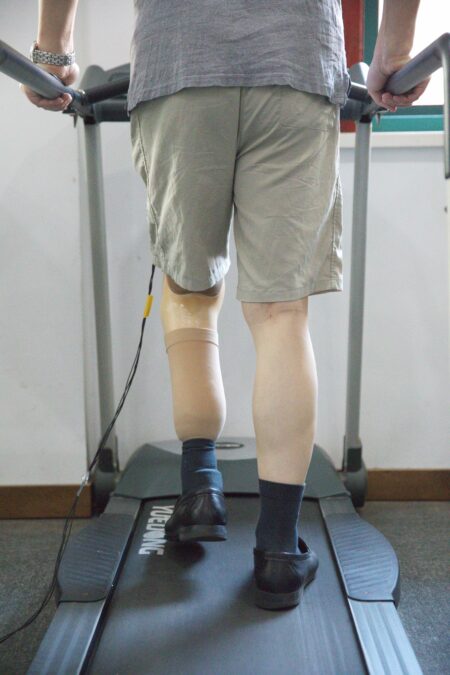
During running, the device detected excessive hip raising to help the prosthetic foot clear the ground. This produced uneven loading and increased pressure at the front of the residual limb. System feedback helped participants adjust their gait and reduce excessive hip movement.
To compare its warnings with human assessments, the researchers used participants’ numerical discomfort ratings and observers’ ratings of facial expressions. Combining signals across space and time correctly identified 86.4 percent of brief discomfort events and 90.9 percent of prolonged ones.
Those figures describe agreement in these tests, not user satisfaction. The paper does not report how long participants wore the system overall or include a satisfaction survey, so it cannot yet show whether users would find it comfortable or practical in daily life.

Other prostheses have restored feedback differently.
A bionic hand connected to a user’s bones, muscles, and nerves provided limited touch, while a sensory prosthetic leg translated pressure beneath an artificial foot into signals sent to nerve endings.
This device instead monitors the hidden interface between the residual limb and socket, where sustained or uneven loading can damage tissue.
Warnings could prompt users to change position, adjust their gait, rest, or have the socket checked. Recorded patterns could also help clinicians personalize socket fitting and gait training.
Related: Paralyzed Man Controls a Robotic Arm With The Power of His Mind
The results remain preliminary, and the wired prototype must be miniaturized into a compact, low-power wireless system.
“Medical-grade protection, secure attachment, and stability under repeated loading, sweat, temperature changes, and socket deformation must also be established,” Wu told ScienceAlert.
Larger and longer studies involving different amputations and socket designs are needed to determine whether the system improves comfort, tissue protection, and rehabilitation.
If it proves reliable, this artificial skin could warn prosthesis users about dangerous pressure before discomfort becomes injury.
The study was published in Cyborg and Bionic Systems.
This article was fact-checked by Rachel Garner and edited by Rebecca Dyer. While we pride ourselves on our process, we are only human. If you spot a mistake, please let us know.

