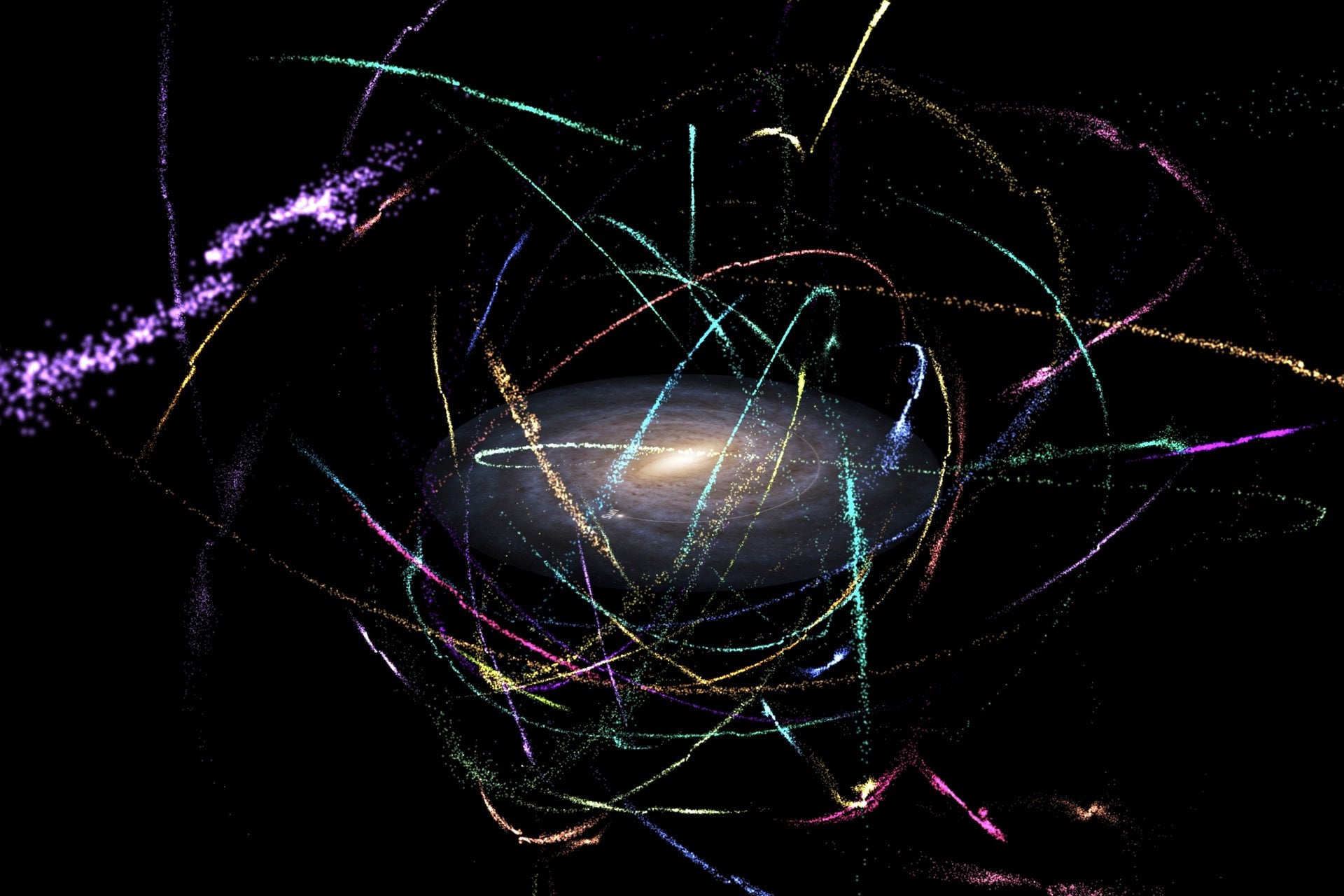
Шинэ компьютер загварчлалаар оддын урсгалд үүсдэг мушгиралт, гажилт нь ердийн материйн нөлөөнөөс үүдэлтэй байж болохыг илрүүлжээ.
Одон орон судлаачид харанхуй материйн шинж чанарыг ойлгохын тулд ихэвчлэн сансрын том бүтэц дэх нөлөөллийг судалдаг. “The Astrophysical Journal” сэтгүүлд нийтлэгдсэн шинэ судалгаагаар манай галактикийн оддын урсгалын зан төлөвийг компьютер загварчлалын тусламжтайгаар судалжээ. Оддын урсгал нь одой галактик эсвэл оддын бөөгнөрөл том галактиктай мөргөлдөх үед үүсдэг бөгөөд тэдгээр нь галактикийн хавтгайгаас гадуур тойрог замаар хөдөлдөг байна.
Судлаачид харанхуй материйг жигд тархалттай гэж үзэн, зөвхөн ердийн материйн харилцан үйлчлэлийг загварчилжээ. Үр дүнд нь ердийн матери дангаараа оддын урсгалд мушгиралт, гажилт үүсгэх чадвартай болох нь тогтоогдсон байна. Энэхүү гажилт нь галактикийн төвтэй ойр орших урсгалуудад илүү хүчтэй ажиглагддаг ч алс хэтэд орших урсгалуудад ч мөн адил өөрчлөлт үүсдэг нь илэрчээ.
Энэхүү олдвор нь Сүүн зам галактикийн урсгалуудад ажиглагддаг гажилт, бөөгнөрөл нь заавал харанхуй материйн нөлөөгөөр үүсдэггүй байж болохыг харуулж байна. Иймд галактикийн дотоод бүтцийн томоохон онцлогийг ашиглан харанхуй материйн тархалтыг судлах боломж хязгаарлагдмал байж болзошгүй юм.
Цаашид Vera Rubin дурангаар хийх ажиглалтууд нь Сүүн зам галактикийн зах хэсэгт орших бүдэг урсгалуудын талаар илүү дэлгэрэнгүй мэдээлэл цуглуулна. Хэрэв эдгээр алсын урсгалуудад хүчтэй гажилт ажиглагдвал, түүнийг харанхуй материйн нөлөөлөл гэж үзэх үндэслэлтэй болно. Одоогоор энэхүү судалгаа нь цаашдын ажиглалт болон бодит байдлыг харьцуулах суурь үзүүлэлтийг бүрдүүлж байна.
Дэлгэрэнгүйг эх сурвалжаас харах
Эх сурвалжийг нээх ↓
Ah, that ever-elusive dark matter. Although there has been some tantalizing evidence suggesting the detection of a dark matter particle, the data isn’t strong enough to be conclusive. So astronomers continue to rely upon indirect evidence and computer simulations to help us understand the detailed properties of dark matter. A new study in The Astrophysical Journal adds to the simulation column, but with a bit of a twist.[^1]
Most dark matter simulations look at large-scale cosmic structure. They simulate how dark matter affects the clustering of galaxies over time. This new study looks at streams of stars in our galaxy instead.
Stellar streams form when a dwarf galaxy or star cluster collides with a larger galaxy. The gravitational interactions cause stars to spray out in streams that then orbit the large galaxy. Most of these streams orbit the galaxy outside the galactic plane, so they are easy to recognize as distinct features. The Milky Way is known to have at least two dozen streams, and we’ve also found several around the Andromeda galaxy.
This new study simulates the behavior of stellar streams around simulated galaxies similar to the Milky Way. Interestingly, it doesn’t simulate the variations of dark matter, only regular matter. In the simulations, dark matter is treated as a simple, uniform halo. The idea is that by understanding how regular matter interacts with stellar streams, we can filter them out to study more subtle dark matter effects.
One of the surprising results is that regular matter can cause kinks and twists within a stellar stream. It was thought that deformations of a stream could be caused by clumps of dark matter within the galactic halo, but this study finds that dark matter isn’t needed to create them. The kinking effect is strongest for streams that orbit closer to the galactic center, but even more distant streams develop deformations. Streams that remain smooth are rare.
The team also found that many of the simulated streams resemble the streams we observe around the Milky Way. The same twists, kinks, and clumps are found in real streams. This means that the large features within Milky Way streams likely can’t be used to study dark matter clumping in our galaxy. But that could change. Observations from the Vera Rubin telescope will capture plenty of data on the faint streams on the edge of the Milky Way. If those show strong deformation effects, that could be due to dark matter interactions.
Overall, this study gives us some good baselines to compare against. As with most studies such as this, we will need more observational data to see where simulation and reality diverge.
Reference: Arora, Arpit, et al. “No Stream Left Unscathed: The imprint of a host galaxy.” The Astrophysical Journal 1008.1 (2026): 91.

