Сансрын уудамд өндөр хурдтайгаар нүүж буй хар нүх нь хоёр хар нүхний мөргөлдөөний улмаас үүссэн таталцлын долгионы хүчээр эх галактикаасаа шидэгдсэн болохыг физикчид илрүүллээ.
2022 оны есдүгээр сард одон орон судлаачид Дэлхийгээс 7.5 тэрбум гэрлийн жилийн зайд орших галактикаас 202,000 гаруй гэрлийн жилийн урттай, оддын мөрийг араасаа татуулан, секундэд 1,000 км орчим хурдтайгаар хөдөлж буй RBH-1 хэмээх содон үзэгдлийг ажиглажээ. Калифорнийн их сургууль, Санта Барбара (UCSB)-ийн одон орон судлаачид Hubble болон James Webb сансрын дурангийн өгөгдлийг ашиглан уг хар нүхний гарал үүслийг мөшгөн судалсан байна.
Судалгааны багийнхан олон зуун мянган хар нүхний хослолыг загварчлан тооцоолсны дүнд RBH-1-ийн хөдөлгөөний хурдтай тохирох хувилбарыг олж тогтоожээ. Үүний үр дүнд, уг хар нүх нь ойролцоогоор 70 сая жилийн өмнө хоёр галактик мөргөлдөх үед тэдгээрийн төвд байсан хоёр супермассив хар нүх нэгдсэний улмаас үүссэн болохыг тогтоосон байна. Мөргөлдсөн хар нүхнүүдийн эргэлтийн тэнхлэг нь хазайсан, жингийн хувьд ялгаатай байсан нь таталцлын долгионыг үүсгэж, улмаар шинээр үүссэн хар нүхийг эх галактикаас нь хөөж гаргах хангалттай хүчийг бий болгожээ.
Энэхүү нээлт нь супермассив хар нүхнүүдийн хувьсал болон галактикийн нэгдлийн талаарх ойлголтыг гүнзгийрүүлж байна. Ерөнхий харьцангуйн онолоор галактик мөргөлдөх үед 5-10 хувьд нь хар нүх ийнхүү шидэгдэх боломжтой гэж таамагладаг байсан ч бодит ажиглалтаар баталгаажуулсан анхны тохиолдол энэ болж байна.
Цаашид энэ төрлийн үзэгдлийг судлах ажил нь хар нүхний нэгдлээс үүсэх бага давтамжтай таталцлын долгионыг илрүүлэх чадвартай LISA зэрэг дараагийн үеийн дуран авайнуудын тусламжтайгаар илүү өргөн хүрээнд үргэлжлэх юм. Эрдэмтэд уг судалгааг Physical Review Letters сэтгүүлд нийтлүүлсэн бөгөөд энэ нь таталцлын долгионы физик болон галактикийн хувьслын холбоог ойлгоход чухал ач холбогдолтой юм.
Дэлгэрэнгүйг эх сурвалжаас харах
Эх сурвалжийг нээх ↓
In September 2022, astronomers observed something very odd in a galaxy around 7.5 billion light-years from Earth. Extending from this galaxy was a thin line stretching more than 202,000 light-years from the galaxy’s center. At the end, there appeared to be an unresolved feature with no stars pushing through intergalactic space at close to 1,000 km/s (620 mi/s), causing new stars to form in its wake. The team named this feature RBH-1 and deduced that it was a supermassive black hole kicked from its galaxy by some violent event.
In a recent study, a team led by astronomers from the University of California, Santa Barbara (UCSB) observed RBH-1 using data from the Hubble Space Telescope and the James Webb Space Telescope. This allowed them to trace the SMBH back to its source and conclude that the black hole merger that produced the SMBH was responsible for its ejection. Their results, published in Physical Review Letters, provide the first account of a violent merger event that could have profound implications for the study of gravitational waves (GWs).
For over a decade, astrophysicists have studied the strong gravitational waves produced by black hole mergers. These waves were originally predicted by Einstein’s Theory of General Relativity, which describes how the merger of massive objects will cause ripples in spacetime that can be detected millions of light-years away. If the black holes are lopsided, the waves produced from a merger can be strong enough to launch the newly formed black hole in a different direction.
Scientists first dismissed the line as an imaging artifact from Hubble’s cameras. But follow-up spectroscopic observations reveal it is a 200,000-light-year-long chain of young blue stars leading back to the galaxy at upper right. Credit: NASA/ESA/Pieter van Dokkum (Yale)/Joseph DePasquale (STScI)
The SMBH in question, known as RBH-1, was previously identified by another team of astronomers, who determined it was a black hole hurtling through intergalactic space. The team led by Tousif Islam, a professor of mathematics at the Kavli Institute for Theoretical Physics (KITP) at UCSB and the paper’s lead author, followed up by tracing RBH-1 back to its point of origin. This involved simulating hundreds of thousands of hypothetical black-hole pairs, then computing the recoil each would have produced.
They then eliminated all simulations that didn’t match the speed of RBH-1. This revealed that the parent black holes were likely similar in mass, with one being (at most) six times as massive as the other. They further concluded that both were spinning very rapidly, and that their spins were misaligned. Lastly, they found that the heavier of the pair was spinning at 70-75% of what General Relativity allows, and that its rotation was tilted and wobbling.
“I was initially surprised by how extreme this sounds, but then I realized it probably had to be the case in order to have produced the dramatic feature visible in telescopes,” Said Tejaswi Venumadhav, an associate professor of physics at UCSB and a co-author of the study. This discovery provides additional insight into the evolution of SMBHs and their respective galaxies.
As Webb’s observations showed not long ago, massive black holes appear to have evolved relatively quickly in the early Universe – less than 1 billion years after the Big Bang. However, by the time RBH-1 was created by the merger of two black holes (7.5 billion years ago), neighboring galaxies would have SMBHs that had already grown through consolidation. This suggests that the event that formed RBH-1 resulted from a merger between two galaxies roughly 70 million years ago, with the two progenitor black holes being located at their centers.
Based on their spins, the team concluded that the galaxies’ rotations were misaligned as well, and that one was larger than the other. As Islam and his colleagues note in their paper, the galaxy (which they named GX) still shows signs of this merger.
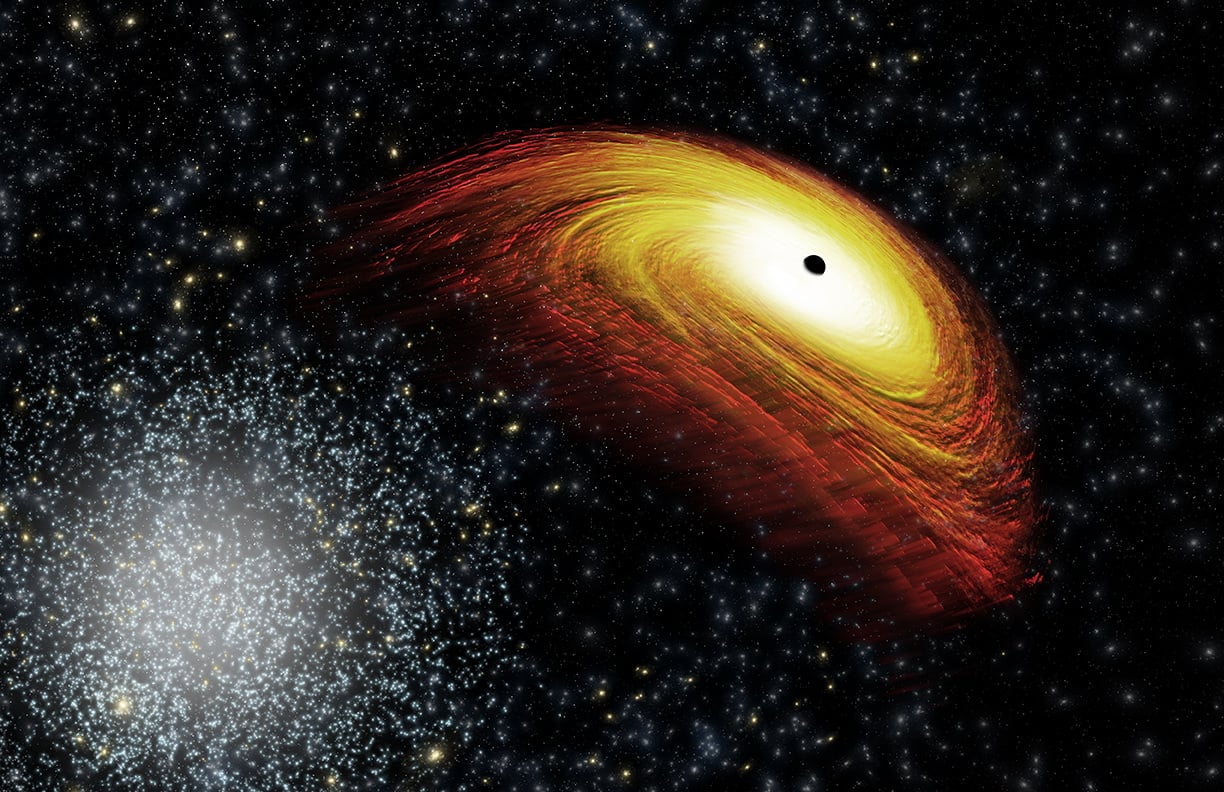 Artistic representation of a supermassive black hole (SMBH) ejected from its host galaxy. Credit: NASA
What’s more, General Relativity predicts that 5-10% of galactic mergers will cause the resulting SMBH to be ejected. While astronomers have predicted these ejections before, this is the first time that scientists have observed the process in action. These results will therefore inform future studies that combine the physics of GWs and the galactic mergers that produce them. This will be challenging since SMBH mergers produce GWs at a much lower frequency than stellar-mass or intermediate-mass black holes.
Efforts to study these larger mergers will benefit from next-generation observatories like the Laser Interferometer Space Antenna (LISA), which will be large enough to detect these low-frequency signals. Combined with the sensitivity of Webb’s observations, scientists stand to learn more about this phenomenon.
Further Reading: UCSB, Physical Review Letters

