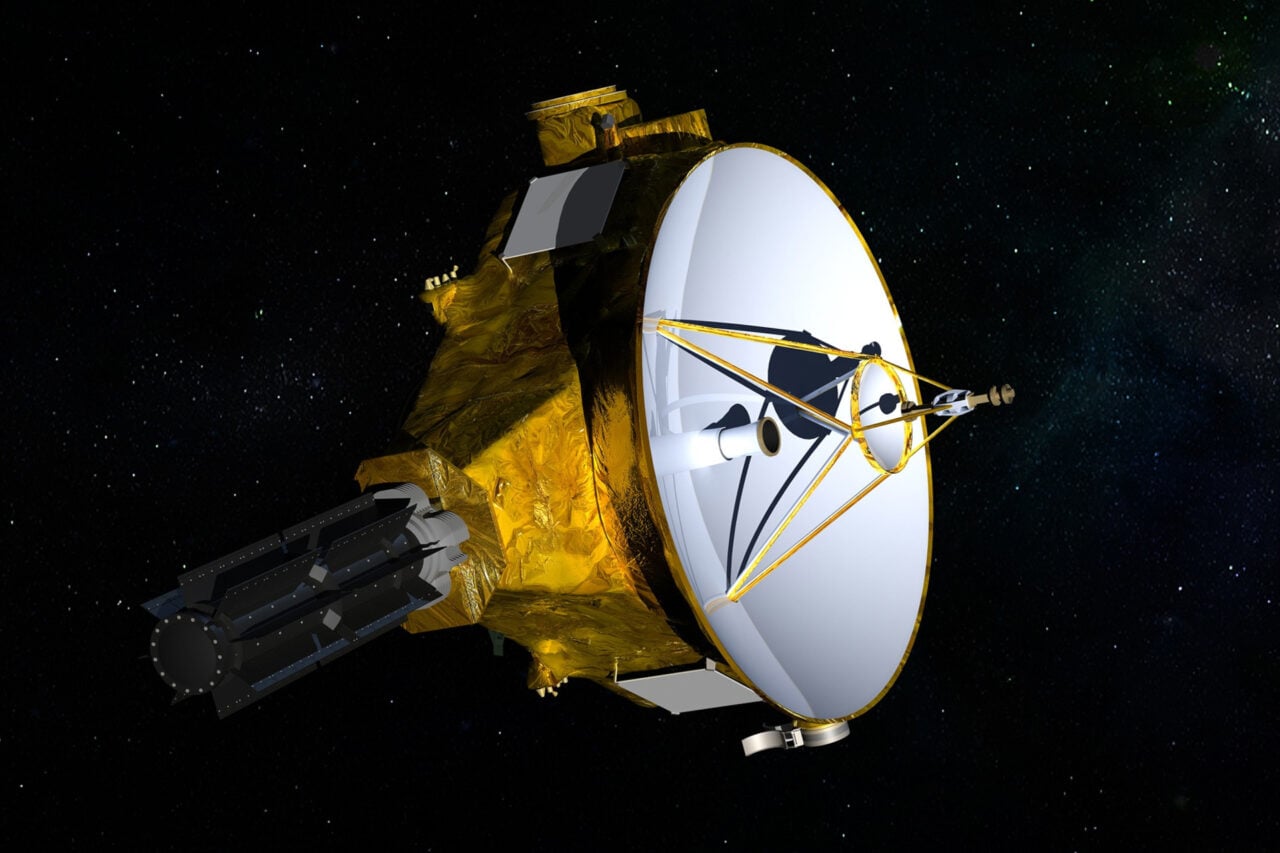
Нарны аймгийн хязгаарыг судлахаар төлөвлөсөн тус хөлгийн чухал хэмжилтүүд санхүүгийн хүндрэлийн улмаас тасалдах эрсдэлтэй тулгарчээ.
Дэлхийгээс 9.7 тэрбум км зайд орших NASA-гийн New Horizons сансрын хөлөг оддын хоорондын орон зайд нэвтрэх чухал үе шатандаа явж байна. Гэвч санхүүжилтийн дутагдлаас шалтгаалан хөлгийн нарны салхи болон бөөмсийн судалгаанд ашигладаг PEPSSI, SWAP хэмээх хоёр гол багажийг ирэх сард багтаан унтраахаас өөр аргагүй нөхцөл байдал үүсээд байна.
Энэхүү хөлөг нь 2006 онд хөөргөгдөж, 2015 онд Далайн ван гаригаас цааш орших Плуто гаригт дөхөн очсон түүхэн амжилтыг тогтоосон юм. Түүнээс хойш Койперийн бүсэд судалгаа хийж буй тус хөлөг 2029-2040 оны хооронд нарны аймгийн хил хязгаараас гарах төлөвтэй байна.
SWAP болон PEPSSI багажууд нь нарны салхины бөөмс болон сансрын туяаны өндөр энергийн ионуудыг хэмжих үүрэгтэй. Эдгээр мэдээлэл нь нарны салхины урсгал огцом саарч, оддын хоорондын материалтай харилцан үйлчлэлцдэг “терминацийн цохилт” (termination shock) зэрэг бүсүүдийн физик шинж чанарыг тайлбарлахад нэн чухал ач холбогдолтой юм.
NASA-гийн Heliophysics Division энэ болон ирэх онд хуваарилах ёстой байсан 2 сая ам.долларын санхүүжилтийг олгоогүй байгаа бөгөөд үүний шалтгаан нь тодорхойгүй байна. Хэдийгээр хөлгийн ерөнхий үйл ажиллагааны зардлыг Planetary Science Division үргэлжлүүлэн хариуцаж байгаа боловч дээрх хоёр багажгүйгээр эрдэмтдийн зорьж буй шинжлэх ухааны чухал үр дүнд хүрэхэд хүндрэлтэй болох юм.
Дэлгэрэнгүйг эх сурвалжаас харах
Эх сурвалжийг нээх ↓
An iconic NASA probe is currently around 6 billion miles (9.7 billion kilometers) away from Earth, returning data from the far reaches of the solar system. New Horizons is set to become the third human-made object to cross into interstellar space, but it may do so without two of its key science instruments.
NASA’s New Horizons mission team may be forced to shut down two particle detectors on the spacecraft due to a lack of funding, Science reported. The mission barely survived proposed budget cuts last year, which almost killed New Horizons entirely. Although the spacecraft remains in perfect health and could operate until 2050, its mission may soon be compromised without its full suite of instruments.
Lights off
New Horizons launched on January 19, 2006, and spent nearly 15 years on a journey toward the far reaches of the solar system (around 50 times farther from the Sun than Earth). The spacecraft was thefirst to visit Pluto in July 2015, conducting the farthest flyby in history.
In 2019, New Horizons approached its next target, abinary objectlater named Arrokoth (which is Native American for “sky”,) the most distant and most primitive object ever explored by a spacecraft. Since then, the probe has been exploring the Kuiper belt, a donut-shaped ring of icy objects that extends just beyond the orbit of Neptune.
The mission is currently preparing to venture outside the solar system and cross into interstellar space. So far, the only spacecraft to have traveled beyond the heliosphere are NASA’s Voyager 1 and 2. A recent study estimated that New Horizons will exit the solar system as early as 2029 or as late as 2040.
Just as it approaches this crucial milestone, two of New Horizons’ particle detectors—the Pluto Energetic Particle Spectrometer Science Investigation (PEPSSI) and Solar Wind Around Pluto (SWAP)—are at risk. NASA has withheld $2 million in funding for the instruments during the past two years, and the mission team is left with no choice but to turn them off by next month, according to Science.
“We just can’t afford to keep the lights on on the heliospheric instruments,” Alan Stern, New Horizons’s principal investigator and a planetary scientist at the Southwest Research Institute, told Science.
New Horizons is funded by different divisions of NASA’s Science Directorate. NASA’s Planetary Science Division continues to provide the core operational budget of approximately $10 million per year, while the agency’s Heliophysics Division has withheld its $2 million annual funding contribution for 2025 and 2026, according to Science. The reason behind withholding the funding is not known.
NASA Administrator Jared Isaacman addressed the issue on X, indicating that the agency is looking into it. “The big dollars were already invested in New Horizons, so generally supportive of generating high-quality scientific returns for low-dollar spend,” Isaacman wrote.
A major loss
The two instruments at risk are extremely vital given what New Horizons is up against.
The Sun sends out a constant flow of charged particles, known as solar wind, which travels past all the planets. This forms a giant, comet-shaped bubble around the solar system, known as the heliosphere. The heliosphere ultimately acts as a giant shield, protecting the solar system from galactic cosmic radiation.
As it continues its journey toward the edge of the solar system, the spacecraft must surpass a large bubble of plasma carved out by the Sun’s wind. The exact boundary of this bubble, however, has yet to be determined.
New Horizons’ first particle detector, SWAP, measures lower-energy particles and plasma in the solar wind, while PEPSSI measures higher-energy ions and electrons, up to 1 MeV, using a time-of-flight sensor.
Scientists have been eagerly waiting for data from New Horizons to help them studythe heliosphere’s outer boundaries, including the termination shock and the heliopause, where the solar wind abruptly slows as it interacts with interstellar material.
“New Horizons is estimated to encounter and cross the heliospheric Termination Shock (TS), where its new measurements will be crucial to uncover the physics at this important boundary. This will be a historical milestone for NASA and the Heliophysics Division,” James Green, NASA’s former chief scientist, wrote in a petition to keep the instruments running. “As the only spacecraft now in the outer heliosphere, New Horizons is therefore an essential element of the Heliophysics System Observatory.”

