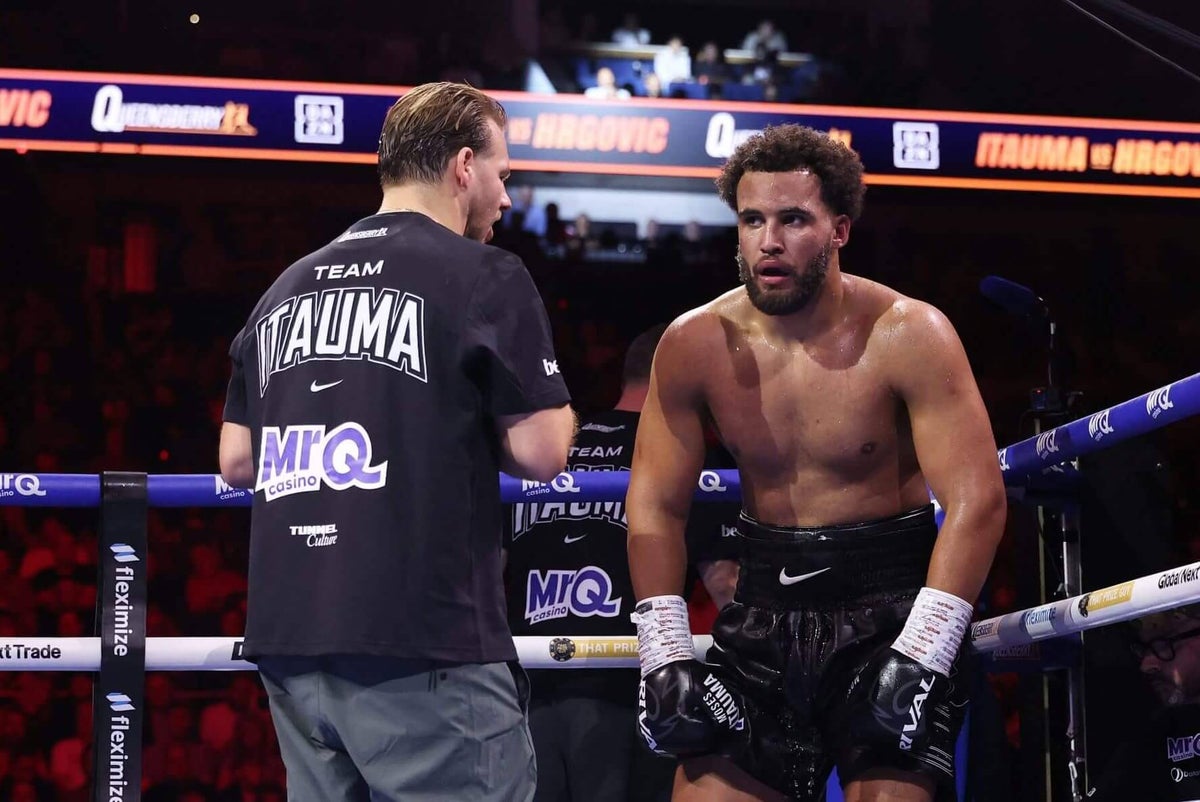
Хүнд жингийн залуу боксчин Мозес Итаума Филип Хрговичтой хийсэн аваргын бүсний төлөөх тулаанд бүрэн ядарч сульдсаны улмаас есдүгээр раундад техникийн нокаутаар ялагдлаа.
Өнгөрсөн бямба гарагт болсон тулааны эхний найман раундын дараа 21 настай Британийн боксчин Мозес Итаума шүүгчдийн оноогоор тэргүүлж байсан ч биеийн хүч нь эрс муудсан байна. Наймдугаар раундад өрсөлдөгчөө дуусгахыг оролдсон боловч Хрговичийн цохилтуудыг тэсвэрлэж, хариу цохилт авснаар Итаумагийн биеийн нөөц шавхагджээ. Есдүгээр раунд эхлэхэд тэрээр хөдөлгөөнөө хянах чадваргүй болж, дасгалжуулагч Бен Дэвисон тулааныг зогсоох шийдвэр гаргасан байна.
Спортын физиологич доктор Эндрю Ашерийн тайлбарласнаар, Итаумагийн биеийн байдал нь боксчдын дунд түгээмэл тохиолддог “нөөцөө бүрэн шавхах” буюу хүчилтөрөгчийн дутагдалд орох үзэгдэл юм. Бусад спортоос ялгаатай нь боксын тулааны үеэр тамирчид зөвхөн ус хэрэглэх боломжтой тул гликогенийн нөөцөө нөхөх боломжгүй байдаг нь энэхүү эрсдэлийг нэмэгдүүлдэг. Ялангуяа тулааны өмнөх хэт их сэтгэл хөдлөл, адреналин нь энергийн зарцуулалтыг хурдасгаж, булчингийн хүчилтөрөгч ашиглах чадварыг бууруулдаг байна.
Энэхүү хэт ядаргаа нь тамирчны танин мэдэхүйн чадварыг сулруулж, тархины гэмтэл авах эрсдэлийг өндөрсгөдөг гэдгийг мэргэжилтнүүд анхааруулж байна. Итаумагийн хувьд тэмцээний өмнөх их дарамт, хэт өндөр хэмнэлээр эхлүүлсэн тулаан нь түүнийг эрт ядрахад хүргэжээ. Тулааны дараа Итаумагийн менежер Фрэнк Уоррен тамирчны сэтгэл зүйн бэлтгэл болон адреналиныг удирдах тал дээр дутагдалтай байсныг хүлээн зөвшөөрсөн байна.
Дэлгэрэнгүй эх сурвалжийг харах
Эх сурвалжийг нээх ↓
After eight rounds of his first world title fight, against Croatia’s Filip Hrgovic last Saturday, Moses Itauma’s legs somehow carried his 241.7lb, 6ft 4in frame back to his corner.
The 21-year-old British heavyweight had the beating of his more experienced opponent – up on all three judges’ scorecards – but he was exhausted. He’d gone for the kill in round eight, unleashing a salvo of punches designed to result in a stoppage. But Hrgovic had soaked them all up and even sent a few back Itauma’s way.
As Itauma sat on his stool, his breathing was fast and heavy. It stayed that way throughout the 60-second break between rounds. As he got to his feet again, he grimaced.
Hrgovic saw his opportunity, and pounced at the start of the ninth round, marching forward and unleashing heavy shots. Itauma retaliated but his body was no longer his own. The punches were wild swings. The force of those that did land had more of an impact on him than his opponent – sending him staggering backwards into the ropes.
Referee Howard Foster intervenes in the Itauma-Hrgovic fight (Richard Pelham/Getty Images)
With 33 seconds of the round remaining, the referee stopped the fight, just as Itauma’s trainer Ben Davison threw in the white towel. Itauma’s bid to become the second-youngest heavyweight champion in history was over. He was carried out of the ring on a stretcher; his body finally succumbing to complete exhaustion.
The diagnosis from seasoned boxing observers was emphatic: Itauma had ‘gassed out’. But what exactly does that mean? What is it that turns the arms and legs of some of the strongest athletes in sport into jelly beyond their control?
“In the world of exercise physiology, you’ve got two components,” explains Dr Andrew Usher, exercise physiologist and British Boxing Board of Control-licensed coach. “You’ve got your heart and lungs, traditionally classed as your aerobic capacity, and the oxidative capacity of your muscles (the maximum rate at which your muscles can use oxygen to produce energy).
“A lot of coaches are training purely for the heart and lungs, thinking that that is going to get them through the fight. But your heart and lungs are only delivering the oxygen to the muscle. The muscle still needs to be able to extract the oxygen.”
If the muscle can’t do that sufficiently during a fight, the boxer will struggle to recover appropriately between rounds, says Usher, and they will start each one in an increasing deficit. “That means things like gross movement skills will start to deteriorate much quicker.”
Usher has conducted research into the physiological demands of boxing and the speed and pattern at which active muscles consume oxygen during physical activity (also called muscle oxygen kinetics). He says that although developing a fighter’s aerobic engine is important, they also need a better way for their muscular system to utilize the oxygen that’s being delivered.
“That has to be trained much more appropriately than it currently is” says Usher. “Especially in big guys like Itauma, who carry a lot of muscle mass – you’re going to have a lot more oxygen debt than a small super bantamweight.”
What sets Itauma apart from most heavyweights is his speed and explosiveness. But that explosiveness becomes expensive if it’s not managed correctly because with every explosion, the muscle is contracting and using oxygen, which it then has to replace.
“For Itauma, that debt is just stacking up and stacking up”, says Usher, “to the point where the muscle can’t extract enough oxygen and it’s not got enough calcium sensitivity so the muscle can’t contract. That’s why you see fighters having to swing the arm because they can’t contract the muscles to put the glenohumeral joint in the right position, to get the hip into the right place – it becomes handbags at dawn. The problem with that is that it burns even more energy.”
There are various ways of training the muscle’s ability to extract and use oxygen. Usher’s preferred method is supramaximal bike sprints as part of a sprint interval training programme. These are short, all-out bursts of exercise performed at an intensity higher than your maximal oxygen uptake (VO₂ max). It can also be done with boxers via targeted and individually tracked intervals on the punchbag.
The purpose of these sessions, says Usher, is to “generate more mitochondria (tiny structures in the cell that generate energy to power cellular functions) in the muscle, so you have a larger oxygen reserve and energy production. At the same time, you’re improving the muscle’s capacity to extract oxygen and, more importantly, to resynthesize it back into the muscle.”
In endurance sports, “bonking” or “hitting the wall” is a widely known danger that can occur when an athlete’s glycogen stores get depleted. Pace, power and various other functions can all suffer as a result.
At the end of the 2019 London Marathon elite runner Hayley Carruthers was approaching the finish line when her legs stopped working. With the help of race marshals, she crawled to an 18th-place finish. “I started counting my steps and my head was gone,” she told the BBC Radio 1 Newsbeat afterwards. “I think I lost sight in one eye. I just couldn’t lift my legs at all. It was petrifying.”

Hayley Carruthers crawls over the finish line at the 2019 London Marathon (Naomi Baker/Getty Images)
Usher says that what happened to Itauma — and there are other examples from heavyweight boxing history, such as Wladimir Klitschko in his first pro defeat against Ross Puritty, or David Haye versus Carl Thompson — is a form of bonking.
The impact of this on a fighter can be devastating, affecting cognitive capacity and increasing the risks of brain trauma. The 60-second window between rounds is a crucial period here, says Usher, and it’s one that’s tricky to manage.
“The bell goes and it could be four to six seconds before that athlete sits down, then you have to look at how they’re sitting – are they closing over the diaphragm or is the diaphragm open? Depending on where you put ice, it could be having an effect or it could be having no effect. And you’re trying to give instructions to that athlete.
“If they’re not recovering until the last three, four seconds of your 60 seconds, everything that’s happened before it is probably not going into their brain.
“Plus, when you’re breathing heavily, you are hyperventilating, so oxygen is not getting to the brain as quickly. That’s when the higher risk of brain trauma and subcutaneous hematomas comes in.”
The reasons why Itauma reached such a point of exhaustion after eight rounds have been debated endlessly since Saturday. For Usher, who was watching the drama play out from his home in Scotland, a couple of factors were clear: the tension with which Itauma entered the ring, and his inability to pace himself.
“There’s been a lot of pressure on that kid,” says Usher, referring to how the fight was framed as Itauma becoming the youngest heavyweight champion since Mike Tyson. “That pressure is going to increase adrenaline levels, so you’re going to start to burn glycogen much quicker than you would normally.”
Usher uses the word “wired” to describe Itauma as he entered the ring – a complete gear change for a fighter whose demeanour had previously been so calm. That can be used to a fighter’s advantage, but Itauma was simply burning through valuable energy stores before the fight had even started.
After the fight, Itauma’s manager Frank Warren acknowledged that Itauma’s adrenaline levels could have been “controlled a bit better pre-fight. Because I think he looked exhausted before he even got in there.”
Usher explains that “stress starts to create a kind of hormonal boiling pot, so you get epinephrine (also called adrenaline) and cortisol levels starting to increase and that all needs energy to facilitate it.
“If you come out wired and you’ve got seven or eight minutes before you actually box, by the time you go through a ring announcement and anthems, you’re already bleeding energy.”

Itauma is on the receiving end of a fearsome punch from Filip Hrgovic (Richard Pelham/Getty Images)
While other sports allow athletes to refuel glycogen stores once competition is under way, boxers are only allowed water, removing any opportunity to restock glycogen as it starts to deplete.
Itauma started fast, taking the centre of the ring and catching Hrgovic with fast, explosive shots to the head and body. By round three, there were signs that his pace was just starting to slow – a result of the dual impact boxing has on the body. “When you think of energy coming out of the body, you’ve got to think about it two ways,” says Usher. “One: heart and lung, and two: from the muscle.
“And the muscle is king because if the muscle can’t get oxygen from the blood supply, it can’t contract, it can’t perform. Effectively, that’s what happened to Itauma. His muscle reached the point where it couldn’t get enough oxygen back in, and at that time the only thing you can do is swing. That’s where efficiency comes in. That’s when it’s a case of: conserve your energy, hold the centre of the ring, just throw out a jab, keep them busy.”
At 21, Itauma has time to learn, train and understand what went wrong last weekend.
“You could give Moses a good engine, but if he drives it around like a Ferrari the way he did in that fight, it’s not going to last too long,” Usher adds. “That’s part of the learning strategy. But at 21, in a huge fight broadcast all over the world, how much goes to your head?”

