АНУ-ын Тэнгисийн цэргийн хүчин түүхэн хугацаанд үүрэг гүйцэтгэхдээ үндсэн байлдааны хөлгүүдээс гадна туршилтын болон тусгай зориулалтын олон арван ер бусын загвартай хөлөг онгоцыг ашиглаж иржээ.
АНУ-ын Тэнгисийн цэргийн хүчин 1775 онд байгуулагдсанаас хойш хуягт хөлөг, цөмийн шумбагч онгоцноос эхлээд тагнуулын болон судалгааны зориулалттай олон төрлийн хөлгийг ашигласан байдаг. Тухайлбал, 1862 онд ашиглалтад орсон “USS Monitor” нь эргэдэг их бууны цамхагтай, усны түвшинтэй бараг зэрэгцсэн тавцантай анхны хуягт хөлөг байсан бол “R/P FLIP” судалгааны платформ нь 90 хэмийн өнцгөөр усанд хагас шумбан босоо байрлалд шилждэг өвөрмөц хийцтэй юм.
Түүнчлэн, Дэлхийн хоёрдугаар дайны үед ашиглаж байсан “USS Wolverine” нь Их нууруудад нисгэгчдийг бэлтгэхэд зориулагдсан, онгоц тээгч хөлөг болгон өөрчилсөн уурын хөдөлгүүртэй хөлөг байв. Харин “USS Echo” хөлөг нь 1892 онд баригдсан модон дарвуулт онгоц байсан хэдий ч Номхон далайд тагнуулчдыг дайсны ар талд хүргэх нууц ажиллагаанд үр дүнтэй ашиглагдаж байжээ.
Зарим хөлөг онгоцны үйл ажиллагаа нь олон улсын дипломат маргаан дагуулсан тохиолдол ч бий. Жишээлбэл, 1968 онд БНАСАУ-ын талд олзлогдсон “USS Pueblo” тагнуулын хөлөг өнөөг хүртэл Пхеньянд музейн үзмэр болон хадгалагдаж байна. Үүнээс гадна, АНУ-ын Тэнгисийн цэргийн хүчин 1974 онд Зөвлөлтийн шумбагч хөлгийг далайн ёроолоос татан авах зорилгоор “USNS Hughes Glomar Explorer” хөлгийг ашиглаж байсан бол, “Sea Shadow” хөлөг нь үл үзэгдэгч технологийн туршилтад гол үүрэг гүйцэтгэж байв.
Орчин цагт цэргийн баазуудын аюулгүй байдлыг хангах зорилгоор ашиглаж буй 19 фут урттай “Boomin’ Beaver” чирэгч хөлгүүд нь АНУ-ын Тэнгисийн цэргийн хүчний хамгийн жижиг хөлгүүдийн нэгд тооцогддог. Эдгээр хөлөг онгоцууд нь хийц загвар болон гүйцэтгэх үүргийн хувьд уламжлалт байлдааны хөлгүүдээс эрс ялгаатай бөгөөд цэргийн технологийн хөгжлийн түүхэнд өвөрмөц байр суурийг эзэлдэг.
Дэлгэрэнгүйг эх сурвалжаас харах
Эх сурвалжийг нээх ↓
Since its inception on October 13, 1775, the United States Navy has utilized all kinds of ships. With everything from wooden 18th-centurySloops-of-War to modern-day supercarriers, the Navy hasn’t suffered from a lack of options. The public has long been aware of what the Navy sails, thanks to movies, museum ships, and news surrounding the latest and greatest warships, but most folks’ knowledge is limited to only a handful of varieties.
If you stop a person on the street, they could probably name aircraft carriers, submarines, destroyers, and cruisers, but that’s likely it. There are hospital ships, littoral combat ships, amphibious vessels, hovercraft (known as Landing Craft, Air Cushion), supply and fuel ships, and many more. While those are all fairly typical of the U.S. Navy and other blue-water navies around the world, there are a few ships the service has used that are, in a word, weird.
These are the vessels that look nothing like those that came before them, including the USS Zumwalt (DDG-1000), which is an unusual-looking new class of guided-missile destroyer. While strange to see, it’s not unique, as there are three in the class. Each of the ships detailed below was weird when it first set sail and all of them remain so, either for how the Navy used them, what they looked like, or how much they differ from other ships operated by the service.
USS Monitor
Whenever a new type of ship enters the fight, it tends to look weird, but when the USS Monitor was launched in 1862, it was unlike anything that preceded it. The Monitor was an ironclad warship sailed by the U.S. Navy, making it the first of its kind commissioned by the service. This was at a time when most naval vessels were wooden-masted affairs, but the Monitor was something else entirely.
While not the first steam-powered ship, the Monitor, which went on to fight the CSS Virginia in 1862, had several innovative designs that made it outclass every wooden ship in the Confederate States Navy. Most notable was how its deck barely scratched the surface of the water, leaving little more than its revolving turret exposed. This made the Monitor look something like a submarine, though it was a surface ship.
The gun turret held two 15-inch smoothbore Dahlgren guns, enabling firing in all directions without relying on the tried and true method of broadside attacks. The ship’s armor also made it unusual, as it featured significant iron plating on the deck, around the pilot house, along the waterline belt, and surrounding the gun turret. The USS Monitor sank in 1862, but not from enemy action. It succumbed to a storm off the coast of Cape Hatteras, North Carolina, where it remains submerged as the nation’s first national marine sanctuary.
USS Reina Mercedes (IX-25)
The USS Reina Mercedes (IX-25) was unusual in how it served and the manner in which it was used throughout its time above water. The vessel was initially a Spanish cruiser that the U.S. Navy captured in Cuba in 1898 during the Spanish-American War. The Navy returned the vessel to the surface after Spain deliberately sank it and refurbished it to function in a variety of roles.
First, the Reina Mercedes functioned as a station ship, eventually finding its way to Annapolis, Maryland, where it remained moored. The nearby United States Naval Academy used the ship, not for training, but as an unofficial brig. Between 1912 and 1940, the Academy sent its cadets to the Reina Mercedes as a form of punishment, where they would billet for up to two months while still attending drills and their studies.
After 1940, the vessel transitioned into a proper floating barracks for enlisted personnel assigned to the Naval Academy. For years, the Reina Mercedes was known as “The fastest ship in the Navy” because it was tied fast to her home in Annapolis. In 1957, the Navy scrapped the Reina Mercedes, as the Board of Inspection and Survey found that it was no longer fit for service. The former Spanish ship was sold to a scrap company in Baltimore, Maryland, and its bell was returned to Spain.
USS Wolverine (IX-64)
One of the weirdest ships used by the Navy wasn’t strange because of what it was; rather, it was weird because of where it was placed. The USS Wolverine (IX-64) started life as the Seeandbee, a sidewheel steamer that operated on the Great Lakes, where it served in that capacity from 1912 until 1941. The Navy acquired the ship in 1942 and converted it into an aircraft carrier, but not one that would be used to fight during World War II.
Instead, the USS Wolverine, as it was renamed, was tasked with training naval aviators. Instead of potentially exposing it to the dangers of German U-boats, the ship remained at Navy Pier in Chicago, Illinois, where aviators practiced takeoff and landing procedures on a flattop. The Wolverine had a sister ship, the USS Sable (IX-81), which also started life as a sidewheel steamboat. The Navy used both vessels extensively, but they weren’t real aircraft carriers; they lacked hangars and elevators, somewhat limiting daily operations.
Regardless, the Wolverine helped qualify over 18,000 naval aviators who would go on to fight throughout WWII. After the war ended, the Navy decommissioned the USS Wolverine and sold it for scrap. While the ship was certainly practical and necessary during the war, it was undoubtedly weird, especially when compared to other contemporary aircraft carriers, which were completely different and not limited to freshwater.
USS Echo (IX-95)
Throughout WWII, the Navy used all kinds of vessels, building Liberty ships at impossible speed while using unconventional vessels for practical purposes. One such ship was the USS Echo (IX-95), a two-masted scow built in 1892 that was loaned to the U.S. from New Zealand. The Navy commissioned it in 1942, and the USS Echo began sailing as a U.S. Army supply ship for the next two years.
What’s weird about the USS Echo is that it functioned as an active warship, carrying supplies throughout the Pacific, but the ship was constructed 50 years prior and looked nothing like what was in use at the time. This likely benefited the Echo and its crew because, while Japan wasn’t unwilling to target what appeared to be a civilian vessel, Imperial Japanese Navy officers probably wouldn’t have bothered to expend the ammunition.
After all, the Echo was a wooden sailing ship built the previous century, so it would have been inconceivable that it served the ongoing war effort. To this end, the Echo’s commander, Lt. Meredith “Rip” Riddle, snuck through heavily patrolled Japanese waters to place coastal observers behind enemy lines in the South Pacific. The Navy decommissioned the Echo in 1944 and returned it to New Zealand. The story of the USS Echo and its unusual mission was made into a film, “The Wackiest Ship in the Army.”
USS Pueblo (AGER-2)
The USS Pueblo (AGER-2) isn’t a weird ship; at least, it’s not weird because of how it looks or how the U.S. Navy utilized it. The Pueblo is a Banner-class technical research ship that launched during WWII. After the conflict, the Pueblo gathered intelligence wherever it sailed, and in January 1968, a Democratic People’s Republic of Korea (DPRK) ship found the Pueblo in the Sea of Japan, attacked, and captured it in what is now known as the “Pueblo Incident.”
The attack caused widespread diplomatic upheaval in the region, in which the U.S. was actively fighting a war in Vietnam. One sailor died in the attack, while the remaining 82 were taken prisoner. They remained in captivity for 11 months, enduring torture and harsh treatment throughout, resulting in an eventual lawsuit. The sailors were eventually repatriated, but the DPRK never gave back the Pueblo, which is why it sways into weird territory.
The USS Pueblo, which remains on the Naval Vessel Register as active, now resides in a permanent mooring in the Pothonggang Canal in Pyongyang as part of the Victorious Fatherland Liberation War Museum. Museum ships aren’t weird, but this one certainly is due to how it’s displayed. It’s now loaded with DPRK propaganda and is open to visitors who want to see the only U.S. Navy ship held in enemy hands that remains active.
R/P FLIP
One of the weirdest ships sailed by the U.S. Office of Naval Research (ONR) is the R/P FLIP, which stands for research platform floating instrument platform. The vessel stretches 355 feet in length, but when it does its thing, only 55 feet can be seen above the water. That’s because the R/P Flip was designed to semi-submerge, pitching itself backward at a 90-degree angle. What remains sticks out of the water, looking like an odd platform, as you can see in this video:
The R/P FLIP accomplishes this by purposefully flooding its ballast tanks in certain areas, which allows 300 feet of the ship to submerge. To undo the action, the R/P FLIP pushes compressed air into the ballast tanks, causing the stern of the ship to rise. Outside of this unusual activity, the R/P FLIP has no propulsion system of its own and must be towed to and from wherever it needs to do its thing, which enables research.
The vessel was primarily used to study acoustic signals, changes in water density, water turbulence, different temperatures, wave heights, meteorological data, and more. The ONR used the R/P FLIP from 1962 until 2023, and it was sold the following year to the DEEP organization for continued research use and potential underwater human habitat construction after a modernization program that is still ongoing as of writing.
Baylander (IX-514)
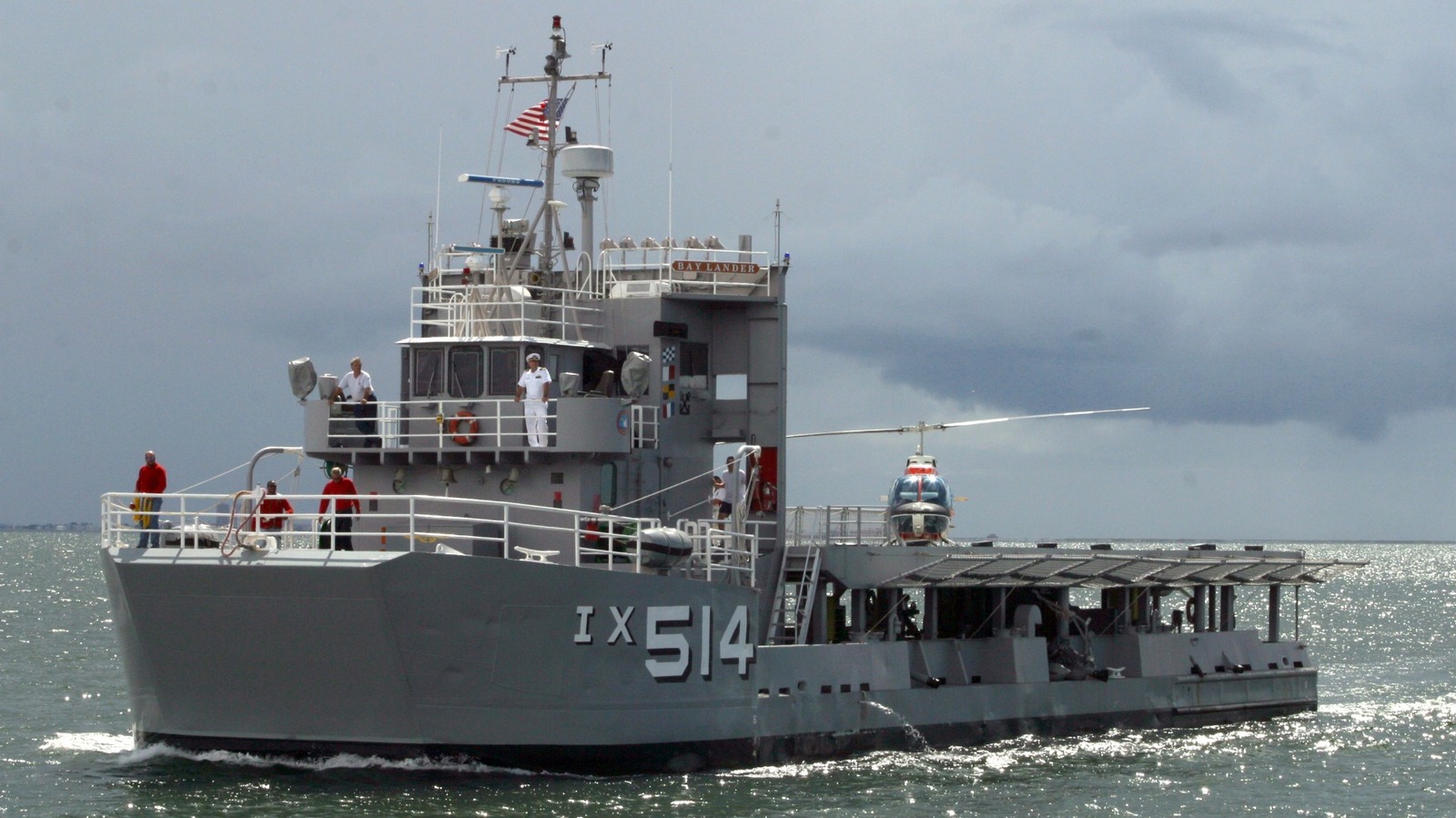
If there’s one thing everyone can agree on, it’s that aircraft carriers are massive vessels. The interesting thing is that they don’t have to be; case in point, the Baylander (IX-514), known as the world’s smallest aircraft carrier. The Baylander began operating for the Navy in 1968 as a harbor utility craft during the Vietnam War. In 1986, the Navy reconfigured the Baylander as a Helicopter Landing Trainer, transforming it into a tiny flattop.
Helicopters can land on just about anything, including water if they have pontoon skids. They don’t require much space, which worked well for the Baylander, as its deck was relatively small. While choppers can land on any flat surface, putting one down on a moving carrier’s flight deck is considerably more challenging. Often, a carrier is in motion, requiring the pilot to carefully time their landing, so the Baylander proved vital in training for that purpose.
For 25 years, more than 122,000 landings helped helicopter pilots learn to land on carriers, thanks to the Baylander. The Navy decommissioned and sold the Baylander at auction in 2012. It was subsequently moored on the Hudson River at 125th St. West Harlem Piers Park, where it operates as one of the most unique locations in the Big Apple. You can visit the Baylander, where you’ll find a small museum detailing the ship’s history, a bar, and a restaurant.
USS Plainview (AGEH-1)
The Navy has used numerous types of propulsion systems over the centuries, and one of the weirdest came in the form of the USS Plainview’s (AGEH-1) hydrofoil. A hydrofoil is a wing-like structure set beneath a vessel that lifts it out of the water when pushed to high speed, and that’s precisely how the Plainview moved. The 315-ton ship is the world’s largest hydrofoil, which was commissioned in 1969.
If you happened to see the Plainview just sitting on the water, it didn’t look weird at all, though its makeup isn’t comparable to something like a destroyer. As the Navy’s second hydrofoil ship, the Plainview was something of an experiment. It was powered by two General Electric LM1500 free-turbine turboshaft engines, a derivative of the engine used to power the F-4 Phantom. This gave it the power it needed to speed along at an impressive 57.5 mph with the entire hull lifted out of the water.
Seeing it in action certainly let the Plainview cross over into weird territory. The ship was used to test the design and benefits of hydrofoils before it was decommissioned in 1978 and sold for scrap. The ship currently resides on private property, where it sits atop a mudflat on the Columbia River near Astoria, Oregon. It now poses a potential environmental risk to the area, as its condition could further deteriorate, leaking toxic pollutants into the water.
NR-1
U.S. Navy/Wikimedia Commons
Back in 1969, the U.S. Navy launched a highly classified nuclear-powered submarine designated NR-1. Known as the Nerwin by its sailors, the boat was the smallest nuclear submarine ever made, and its primary purpose was finding and collecting objects on the ocean bottom in deep seas. In this capacity, the NR-1 was used to find lost missiles and sensitive equipment that the Navy couldn’t afford to have fall into Soviet hands.
After the Challenger disaster in 1986, the NR-1 was used to locate pieces of the space shuttle. It also explored famous shipwrecks, including the HMHS Britannic, which was a sister ship of the infamous RMS Titanic. What made the NR-1 weird was its size and the fact that it was nuclear-powered, while weighing only 400 tons. It measured 147 feet, 8 inches in length and could achieve a maximum submerged speed of 4 mph.
The NR-1 was crewed by only 11 personnel, some of whom were scientists, so it was tiny, though not a U.S.-operated midget submarine like the X-1. It operated from 1969 until 2008, conducting various kinds of research, thanks to its ability to descend 3,000 feet. Once on the bottom, it could roll along the seafloor with its wheels, and thanks to its nuclear reactor, it could remain submerged for up to 30 days. The Navy deactivated NR-1 in November 2008 and transferred it to be scrapped.
USNS Hughes Glomar Explorer (T-AG-193)
While the USNS Hughes Glomar Explorer (T-AG-193) isn’t weird to look at, seeing as it’s a rather standard-looking deep-sea drillship platform, its mission was certainly unusual. The Explorer was built for Project Azorian, which was a classified mission led by the CIA’s Special Activities Division to recover the K-129, a sunken Soviet submarine. None other than Howard Hughes himself directed the vessel’s construction.
K-129 was lost and settled at a depth of 16,500 feet in the Pacific Ocean, about 1,795 miles northwest of Hawaii. The CIA wanted to get their hands on the wreck, as it was a ballistic missile submarine that held Soviet secrets. The recovery operation launched in 1974, and the Explorer’s unique design made it look like a commercial deep-sea drilling platform, but it was something entirely different underwater. Below the surface, the ship featured an elaborate system that functioned somewhat like a toy crane machine.
Once the K-129 was located, the Explorer lowered the device and recovered around one-third of K-129 after a mechanical failure resulted in the loss of the rest of the wreckage. After the CIA was done with it, the Explorer entered the Naval Reserve Fleet in Suisun Bay, California. Finally, the Explorer was retrofitted into a real deep-sea drill ship. After several years of operation for one company or another, the renamed GSF Explorer was scrapped in 2015.
Sea Shadow (IX-529)
Ships have taken great strides in the art of camouflage and stealth, including the Dazzle camouflage of World War I. Stealth is a challenge for naval vessels because they’re constantly in contact with the water, which is why the Navy tested out the Sea Shadow (IX-529) in 1985. The jet-inspired experimental stealth ship was built in secret by theDefense Advanced Research Projects Agency (DARPA), and it certainly looks weird when compared to everything else on the water.
The design goal was to limit the radar signature using unusual hull configurations, and it leaned into automation to limit the size of the crew. The ship’s complement required only four personnel, which is far fewer than most 563-ton Navy vessels. The odd shape included a submerged twin-hull design, each featuring a propeller and hydrofoil. Two angled struts connected the hull to the above-water portion.
While the Navy tested the Sea Shadow, it never commissioned it into the Naval Vessel Register. Also, while it was completed in 1984, it wasn’t unveiled to the public until 1993, which gave the Navy plenty of time to utilize the unusual ship. The Sea Shadow joined the Suisun Bay Reserve Fleet in 2006, and the Navy sold it for scrap in 2012. Its design helped inform the shape and structure of Zumwalt-class ships despite never moving out of the testing phase and into the active inventory.
19BB: Boomin’ Beavers
The Navy is well known for its big ships, and most are incredibly large, but what about the Navy’s smallest vessel? That would be the 19BB, better known as the Boomin’ Beaver. Boomin’ Beavers are small but mighty tugboats used by the Navy, and they look as odd as you’d expect, given their size. The security tug is designed and used to set up and maintain floating underwater Port Security Barrier buoys around Navy assets.
Think of Port Security Barriers as the Navy’s version of a bollard — it protects the Navy’s ships, ports, and bases, and the Boomin’ Beavers ensure they’re placed and maintained. Boomin’ Beavers first arose in the 1980s, and in 2002, the Navy ordered 13 at a cost of just over $2.3 million. Each Boomin’ Beaver measures 19 feet long and 10 feet wide.
In order to produce 7,500 lbs. of pulling power, each Boomin’ Beaver is equipped with a turbocharged 5.9-liter, in-line 6-cylinder, 260 horsepower Cummins 6BTA5.9 diesel engine. As of 2020, the Navy operated 10 Boomin’ Beavers, though it’s unclear how many are in service as of writing. One Boomin’ Beaver popped up on the government auction site, GSA Auctions, where it sat with six bidders and a top bid of $186,700, so if you want one of these tugs, you might be able to buy one for yourself.


Өвөрмөц хийцтэй хөлөг онгоцуудын тухай уншаад их сонирхолтой санагдлаа, та ямар нэгэн хөлгийг бодит амьдралдаа үзэж байсан уу? Тэгвэл эдгээр онцгой загварууд ямар нэгэн шинэ ойлголт өгсөн үү?