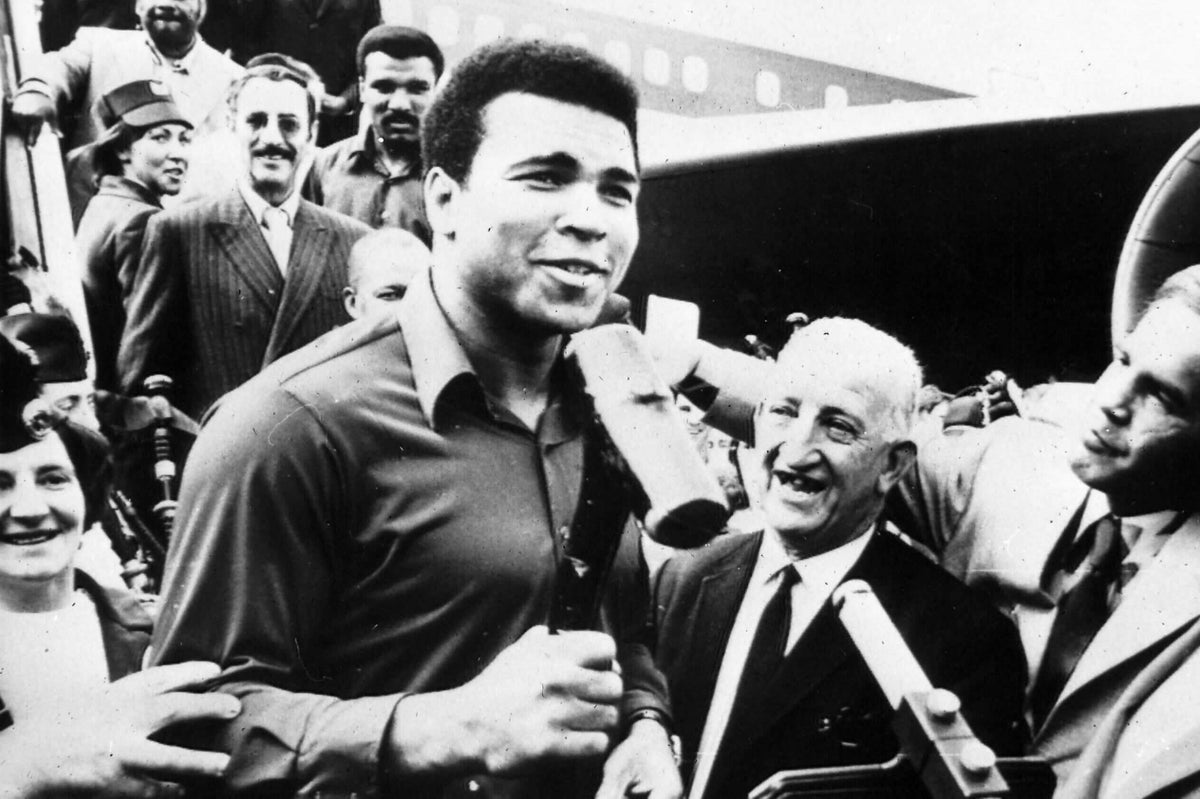
Кэти Тейлор карьераа өндөрлөх тулаанаа хийх гэж буй Кроук Парк цэнгэлдэх хүрээлэн нь 1972 онд Мухаммед Али, Эл Льюис нарын тулааныг хүлээн авч байсан түүхтэй.
1972 оны долдугаар сарын 19-нд болсон Мухаммед Али болон Эл Льюис нарын тулаан эхлэхээс өмнө бээлий дутагдсаны улмаас товлосон хугацаанаасаа хоцорч эхэлж байв. Лондоноос яаралтай нисгэсэн бээлий ирснээр тулаан амжилттай болж, Али 11 дүгээр раундад өрсөлдөгчөө техникийн нокаутаар буулган авсан юм. Тухайн үед 82,000 хүний суудалтай цэнгэлдэхэд 18,000 тасалбар зарагдсан ч олон мянган хөгжөөн дэмжигчид хашаа даван орж ирсэн гэдэг.
Али Ирландад байх хугацаандаа орон нутгийн соёлтой танилцаж, хөрлинг спортоор хичээллэж, улс төрийн зүтгэлтнүүдтэй уулзалт хийж байв. Түүний менежер асан Жин Килройн дурссанаар, Али тухайн үед ханиадтай байсан хэдий ч промоутеруудын зардал болон үзэгчдийг хүндэтгэн тулааныг цуцлаагүй аж.
Өнөөдөр Кэти Тейлор болон Флора Пили нарын тулаан болох гэж буй нь Кроук Парк дахь боксын спортын түүхийг дахин сэргээж байна. Алигийн 1972 оны айлчлал нь Ирландын боксын түүхэнд тод мөр үлдээсэн бөгөөд хожим нь тэрээр 2003 болон 2009 онд Ирландад дахин зочилсон байдаг.
Дэлгэрэнгүй эх сурвалжийг харах
Эх сурвалжийг нээх ↓
It was nearing lunchtime in Dublin on July 19, 1972. The boxers had all weighed in, and the ring — acquired from an amateur boxing club in the town of Edenderry – had been erected.
Muhammad Ali was going to take on Al ‘Blue’ Lewis at Croke Park, a venue more famous as the home of Gaelic games but now hosting a major boxing match for the first time in its storied history.
Both men were shortly due to be ferried to the stadium from their hotels when a pertinent question was raised: Where were the gloves?
A rather essential part of a fight night was nowhere to be seen. Nobody had sorted them. And, to make matters worse, there were no gloves of sufficient quality anywhere to be found in the Irish capital.
A call had to be made to London, to the headquarters of the British Boxing Board of Control, to see if they had any lying around. They were in luck. The gloves were sent immediately to the airport to be flown to Dublin.
The fight started late, but Croke Park did ultimately get its big night with Muhammad Ali.
Muhammad Ali in action against Al ‘Blue’ Lewis in July 1972 (Don Morley/Allsport/Getty Images)
The 82,000-capacity stadium has not hosted a bout since, but today Katie Taylor brings down the curtain on her remarkable career by following in the footsteps of Ali when she takes on Flora Pili of France.
It will be an emotional night, and a fitting send-off for a woman who has changed the face of her sport, but it will need to be very special to eclipse Croke Park’s previous dalliance with boxing in the week Ireland and Muhammad Ali enjoyed a whirlwind romance.
It was at an Irish pub in Shepherd’s Bush, west London, where the first discussions took place about bringing the most famous sportsmen on the planet to Ireland for a fight.
In his book, The Big Fight: When Ali Conquered Ireland, Dave Hannigan writes about how Kerry-born Michael ‘Butty’ Sugrue, a circus strongman and London publican, met with Ali’s promoter, Harold Conrad.
Conrad had dealt with many people who thought they could bring Ali to their country or city. Initially, he felt Sugrue was another man making promises he couldn’t deliver.
However, Ali was not averse to boxing abroad. He was in the middle of rebuilding his career after his defeat by Joe Frazier and chasing a rematch with his great foe. At 30, he had lost just once but this was before ‘The Rumble in the Jungle’ and ‘The Thrilla in Manilla’, and his reputation in the U.S. was bruised by his refusal to be drafted into the military for the Vietnam War.
In the end, the deal got done: Sugrue put up $300,000 to secure Ali, and on July 11, the US fighter arrived on Irish soil. He was handed a shillelagh – a traditional walking stick also used for fighting – and his Eire love affair began.

Michael ‘Butty’ Sugrue paid Ali $300,000 to come to Ireland (Evening Standard/Hulton Archive/Getty Images)
“Muhammad couldn’t wait to get to Ireland,” Gene Kilroy, Ali’s former business manager, nicknamed ‘The Facilitator’, tells The Athletic from his home in Las Vegas. “His great-grandfather was a man called Abe Grady (who hailed from Ennis in County Clare before emigrating to the U.S.), so he thought it was special.
“I got some of the team to wear green jackets when we stepped off the plane. That was my idea and the people loved it.”
Ali stayed and trained at a hotel in a remote rural spot near the Wicklow Mountains, outside Dublin. “He didn’t really like it up there,” says Kilroy. “He wanted to be in the centre of the action.”
Ali was much happier at the Gresham Hotel in the city centre. Crowds would gather in the lobby, hoping to catch a glimpse of ‘The Greatest’, while journalists camped out every day in the hope of securing stories.
The week was full of trademark Ali PR stunts: a training session in a Gaelic handball alley – similar to a squash court – and a meeting at Leinster House, the home of the Irish parliament, with Jack Lynch, the then Taoiseach (Irish prime minister).
Ali made a point of visiting Dublin’s General Post Office, the hub of the 1916 Easter Uprising against British rule, and asked for a meeting with Bernadette Devlin, an Irish civil rights leader and politician. “He insisted on it,” recalls Kilroy. “He was so interested in Irish politics.”
Ali also did an extraordinary interview with Irish broadcaster RTE during the week before the fight, sitting down for 45 minutes with presenter Cathal O’Shannon to discuss race, politics, civil rights and boxing. The notion of a fighter doing something similar nowadays is unthinkable.
As the years have passed, the number of (possibly apocryphal) tales about Ali’s time in Dublin has flourished — from how he dropped in to people’s homes to enjoy tea with the ladies of the house to him having drinks in pubs around the city.
“We ate in a restaurant called Quinns a few times,” says Kilroy. “The people were so kind in there and generous. When he walked around, the people loved him.”

Crowds descend to catch a glimpse of Ali in Dublin (Independent News and Media/Getty Images)
One event which cannot be disputed was the day Ali tried his hand at hurling. Eddie Keher, a six-time All-Ireland winner with Kilkenny, was at work in Dublin when he got a call asking him to meet with Ali.
“I was looking at him star-struck,” said Keher, in 2012 documentary When Ali Came to Ireland. “He said, ‘You play hurling, that’s a very dangerous game’. I saw he was an ordinary guy. We went out to the press and I showed him the various skills attached to hurling; we had good fun.
“He came up close to me then and said, ‘We will put a show on for these guys’. He raised the hurl and I thought he was going to poleaxe me. That was when I saw the showman.”
Even other boxers were in awe. Paddy Doherty was on the undercard that night. He was supposed to be out before Ali’s fight with Lewis, but the glove delay caused a reshuffle, something which worked to his advantage.
“The whole week was crazy,” Doherty tells The Athletic. “There was security around Ali at all times. But I got to meet him in the dressing room at Croke Park. It was a special moment. Then, when I was heading out to the ring, Ali was coming back and gave me a tap on the head as good luck.”
The only disappointment that week was the attendance at Croke Park for the fight. Just 18,000 tickets were sold. Some felt prices were too expensive, while Hannigan wondered if the availability of Ali to people during the build-up meant many punters felt they had already got their piece of the star.
Yet there were many more people inside the stadium than the official attendance figure suggested. Thousands climbed the walls at the Hill 16 terrace at one end of the ground just before Ali was due to emerge.
“People had told me all week they were coming but when I asked them how much they paid for tickets, they just said ‘We won’t be paying but we will be there’,” says Kilroy. “I liked that!”
Those who did make it inside were not treated to a thriller. Ali was some way short of his best, but knocked Lewis down in the fifth and stopped him in the 11th. Fans still invaded the ring at the end to get close to ‘The Greatest’.
“Muhammad had a cold in the build-up,” says Kilroy. “He thought about pulling out and delaying it, but then he knew how much it had all cost the promoters so he didn’t want to. There were so many people in the ring at the end, I thought it was going to collapse.”
Ali eventually fought his way through the crowd and back to the dressing room to meet the press. He gave an honest assessment of his performance and then headed for the hotel. He left the next day for home.
Ali never fought again in Ireland — although he did return to the country twice: in 2003, to attend the Special Olympics, and again in 2009 to trace his family roots in Co. Clare. But the impact of his first visit still resonates with many.

Ali attends the Special Olympics opening ceremony after-party in 2003, with singer Sinead O’Connor in the background (ShowBizIreland.com/Getty Images)
One such person is Brian Peters, Katie Taylor’s manager and one of the biggest figures in Irish boxing, who played a crucial role in making this weekend’s fight at Croke Park happen.
In April 1992 Peters was in East Rutherford, New Jersey, to watch Irish middleweight Steve Collins fight Reggie Johnson. He found out Ali was in town and went to the hotel where the boxing icon was staying.
By chance, one of Ali’s entourage was at the reception desk when Peters was loitering. After finding out where Ali was located, Peters snuck into the hotel kitchen, got a cheesecake and some milk, and made his way to Room 770.
“So, I knock on the door, and say ‘Room service’,” Peters tells The Athletic. “This big f***ing man, never seen a man as big as him, blocked out the sky, opens the door, and he says, ‘I didn’t order no room service.’
“So, I kind of edge in with my shoulder, push the door open, your man is standing there looking at me, giving me evils, and there’s Ali lying on the couch — hands behind the head, kind of one foot in the ground, looking at me a bit perplexed.
“I said, ‘Look, Mr. Muhammad, Mr. Ali, sorry, not sure what to call you, Mr. Muhammad Ali… I just wanted to meet yourself, and sorry for the way I had to do it. So I went in, told him the story, and he thought it was hilarious, brilliant.
“We had some craic. We started talking about that week in Dublin and he says, ‘I think I was the only black man in Ireland. People are coming up, they’re looking at me and they’re touching me.’ And he might have been right in 1972.
“And I always remember him saying, ‘That show lost a lot of money. I don’t know if I got fully paid. I don’t think I did.’”


Мухаммед Алигийн Ирландад хийсэн аялал түүхэнд нэрлэгдсэн бөгөөд түүний ирсэн нь хэзээ ч мартагдахааргүй сайхан дурсамжууд үлдээжээ. Тэр эхлээд ирланд соёлд шимтэн оролцож, спортын хөгжөөн дэмжигчидтэй хамт байж байсан нь сонирхол татам. Харин түүний ирсэн тухай ямар нэгэн сонирхолтой зүйл санагддаг уу?