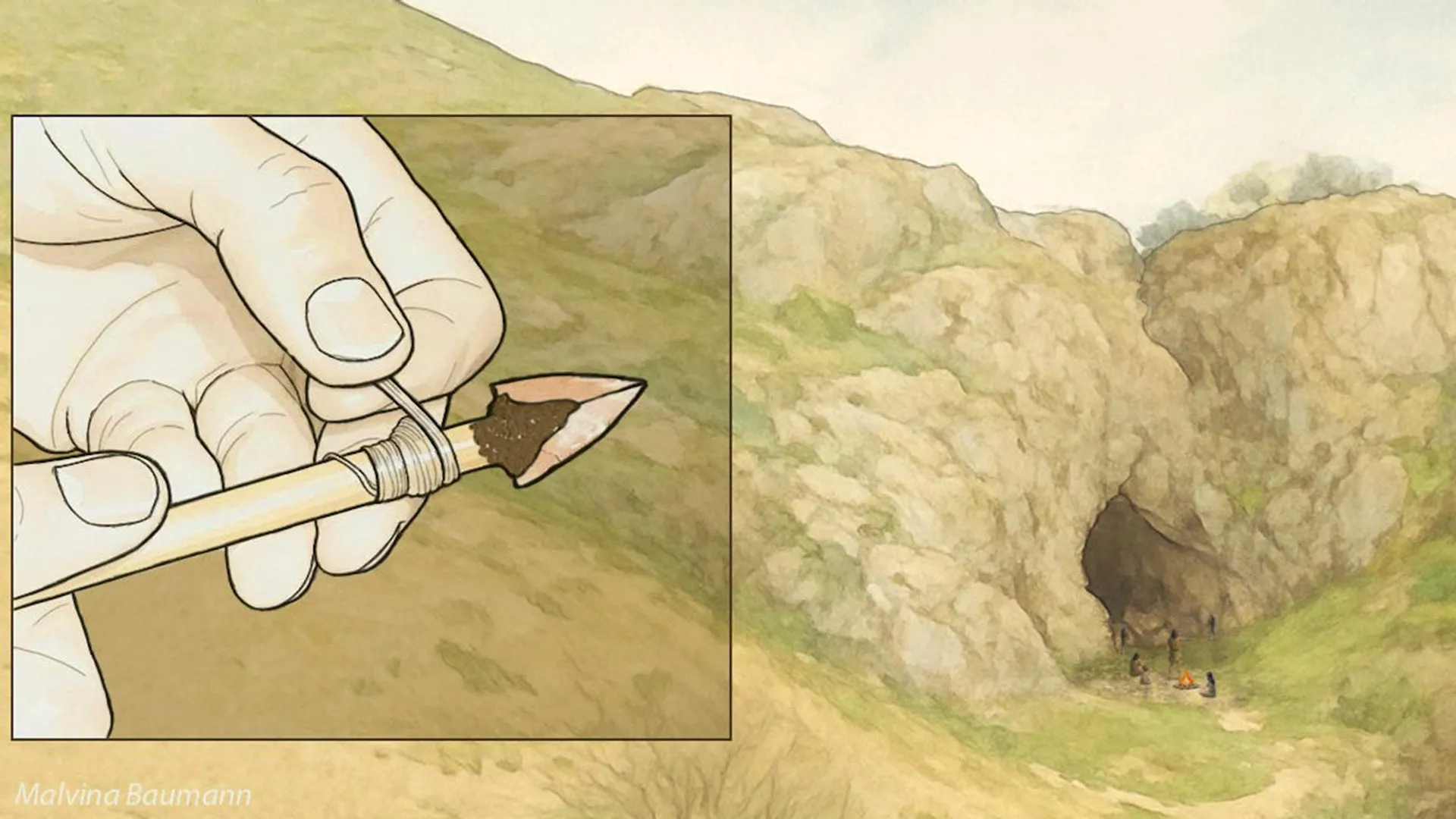
Оби-Рахмат суурины малтлагаас илэрсэн чулуун зэвсгийн үлдэгдэл нь Homo sapiens-ийн Евразид суурьшсан хугацаа болон технологийн хөгжлийн талаарх шинэ таамаглалыг дэвшүүлж байна.
Узбекистаны Тянь-Шаны нурууны Оби-Рахмат хадны хоргодох байрнаас олдсон 80,000 жилийн настай гурвалжин хэлбэрийн бичил зэвсгүүдийг олон улсын судлаачдын баг шинжилжээ. Микроскопын шинжилгээгээр эдгээр олдвор нь харвах зориулалттай сумны үзүүр болохыг тогтоосон байна. Тэдгээрийн хэмжээ болон хийц нь 25,000 жилийн дараа Францын Рона хөндийд олдсон Homo sapiens-ийн сумны үзүүртэй ижил төстэй байгаа нь эрдэмтдийн анхаарлыг татаж байна.
Судлаачид эдгээр бичил зэвсгийг тухайн үеийн баллистик болон физик хязгаарлалттай уялдуулан судалсны дүнд, тэдгээрийг гараар шидэх жад бус, харин нум сум зэрэг харвах хэрэгсэлд ашиглаж байсан гэж үзжээ. Оби-Рахмат сууринд олдсон олон төрлийн зэвсгийн үлдэгдэл нь тухайн үед Homo sapiens-ийн бүлгүүд нарийн зохион байгуулалттай ан агнуурын технологи эзэмшсэнийг гэрчилж байна.
Энэхүү судалгаа нь Homo sapiens Африкаас Еврази руу нүүдэллэж, суурьшсан түүхийг өөр өнцгөөс харах шаардлагатайг сануулж байна. Өмнө нь хүн төрөлхтнийг 45,000 жилийн өмнө шууд нүүдэллэн ирсэн гэж үздэг байсан бол шинэ олдвор нь тэд Төв Азийн бүс нутагт эртнээс суурьшиж, технологийн шинэчлэл хийж байсныг харуулж байна. Палеогенетикийн судалгаагаар Персийн тэгш өндөрлөгийг хүн амын нүүдлийн гол зангилаа байсан хэмээн тодорхойлсон нь энэхүү археологийн олдвортой давхцаж байгаа юм.
Одоогийн байдлаар энэхүү нээлт нь Оби-Рахмат болон Францын Мандрин суурин дахь олдворуудыг нэгэн соёлын тархалтын үе шат гэж үзэх таамаглалыг дэвшүүлээд байна. Цаашид Төв Ази болон баруун Газар дундын тэнгисийн хоорондох бүс нутгуудад хийх малтлагаар ижил төстэй бичил зэвсгүүд олдох магадлалтайг эрдэмтэд тэмдэглэв.
Дэлгэрэнгүйг эх сурвалжаас харах
↓Эх сурвалжийг нээх ↓
Unretouched triangular microlithic projectile points have been identified from their impact traces in the oldest occupation layers of the Obi-Rakhmat site in Uzbekistan, dating to 80,000 years ago. Their size corresponds to small arrowheads, which are directly comparable to those produced by Homo sapiens during an incursion into Neanderthal territory in the Rhône Valley, 25,000 years later. This new study, published in the PLOS One journal, provides a strong argument that could rewrite history on Homo sapiens‘ first settlement in Europe.
The chrono-cultural and anthropological frameworks of prehistory, along with the evolutionary models they inspired, were first created in Western Europe, especially France, in the second half of the 19th century. They were initially linear and Eurocentric: Cro-Magnons (European early modern humans), descending from Neanderthals, laid the foundations for the civilizational superiority claimed by this part of the world at the time. It was not until a century later that the African origin of Homo sapiens, as well as the technological and social features that characterised the Western Upper Paleolithic (symbolic productions, long-distance networks, and diversified lithic and bone tools and weapons), were recognized.
The earliest evidence of Homo sapiens in Australia, dating back around 65,000 years, predates that found in Europe by 10 millennia, while the ways in which our ancestors initially colonized Western Eurasia over 45,000 years ago remain contentious. The temporal alignment of the earliest European Upper Paleolithic settlements with those in the Levant, which are considered the closest in terms of typology and technology, is still not satisfactory. This is either because the Levantine data comes from old excavations or because it does not fit into the supposed direct lineage. Despite its geographical proximity to Africa, the origins of the Initial Upper Paleolithic in the Levant are themselves uncertain. This is why the possibility of a Central Asian origin suggested by archaeologist Ludovic Slimak in 2023 deserves attention.
A site in Central Asia
Depending on climatic conditions, Central Asia has served as a corridor facilitating movement between the western and eastern parts of the continent or as a refuge zone. The archaeological record in this region is limited but includes several significant Paleolithic sites.
Among them is the Obi-Rakhmat rock shelter in Uzbekistan, discovered in 1962, whose latest excavation campaigns were led by Andrei Krivoshapkin. At the south-western end of the Talassky Alatau range of the Tien Shan mountains, at an altitude of 1,250 meters, the settlement provides a remarkably consistent lithic industry, comprising points, large blades, and bladelets across a stratigraphic sequence spanning over 10 meters, dating from approximately 80,000 to 40,000 years ago. This industry was initially classified as part of the Initial Upper Paleolithic but it appears to derive from the Levantine Early Middle Paleolithic. The early Middle Paleolithic, associated with archaic Homo sapiens at the Misliya cave, disappeared from the Near East around 100,000 years ago. At Obi-Rakhmat, the skull remains of a child found in a layer dating back ~70,000 years show features considered to be Neanderthal and others to be anatomically modern, a combination that could be the result of hybridization.
Massive blades but microlithic points
In this context, our international multidisciplinary team has identified tiny, unretouched, triangular projectile points within the lithic debris of the oldest stratigraphic layers. These points were distinguished based on their macroscopic and microscopic impact marks, which were compared to experimental reference data. Due to their small size (less than 2 cm in width and weighing only a few grams) and brittleness, they would have been unsuitable for mounting on heavy shafts. The width of their cutting edges corresponds to the diameter of arrow shafts documented ethnographically for low-poundage bows, consistent with transcultural invariants rooted in physical and ballistic constraints.
A question of ballistics
Thrown piercing weapons are complex systems whose components are not interchangeable from one type of weapon to another, as they meet different requirements in terms of intensity and nature of stress.
The significant impact force of spears held or thrown by hand makes the robustness of the weapon an essential parameter, both in terms of effectiveness and the hunter’s survival, with mass ensuring robustness, impact force and penetration. In contrast, the penetration of light projectiles shot from a long distance depends on their sharpness, because their kinetic energy, which is much lower, comes mainly from their speed, which, unlike mass, decreases very rapidly along the trajectory and in the target. As this speed cannot be achieved by the extension of the human arm alone, it necessarily depends on the use of a throwing instrument. Arrowheads and spearheads or javelin heads are therefore not designed according to the same criteria and cannot be mounted on the same shafts, the dimensions and degree of elasticity of which are also essential in terms of ballistics. Thus, as in paleontology, where the shape of a tooth reveals the type of diet and suggests the mode of locomotion, the characteristics of a point provide clues as to the type of weapon of which it is the wounding element.
Weaponry specific to ‘Sapiens’?
The tiny size of Obi-Rakhmat’s points cannot be regarded as a default choice, not only because there is no shortage of good-quality lithic raw material on site from which large blades were made, but microscopic examination of traces of use also shows that within this same assemblage there are also much more robust retouched points, 15 to 20 times heavier and 3 to 4 times thicker (the size of spearheads or javelin heads), similarly impacted by use as axial projectile points.
Returning to the bibliography and our own work on Middle Paleolithic tools, we found that the presence in the same assemblage of various types of projectile points and inserts, some of which were microlithic and produced for this purpose, is only known at Homo sapiens sites. The oldest documented occurrences are in South Africa in the Pre-Still Bay (more than 77,000 years old) and later cultural layers of the Sibudu cave. In contrast, lithic points damaged by use as projectile heads are rare in the Neanderthal record. When present, they tend to be large and do not notably differ in size, manufacture or type from points used for activities other than hunting, such as gathering plants or butchery. This difference in the design of tools and weapons takes on anthropological significance.
Given their respective dates, the distance between South Africa and Central Asia (14,000 km) and the difference in the manufacture of the Obi-Rakhmat and Sibudu weapon heads (unretouched knapped stone points vs. shaped stone points or retouched inserts, shaped bone points), the hypothesis of independent centers of invention is the most likely.
From the foothills of the Tien Shan to the Rhône Valley 25,000 years later
The micro-points from Obi-Rakhmat have no known equivalents in the Eurasian Middle Paleolithic, except for identical projectile points identified by Traceology expert Laure Metz at the Mandrin site, in the Rhône Valley, France, in a layer dating to approximately 54,000 years ago – some ten thousand years before the disappearance of local Neanderthals. Notably, a Homo sapiens milk tooth was also recovered from this layer. The similarity between the micro-points from Obi-Rakhmat and Mandrin, despite being separated by more than 6,000 km and 25 millennia, is such that they could be interchanged without any detail other than the stone betraying the substitution.
Recent work published by paleogeneticists Leonardo Vallini and Stéphane Mazières defines the Persian Plateau, on the north-eastern edge of which Obi-Rakhmat is located, as a population hub where the ancestors of all present-day non-Africans lived between the early phases of expansion out of Africa – long before the Upper Paleolithic – and the wider colonization of Eurasia. This resource-rich environment may have provided a refuge conducive to demographic regeneration after the genetic bottleneck of the exit from Africa, interaction between groups and, consequently, technical innovations.
Obi-Rakhmat and Mandrin may represent two geographical and temporal milestones within the same process of dispersal, as suggested by Ludovic Slimak, characterized by the dissemination of a key technological innovation unique to Homo sapiens. So far unnoticed because they are unretouched, tiny and fragmentary, it is likely that the micro-projectile points for which recognition criteria have now been defined will begin to appear at sites between Central Asia and the western Mediterranean.
Premises for a new scenario of the western peopling by ‘Homo sapiens’
This discovery is stimulating in several ways.
It validates the consistency of the research conducted at the Mandrin site, which came to the conclusion that Sapiens armed with bows made a brief incursion into Neanderthal territory. Several elements of this study had been criticized, which is, however, normal in science when a new proposal deviates too far from established knowledge – but its predictive dimension had not been considered at the time.
The similarity between Mandrin and Obi-Rakhmat’s micro-points cannot be a mere coincidence. It is not only their shape that is similar, but also the way they are made, which requires real expertise, as evidenced by the meticulous preparation of their striking platform and their function. One could debate the appropriate instrument for shooting arrows armed with such tiny tips, the bow being in filigree, or whether it is preferable to remain cautious and speak only of shooting, but this already contrasts with what we know about Neanderthal hunting weapons and their design.
Another remarkable aspect, which is still relatively uncommon, is the convergence and complementarity of data from material culture and from our genetic memory, which did not influence each other given the dates of the respective studies and publications. Together, they sketch out a rewriting of the scenario of Homo sapiens’ arrival in Europe: it was thought that he came directly from Africa by the shortest route 45,000 years ago, but we now discover that he had been established in the heart of the Eurasian continent for a long time, well before expanding in search of more territories.

