
Судлаачид Ангарагийн хөрс, желатин болон тусгайлан боловсруулсан мөөгөнцрийн эсийг ашиглан 3D хэвлэгчээр барилгын бүтэц үүсгэх шинэ аргыг туршиж байна.
Хонконгийн Шинжлэх ухаан, технологийн их сургуулийн эрдэмтэд Ангараг гараг дээрх хязгаарлагдмал нөөцөд тулгуурлан барилга байгууламж босгох шинэ технологийг боловсруулжээ. Chem Circularity сэтгүүлд нийтлэгдсэн судалгаагаар, тус баг Ангарагийн элсэрхэг хөрсийг желатин болон наалдамхай уураг ялгаруулдаг мөөгөнцрийн эстэй хольж, бат бөх бүтэцтэй барилгын материал гарган авсан байна. Энэхүү материал нь Ангарагийн хүйтэн, агаар мандлын даралт багатай орчинд хөлдөөж хатаах зарчмаар ажиллаж, хөөсөнцөр мэт хөнгөн боловч бат бөх байдлыг хадгалдаг аж.
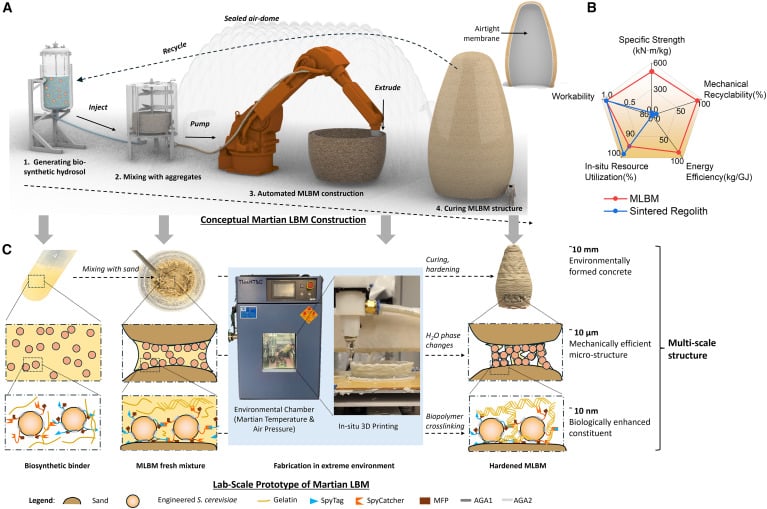
Туршилтын явцад 3D хэвлэгчээр бүтээсэн 45 миллиметр өндөр, 30 миллиметр өргөн жижиг хэмжээний байгууламжууд 10-12 мегапаскаль даацын бат бөх чанарыг үзүүлсэн нь бага зэргийн бетонтой дүйцэхүйц үзүүлэлт юм. Ахлах судлаач Жишэнь Чю-гийн тайлбарласнаар, энэхүү биологийн хольц нь Ангарагийн таталцлын хүчинд олон давхар барилга барихад ч хангалттай бат бөх байж болзошгүй. Мөн тус материал нь дахин боловсруулах боломжтой тул сансрын суурин газруудад нөөцийн эргэлтийг хангах давуу талтай.

Гэсэн хэдий ч энэхүү технологи нь одоогоор зөвхөн Дэлхий дээрх дуурайлган хийсэн орчинд туршигдсан бөгөөд Ангарагийн бодит нөхцөлд мөөгөнцрийн эсүүд хэрхэн тэсвэрлэх нь тодорхойгүй байна. Түүнчлэн барилгын үйл ажиллагааг бүрэн бие даасан болгохын тулд Дэлхийгээс тээвэрлэх шаардлагатай желатин зэрэг түүхий эдийг орон нутгийн нөөцөөр орлуулах шийдлийг олох шаардлагатай юм. Судлаачид биологийн энэхүү арга нь сансрын урт хугацааны даалгаварт барилгын материалыг сэргээгдэх байдлаар ашиглах боломжийг нээж өгнө гэж үзэж байна.

Дэлгэрэнгүйг эх сурвалжаас харах
↓Эх сурвалжийг нээх ↓
Researchers have created a new biological construction material that could help future explorers build shelters on Mars using local rocks mixed with gelatin and engineered yeast, according to a study published in the journal Chem Circularity. The approach could reduce the need to transport massive construction supplies from Earth and introduce a new method for creating recyclable habitats beyond our planet.
A Living Material Designed For Martian Construction
Building on Mars presents extreme challenges. The planet has freezing temperatures, intense radiation exposure and an atmosphere too thin to support conventional construction methods. Transporting large quantities of traditional materials from Earth would require enormous launch capacity and long preparation timelines before any settlement could begin.
Scientists from The Hong Kong University Of Science And Technology explored a different strategy by combining local Martian resources with biological ingredients that could be renewed over time. Their material uses Martian rock-like sand combined with gelatin and specially engineered yeast cells designed to create a strong adhesive structure.
The concept came from observing how materials behave under freeze-drying conditions. Civil engineer and senior author Jishen Qiu explained, “My inspiration came from freeze-dried fruits that become harder,” says civil engineer and senior author Jishen Qiu of The Hong Kong University of Science and Technology. Mars’s extremely low temperature and pressure create conditions similar to freeze-drying. “So I asked myself if we can take advantage of that and make some materials.”
The researchers developed yeast coated with highly adhesive proteins inspired by natural systems, including proteins used by mussels to attach themselves to rocks. The gelatin acts as a biological support system, allowing the cells to grow while binding the mineral components together.
The resulting material can be pushed through a 3D printer nozzle, allowing structures to be formed layer by layer. After printing, the simulated Martian environment causes the water inside the material to freeze and transition directly into vapor, leaving behind a lightweight porous structure similar to foam.
Testing A New Approach To Building On Mars
The team tested the material inside environments designed to reproduce the conditions found on Mars. The printed objects remain small for now, with experimental structures measuring around 45 millimeters tall and 30 millimeters wide, but researchers found that the material achieved mechanical properties comparable to low-grade concrete.
The printed structures reached a compressive strength between 10 and 12 megapascals, demonstrating that the biological mixture can support significant weight despite its lightweight composition. The porous design also offers potential advantages for future space habitats, where reducing mass while maintaining durability remains a major challenge.
Qiu said the strength of the material could allow it to support larger structures under Martian gravity. “So this is actually strong enough to build a one- or two-story building on Earth whose gravity is three times that of Mars,” says Qiu. “So, you can probably easily build a multistory building on Mars with the material.”
The study, published in the journal Chem Circularity, presents the technology as a possible alternative to traditional approaches that rely on melting or processing extraterrestrial materials into construction blocks. Those methods could require large amounts of energy, while biological manufacturing could operate through lower-temperature processes.
The researchers also suggest that the material could support a more circular system for future settlements. Instead of importing all construction resources, astronauts could potentially recover biological components from old structures and use them again.

Yeast Could Support A Recyclable Space Construction System
Future Mars settlements would need systems capable of producing materials locally while minimizing dependence on Earth. The yeast-based approach aims to address this challenge by creating a material that can be repaired, recycled and regenerated through biological processes.
The engineered yeast used in the study could potentially be cultivated in controlled environments and reused for new construction projects. This would allow future habitats to maintain a supply of building material rather than relying entirely on shipments from Earth.
“As long as there’s one yeast that’s still alive, you can grow them again,” Qiu says. The idea reflects a broader movement in space research toward using biotechnology to create renewable resources for long-duration missions.
The researchers believe biology could become part of future engineering systems on other worlds. Instead of treating living organisms only as passengers during space exploration, scientists are exploring ways to use them as tools for manufacturing, recycling and resource management.
Still, major questions remain before this technology could reach Mars. The material has only been tested under simulated conditions on Earth, and scientists do not yet know whether the engineered yeast could survive the full range of environmental challenges found on the Red Planet.

Scaling The Technology For Future Mars Missions
Moving from laboratory demonstrations to real construction on Mars will require major advances in space transportation and habitat technology. The researchers estimate that future engineering operations would still require hundreds of tons of cargo from Earth before large-scale production could begin.
The material also depends partly on ingredients brought from Earth, including gelatin, meaning future missions would need to develop methods for producing similar components using local resources or alternative biological systems.
Qiu remains optimistic about the possibility of expanding the technology.
“I always ask myself: Is there any physical law or fundamental mechanism that prevents us from doing this?” says Qiu. “I can’t see any at this point in time. We are confident in scaling it up. It would surprise me if materials for future Martian engineering will not be as diverse as those used in Earth engineering—and biology will certainly contribute.”
The research adds another potential pathway toward permanent human presence beyond Earth. If future missions can combine local Martian resources with renewable biological manufacturing, the first settlements on Mars may rely on construction methods that look very different from those used on Earth.
Enjoyed this article? Subscribe to our free newsletter for engaging stories, exclusive content, and the latest news.

