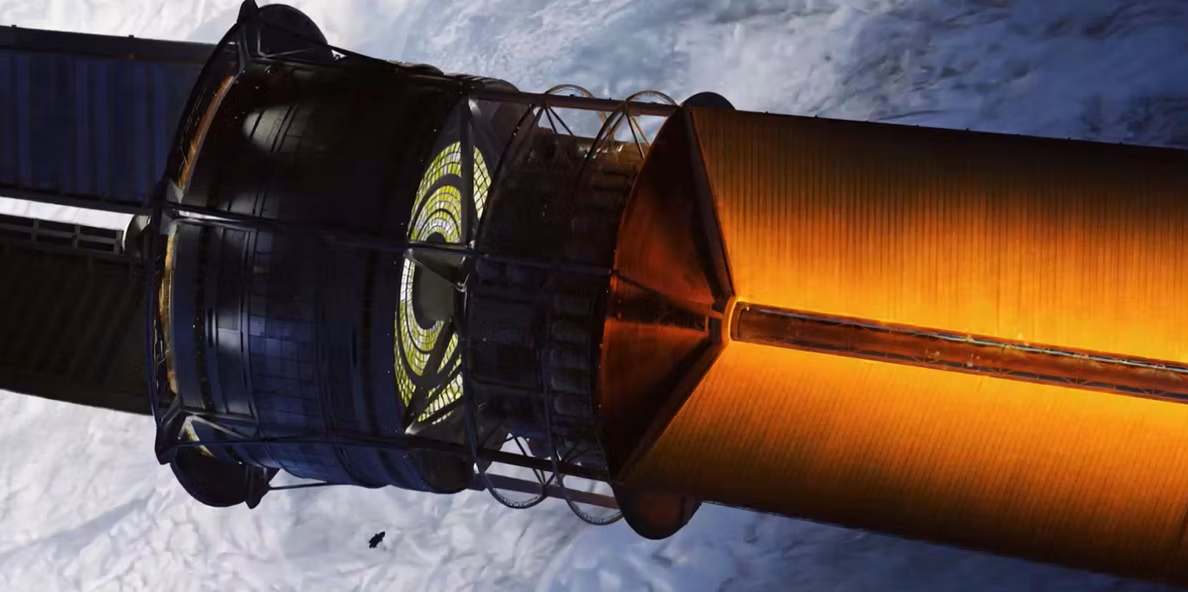
Project Hyperion тэмцээний ялагч болсон энэхүү төсөл нь хүн төрөлхтнийг олон үеэрээ сансарт амьдрахад шаардлагатай техникийн болон нийгмийн бүтцийн нарийвчилсан судалгааг тодорхойлжээ.
“Chrysalis” хэмээх энэхүү сансрын хөлгийн загвар нь 2,400 хүнийг Дэлхийгээс үүрд авч явах, 400 жилийн турш үргэлжлэх аялалд зориулагдсан байна. Хөлөг дотор 16 үеийн турш хүмүүс төрж, амьдрах бөгөөд тэдний хэн нь ч өөр гараг дээр хөл тавихгүй байх магадлалтай гэж үзжээ. Энэхүү төсөл нь хөлгийн хөдөлгүүр, амьдрал тэтгэх системээс гадна хүн амын засаглал, хүүхэд өсгөн хүмүүжүүлэх зэрэг нийгмийн бүхий л талыг багтаасан судалгааны үндэс суурийг тавьсан юм.
Хөлгийн 58 километрийн урттай байх шаардлага нь хиймэл таталцал үүсгэх физикийн хязгаарлалттай холбоотой. Бага эргэлтийн хурдаар Дэлхийнхтэй ойролцоо таталцал үүсгэхийн тулд ийм хэмжээний бүтэц шаардлагатай бөгөөд хөлгийг Дэлхий-Сарны хоорондох Лагранжийн цэгт угсрах нь хамгийн оновчтой гэж үзжээ. Хөлгийн гаднах болон доторх цилиндрүүд нь эсрэг чиглэлд эргэлдэж, бүтцийн чичиргээг бууруулах зориулалттай байна.
Гэсэн хэдий ч төсөлд тусгагдсан технологиуд одоогоор бүрэн боловсруулагдаагүй байна. Тухайлбал, 400 жилийн турш ажиллах хүчин чадалтай цөмийн хайлалтын хөдөлгүүр, сансрын цацрагаас хамгаалах материал, мөн экосистемийн бүрэн битүүмжлэл зэрэг нь шинжлэх ухааны хувьд шийдэгдээгүй асуудал хэвээр байна.
Судлаачид нийгмийн тогтвортой байдлыг хамгийн том сорилт гэж үзэж байна. Олон арван жил үргэлжлэх тусгаарлагдмал орчинд хүн амын сэтгэл зүй, засаглал, соёлын тасралтгүй байдлыг хадгалах туршлага байхгүй тул энэхүү төсөл нь шийдэл гаргахаас илүүтэйгээр ирээдүйн сансрын аялалд тулгарах бэрхшээлүүдийг нарийн тодорхойлж өгснөөрөө онцлог юм.
Дэлгэрэнгүйг эх сурвалжаас харах
↓Эх сурвалжийг нээх ↓
The 2,400 people aboard would leave Earth knowing they would never see it again. Their children would be born in deep space. Their grandchildren would grow old there.
Sixteen generations would live and die inside the same vessel before anyone aboard set foot on another world, assuming the destination proved habitable at all.
That is the premise behind Chrysalis, winner of the 2025 Project Hyperion international design competition for a crewed interstellar vessel. The competition asked teams to tackle more than propulsion and life support: they had to work out the architecture of a civilization kept alive for centuries in vacuum, and the Chrysalis team’s response runs to hundreds of pages, ranging from agricultural modules and water recycling to governance and child-rearing.
The design is notable not because it solves those problems. It doesn’t. What it does, with unusual precision, is spell out what solving them would demand.
Why the Ship Has to Be 58 Kilometers Long
Artificial gravity dictates nearly every structural choice in the Chrysalis design. The physics leave little room to maneuver.
Rotation creates centrifugal force that mimics gravity, but people can tolerate only so much rotational speed. As aerospace engineer John Page has explained, spinning a small structure faster creates a substantial gravitational difference between a person’s head and feet. Blood can pool. Disorientation follows.
The workaround is size: build something large enough to rotate slowly while still producing useful force.
To reach 0.9 times Earth’s gravitational pull at a tolerable rotation rate, the Chrysalis team calculated that the ship would need a nested cylinder structure spanning 58 kilometers. Its outer layers rotate one way while inner shells turn in the opposite direction, a setup meant to cut down structural vibrations moving through the vessel. Up front sits the habitat module, tapered to reduce the cross-section exposed to interstellar debris during acceleration and deceleration.
No existing launch system can carry components on that scale from Earth’s surface, and no orbital facility could assemble them in low Earth orbit.
Instead, the Chrysalis documentation proposes construction at one of the Earth-Moon Lagrange points, gravitationally stable regions where, as NASA describes them, a spacecraft can hold position with minimal fuel expenditure. That reduces the energy cost of operating deep inside a gravity well.
The Gap Between Specified and Solved
For propulsion, Chrysalis calls for a Direct Fusion Drive burning helium-3 and deuterium: one year accelerating, 400 years coasting, one year slowing down.
No operational fusion reactor capable of powering a spacecraft exists as of 2026.
Government fusion research roadmaps put demonstration reactors decades away. None address what a centuries-long deployment adds to the problem, including vacuum-rated radiators, maintenance access to machinery that may become too radioactive to approach, and shielding expected to remain effective for 16 generations.
Radiation brings a parallel set of unknowns. Crews in deep space would face continuous exposure to galactic cosmic rays and solar particle events, while adequate shielding for the entire voyage would demand material thickness beyond what current launch systems and manufacturing processes can deliver. The Chrysalis documentation says suitable shielding materials have not been developed or tested. It treats the problem as a research constraint, not an engineering box already checked.
Ecological closure may be the hardest requirement with any substantial experimental record behind it.

The International Space Station reaches water-recycling efficiency approaching 98 percent and supports limited plant growth under controlled conditions. On Earth, closed-environment trials including the Biosphere 2 project in the 1990s exposed how difficult it is to hold atmospheric composition steady without outside intervention, even over months.
Chrysalis requires fully integrated biological loops covering agriculture, atmospheric cycling, and water recovery to keep running for 400 years without resupply.
No experimental facility has come close to that condition on anything resembling the required timescale.
Social Architecture Across 16 Generations
Physical survival was only part of the competition brief. Teams also had to address social stability, and Chrysalis spends substantial space on it.
Crew selection borrows from research on Antarctic overwintering stations, where months of confinement and isolation produce measurable psychological stress. Before launch, the design proposes training candidates in extreme environments to identify people suited to multidecade confinement.
Community life would look different, too.
The plan includes collective child-rearing instead of nuclear family units, voluntary birth spacing for population management, AI-assisted governance and decision-making, and knowledge-preservation systems meant to carry technical and cultural continuity through generations that will never meet one another.

In the team’s own statement, the psychological problem emerges as the design’s deepest challenge. Future inhabitants, it notes, may adapt so completely to life aboard the vessel that arrival on a new planet falls outside their experiential frame entirely, raising a question the document leaves open: would those generations still want to pursue the mission’s original objective?
There is no empirical record for social stability across anything like this span.
Submarine crews rotate. Antarctic stations overwinter for months. The longest-duration human spaceflight missions have measured confinement in months.
Chrysalis classifies social stability as an open research domain, not a solved one.
The team’s stated aim was never to deliver a construction blueprint. It was to establish a research baseline: a structured account of what an interstellar mission would demand and where the largest gaps remain. On that measure, the document is unusually specific about what nobody yet knows.
Enjoyed this article? Subscribe to our free newsletter for engaging stories, exclusive content, and the latest news.

