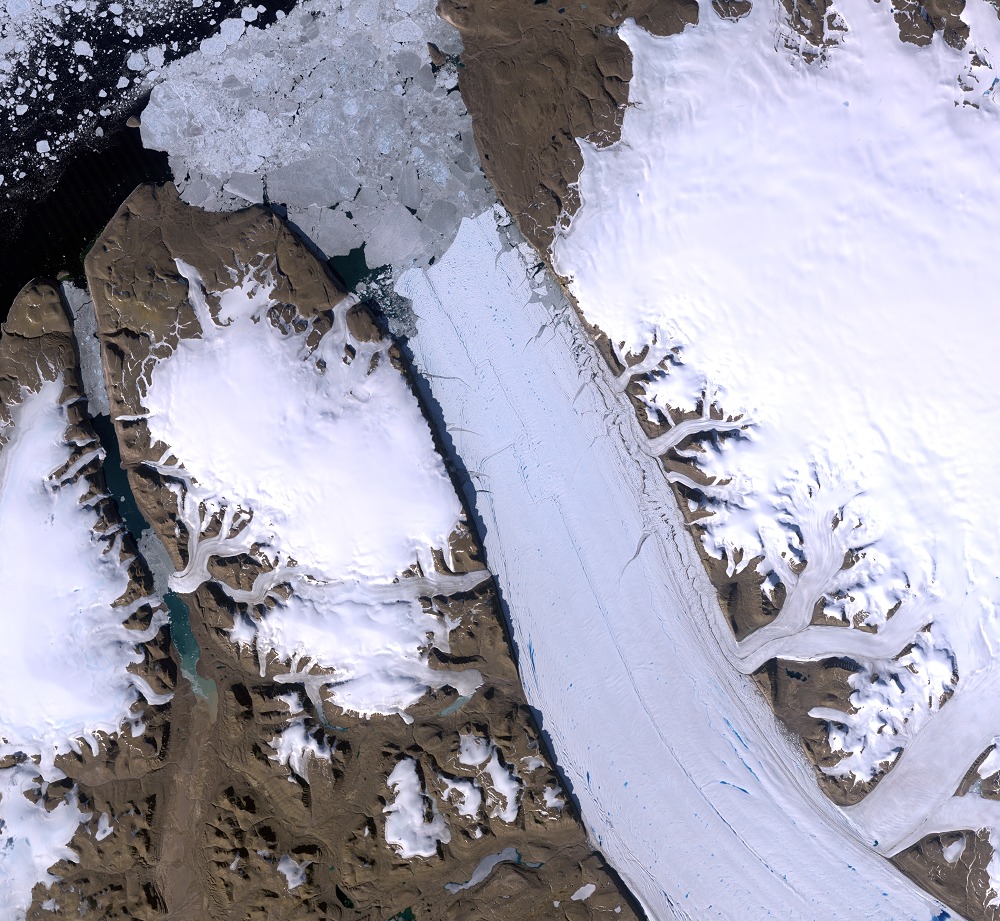
Эрдэмтэд 76 хавтгай дөрвөлжин км талбайтай мөсөн уулыг хад мөргөсний дараа бутарна гэж таамаглаж байсан ч бүрэн бүтнээрээ үргэлжлүүлэн хөвжээ
Гренландын Петерманн мөсөн голоос 2026 оны наймдугаар сарын 4-нд 76 хавтгай дөрвөлжин км талбай бүхий аварга том мөсөн уул салж, Арктикийн усанд хөвж эхэлсэн байна. Оттавагийн их сургуулийн судлаач Адам Гарбо ESA-гийн Sentinel-1 хиймэл дагуулын мэдээлэлд дүн шинжилгээ хийж уг үйл явдлыг илрүүлжээ. Энэхүү мөсөн уул нь 2020 оноос хойш тус бүс нутагт бүртгэгдсэн хамгийн том мөсөн голын тасралт буюу “calving” үйл явдал болсон юм.
Судлаачид Петерманн мөсөн голын хөвөгч хэсэгт үүссэн ан цавыг удаан хугацаанд хянаж байсан ч бодит байдал дээр таамаглаж байснаас өөр хагарал үүсэж, илүү жижиг мөсөн арал салсан нь эрдэмтдийн гайхшралыг төрүүлжээ. Уг мөсөн уул Петерманн фьордоор дамжин Нарес хоолой руу өдөрт дунджаар 3 км-ийн хурдтайгаар хөвсөн байна.
Аялалынхаа явцад мөсөн уул Жо нэртэй хадлаг аралтай мөргөлдсөн нь эрдэмтдийн анхаарлыг ихэд татжээ. Өмнөх жилүүдэд ийм мөргөлдөөнөөс болж мөсөн уулнууд бутран хуваагддаг байсан бол энэ удаад 150 метрээс бага зузаантай уг мөсөн масс бүтэн хэвээр үлдэж, аяллаа үргэлжлүүлсэн нь ховор тохиолдол болов.
NASA болон USGS Landsat хиймэл дагуулын ажиглалтаар мөсөн уул Жо арлыг өнгөрсний дараа баруун өмнө зүг рүү хөвсөөр байгааг тогтоожээ. Гэсэн хэдий ч далайн урсгал, салхи, түрлэг болон хайлалтын нөлөөгөөр уг мөсөн уул цаашид жижиг хэсгүүдэд хуваагдах нь гарцаагүй гэж эрдэмтэд үзэж байна.
Дэлгэрэнгүйг эх сурвалжаас харах
↓Эх сурвалжийг нээх ↓
A giant iceberg covering 29 square miles broke away from Greenland’s Petermann Glacier before hitting a rocky island in Arctic waters. Instead of splitting apart, the enormous ice block survived the impact and continued drifting, surprising scientists who were tracking its movement.
The iceberg separated from Petermann Glacier in August 2026, during a period when Greenland’s fjords typically see increased iceberg activity. The event became the largest calving episode recorded from an Arctic glacier since 2020 and drew attention because of the size of the ice fragment and the unusual journey that followed.
Petermann Glacier is one of Greenland’s major marine-terminating glaciers, meaning it extends into the ocean and regularly releases large pieces of ice through a process known as calving. These events are part of the glacier’s natural cycle, but scientists closely monitor them because changes in glacier behavior can provide clues about the evolution of Greenland’s ice sheet.
NASA Earth Observatory reported that researchers rely on satellite observations and environmental data to follow these changes over time, particularly in glaciers that connect the interior ice sheet to the ocean.
A 29-Square-Mile Iceberg Breaks Free From Greenland
The iceberg’s journey began on August 4, 2026, when Adam Garbo, a doctoral student in glaciology at the University of Ottawa, identified the calving event using images from the European Space Agency’s Sentinel-1 satellite. His work was part of an international effort to monitor the floating ice tongue of Petermann Glacier through remote sensing.
The newly formed iceberg, often described by scientists as an “ice island” because of its large, flat shape, covered just over 76 square kilometers when it separated from the glacier. Researchers studying Petermann Glacier estimated that it was the largest piece of ice released from the glacier since the major 2012 calving event, which produced a 130-square-kilometer iceberg.
Petermann Glacier has produced several other major ice fragments in recent decades. A 31-square-kilometer iceberg broke away in 2008, while the 2010 calving event created a much larger piece measuring slightly more than 250 square kilometers. However, scientists had expected the 2026 event to unfold differently. They had been monitoring several large cracks across the glacier’s floating section, believing one of them could eventually produce an even larger iceberg. The actual break happened along another fracture.
“What surprised us was that the calving instead followed a different fracture, producing a smaller ice island than we had originally anticipated,” Garbo said.
By late August, two major cracks remained visible on Petermann Glacier, although researchers could not determine when they would eventually separate and create new ice islands.
The Giant Iceberg Collides With Joe Island
After breaking away from Petermann Glacier, the iceberg moved through Petermann Fjord toward Nares Strait. Glaciologist Mauri Pelto from Nichols College followed its path using images captured by NASA and USGS Landsat satellites, documenting how the ice mass changed as it traveled.
During the first week after calving, the iceberg moved around 3 kilometers per day. Its route eventually brought it close to Joe Island, a small rocky outcrop located near the entrance of the fjord.
The island plays an important role in the movement of icebergs leaving Petermann Glacier because many large ice fragments pass through this area. In the past, collisions with Joe Island have caused major ones to break apart. The 2010 Petermann iceberg, for example, split into two pieces after hitting the rocky outcrop.
Satellite images captured by Landsat 9’s Operational Land Imager on August 23 and August 24, 2026, showed the iceberg approaching Joe Island. Scientists watched closely because Petermann icebergs are generally thinner and more fragile than those released from glaciers such as Jakobshavn and Helheim.

NASA Earth Observatory noted that these icebergs are also much thinner than the enormous ones released from Antarctica, making their interactions with winds, currents, and coastal features especially important to study.
The Ice Giant Continues Its Journey Through Arctic Waters
Despite striking Joe Island, the giant ice mass remained largely intact. The collision did not cause the fragmentation that scientists had seen during previous encounters between Petermann ice and the rocky outcrop.
“We were certainly watching closely as it interacted with Joe Island and were impressed that it survived the interaction without further fragmentation,” Garbo said.

When it first separated from the glacier, researchers estimated that the iceberg was less than 150 meters thick. After passing the island, winds and surface currents carried it beyond Petermann Fjord, with satellite observations showing the ice mass turning southwest through Nares Strait. Its survival does not mean it will remain unchanged. Over time, melting, tides, winds, and ocean currents will continue to weaken the structure, eventually causing it to break into smaller pieces.
Enjoyed this article? Subscribe to our free newsletter for engaging stories, exclusive content, and the latest news.

