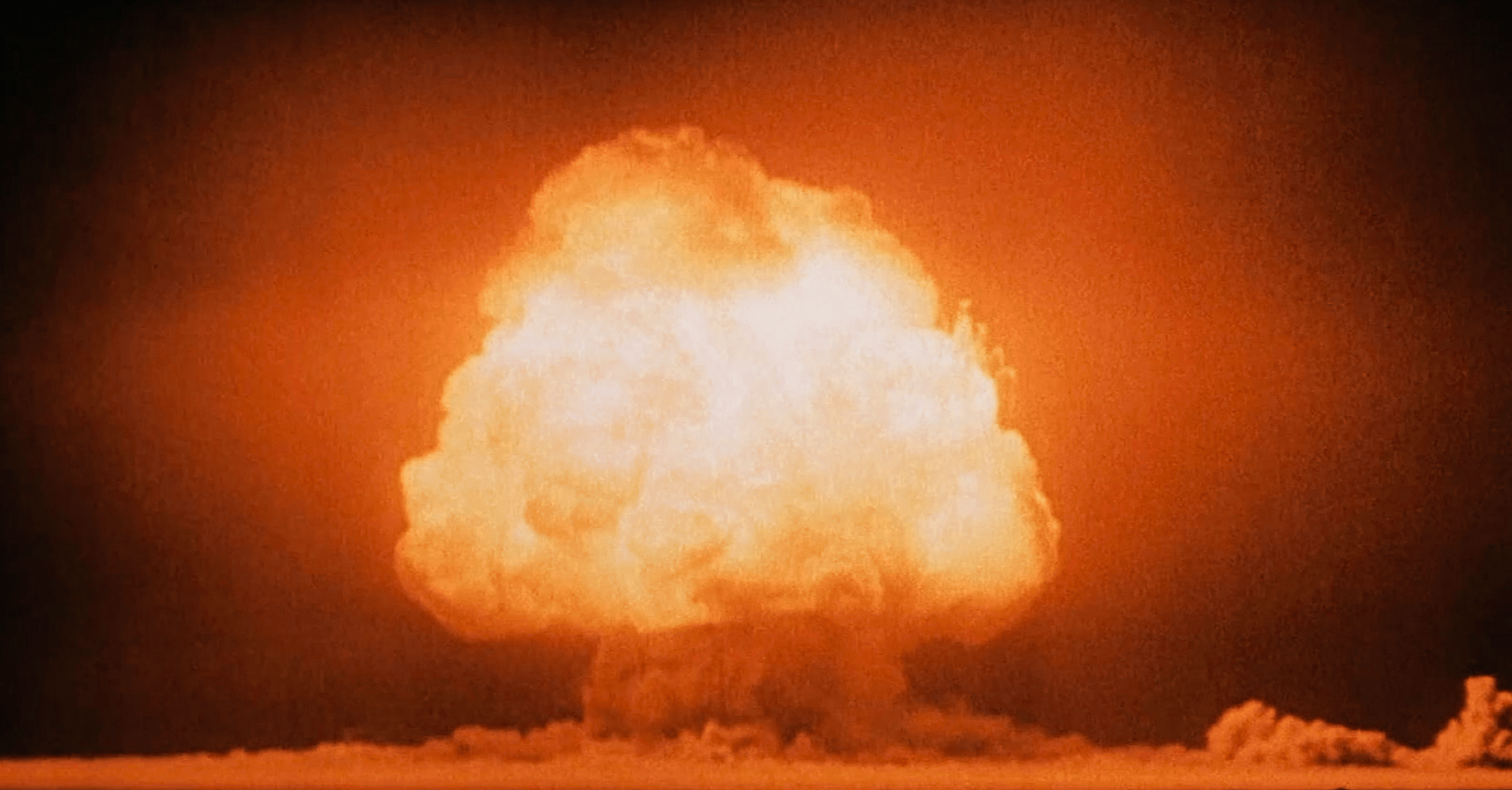
Дэлхийн хоёрдугаар дайны үеэр АНУ-ын удирдлага дор нууцаар хэрэгжүүлсэн цөмийн бөмбөг бүтээх “Манхэттэний төсөл” нь хүн төрөлхтний түүхийг нэг шөнийн дотор өөрчилж, улс төрийн болон шинжлэх ухааны цоо шинэ бодит байдлыг бий болгосон юм.
Цацраг идэвхт бодисыг ашиглах нь
Цөмийн зэвсэг бүтээх зам нь дэлхийн шинжлэх ухааны салбарын томоохон эрдэмтдийн олон жилийн судалгааны үр дүнд нээгдсэн юм. 1896 онд Францын эрдэмтэн Анри Беккерель цацраг идэвхт бодисыг анх нээсэн бол 1903 онд Британийн эрдэмтэд Эрнест Резерфорд, Фредерик Содди нар атомын цацраг идэвхт чанар нь асар их энерги ялгаруулдгийг тогтоожээ. Хүнд атомын цөм задрах үед (цөмийн хуваагдал) их хэмжээний энерги ялгардаг бөгөөд 1904 онд Содди энэхүү хүчийг ашиглан аймшигт шинэ зэвсэг бүтээх боломжтойг Британийн армийн инженерүүдэд мэдэгдэж байв.
1920 онд Британийн эрдэмтэн Артур Эддингтон хөнгөн цөмүүдийг нэгтгэх замаар мөн энерги гарган авч болохыг нээсэн байна. Альберт Эйнштейний онол болон Фрэнсис Астоны судалгаанд үндэслэн тэрээр устөрөгчийн цөмийг гели болгон нэгтгэхэд асар их энерги ялгарна гэж таамаглажээ. Үүнийг энгийнээр тайлбарлавал, сансарт од дэлбэрэхтэй ижил зарчмаар бөмбөг дэлбэлэх боломжтой байв.
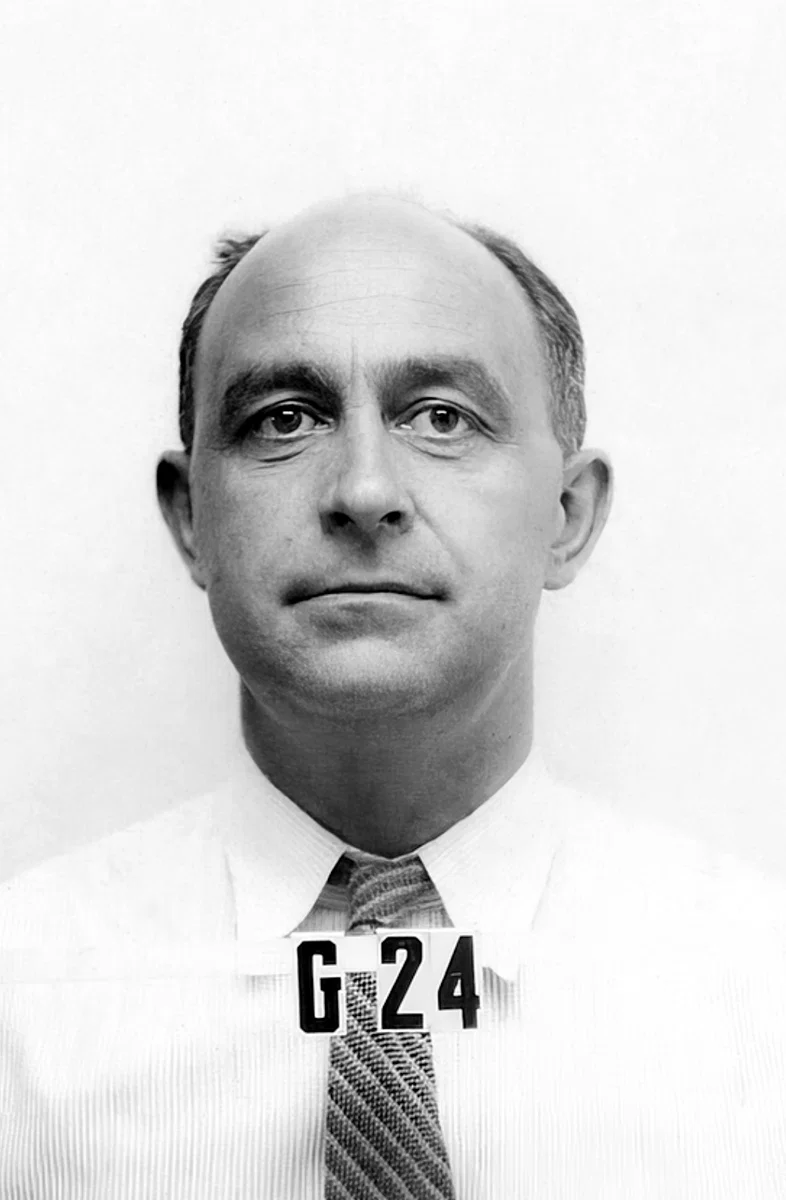
1923 онд Британийн физикч Жеймс Чадвик нейтроныг нээснээр атомын цөмийг нэвтлэх боломж нээгдсэн юм. Улмаар 1924 онд Унгарын физикч Лео Силард цөмийн гинжин урвалын зарчмыг нээжээ. Италийн эрдэмтэн Энрико Ферми нейтроныг ус эсвэл парафинаар сааруулж, металлын цацраг идэвхт чанарыг эрс нэмэгдүүлж болохыг тогтоосон байна. Ферми 1938 онд фашист Италиас дүрвэн АНУ-д иржээ.
Дайны үеийн судалгаа ба өрсөлдөөн
Дэлхийн хоёрдугаар дайн эхэлсэнтэй холбогдуулан Герман улс өөрийн цөмийн бөмбөгийг бүтээхээр “Uranverein” (Ураны нийгэмлэг) төслийг Вернер Хайзенбергийн удирдлага дор эхлүүлсэн нь холбоотны эрдэмтдийн санааг зовоож байв. 1939 оны есдүгээр сард Альберт Эйнштейн, Лео Силард нар АНУ-ын Ерөнхийлөгч Франклин Д.Рузвельтад хандан Германы аюулыг сануулсан захидал бичжээ.
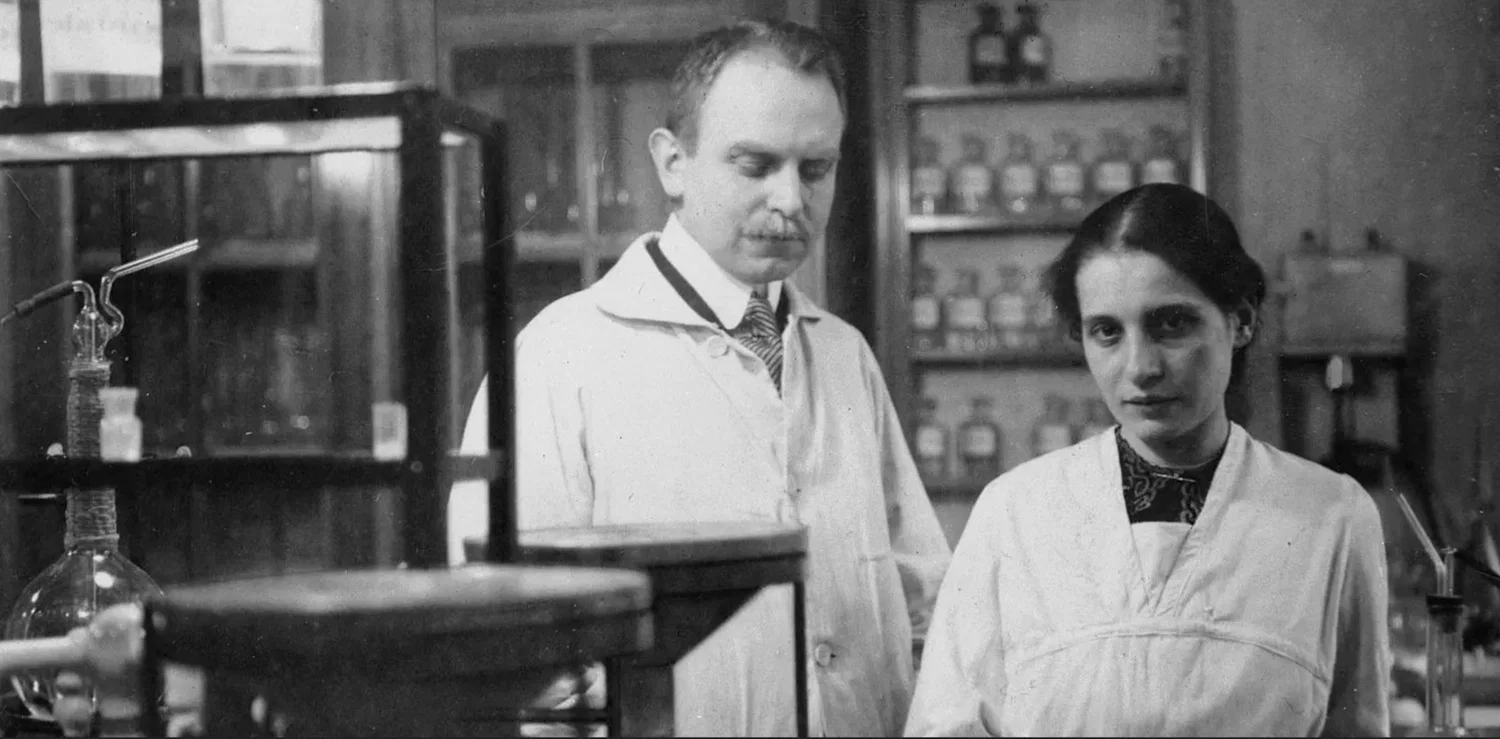
1938 онд Берлинд Отто Хан, Фриц Штрассман нар ураны цөмийг нейтроноор бөмбөгдөж, бари хэмээх шинэ элемент үүсгэсэн бол Австрийн эрдэмтэд болох Отто Фриш, Лиза Мейтнер нар ураны цөм хоёр хуваагдах үед масс нь багасч, тэрхүү алдагдсан масс нь энерги болон хувирдгийг баталжээ. Ийнхүү цөмийн задралын хүчийг хяналттайгаар ашиглах нь дайны үеийн хамгийн чухал зорилт болон хувирав.
1940 онд Нильс Бор, Жон Уилер нар уран-235 изотоп нь цөмийн задралд хамгийн тохиромжтой болохыг тогтоосон юм. Британийн Бирмингем хотод ажиллаж байсан Отто Фриш, Рудольф Пайерлс нар ердөө таван килограмм уран л хэдэн мянган тонн динамиттай тэнцэх дэлбэрэлт үүсгэж чадна гэсэн дүгнэлтэд хүрсэн нь тухайн үедээ хувьсгалт санаа байв. Үүний зэрэгцээ, Британи болон АНУ-д уран-235 ба уран-238-ыг хольж, плутони гарган авах судалгаа хийгдсэн нь бөмбөг бүтээхэд илүү дөт зам байлаа.
Цэргийн удирдлага ба Манхэттэний төсөл
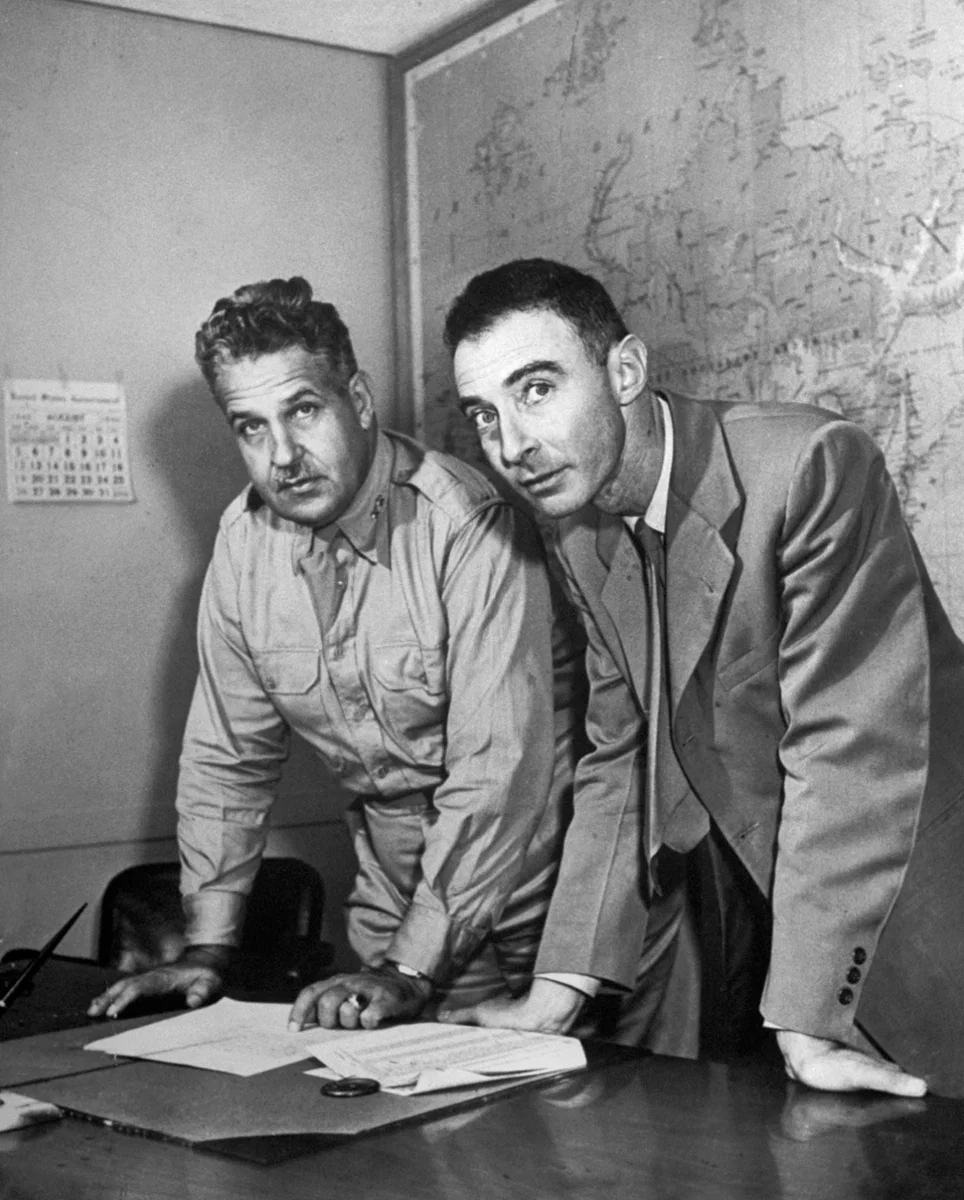
1941 оны арванхоёрдугаар сард АНУ-ын засгийн газар цөмийн бөмбөг бүтээх ажлыг албан ёсоор эхлүүлж, 1942 оны наймдугаар сард “Манхэттэний төсөл”-ийг байгуулав. Төслийг 1942 оны есдүгээр сараас хурандаа (хожим нь дэслэгч генерал) Лесли Р.Гровс удирдах болжээ. Нууцлалыг чанд сахих үүднээс төслийг хэсэгчлэн хуваасан тул хамгийн ахлах эрдэмтдээс бусад хэн ч төслийн бүрэн дүр зургийг мэддэггүй байв.
Төслийн эрдэм шинжилгээний багийг удирдахаар Роберт Оппенхаймерыг сонгожээ. Тэрээр Нью-Мексико мужийн Лос-Аламос хотыг туршилтын төв болгон сонгосон бол Теннесси мужийн Оук-Риж, Вашингтон мужийн Хэнфорд зэрэг газар судалгааны болон үйлдвэрлэлийн төвүүдийг байгуулсан байна. Төсөлд 100,000 гаруй хүн оролцож, 2.5 тэрбум ам.долларын өртөг зарцуулжээ.
Туршилт ба бөмбөгдөлт
1942 оны арванхоёрдугаар сард Силард, Ферми нар Чикагод анхны цөмийн гинжин урвалыг үүсгэв. Плутони ашигласан бөмбөгийг дэлбэлэх аргыг 1945 оны долдугаар сарын 16-нд Нью-Мексикогийн Аламогордогийн ойролцоо “Тринити” нэртэйгээр амжилттай туршсан юм. Энэхүү дэлбэрэлтийн хүч 18,600 тонн ТНТ-тэй тэнцэж, эрдэмтдийн таамагласнаас арав дахин их байв. Оппенхаймер энэ үеэр “Бхагавад Гита”-гийн “Одоо би бол үхэл, ертөнцийг сүйтгэгч боллоо” хэмээх мөрийг санажээ.
Ураны бөмбөг болох “Бяцхан хүү” (Little Boy)-г 1945 оны наймдугаар сарын 6-нд Хирошима хот руу, плутонийн бөмбөг болох “Тарган эр” (Fat Man)-ийг 1945 оны наймдугаар сарын 9-нд Нагасаки хот руу хаясан байна. Энэхүү шийдвэ
Дэлгэрэнгүйг эх сурвалжаас харах
↓Эх сурвалжийг нээх ↓
The Manhattan Project was the code name for the secret US-led programme to develop an atomic bomb during the Second World War (1939-45). Hugely expensive and employing the best scientific minds from Europe and the United States, the project was successful. After a single test, two bombs were dropped, one on the Japanese city of Hiroshima and the other on Nagasaki in August 1945. The bombs caused instant devastation and tremendous loss of life, but they did bring Japan‘s surrender. The atomic bomb had won the war, but the world was transformed overnight, and subsequent generations were left with the lingering spectre that humanity could now literally destroy itself.
Harnessing Radioactive Material
The road to a nuclear weapon was a long and winding one, with contributions coming from some of the best minds in world science. The French scientist Henri Becquerel first discovered radioactive material in 1896. The kinetic power of atoms possessing radioactivity was then realised by the British scientists Ernest Rutherford and Frederick Soddy in experiments conducted in 1903. It was clear that radioactivity produced a huge store of energy, energy which was released when the nuclei of heavy radioactive atoms split (nuclear fission). If this energy could somehow be harnessed, then a devastating new weapon could be made. Indeed, in 1904, Soddy contacted the British Army’s Corps of Royal Engineers describing this potential.
In 1920, the British scientist Arthur Eddington went a step further when he discovered that fusing certain light nuclei could also produce energy. Using theories presented by Albert Einstein and the research of Francis Aston regarding the relationship between mass and energy in the nuclei of hydrogen and helium, Eddington proposed that the fusion of hydrogen nuclei to make helium nuclei would release enormous amounts of energy. In more poetic terms, a bomb could be made to explode exactly like a star in space.
The next step came in 1923 when the British physicist James Chadwick identified the neutron and its capability of penetrating the nucleus of an atom. Further, some nuclei became radioactive when they absorbed a neutron, and when they did this, they could then emit charged particles or additional neutrons, which, in turn, could move on to split other nuclei. Thus, a chain reaction was created, a discovery made by the Hungarian physicist Leo Szilard in 1924.
Enrico Fermi
Enrico Fermi contributed to the nuclear experiment by discovering that the radioactivity of metal is greatly increased when it is struck by neutrons that have been slowed down using water or paraffin. Fermi, a Nobel Prize winner, fled Fascist Italy for the USA in 1938, sailing directly from the Nobel ceremony in Stockholm to a new life in New York.
Except for the most senior scientists, no single person had a view of the Manhattan Project as a whole.
As these international scientists were busy conducting their experiments, their counterparts in Nazi Germany were not idle. Indeed, several prominent Allied scientists were convinced that Germany was building a nuclear bomb. Einstein and Szilard wrote to the US President Franklin D. Roosevelt expressing just such a concern in September 1939. The scientists were dead right, since Germany was indeed developing its own nuclear bomb in a project called the Uranverein (Uranium Society), led by Werner Heisenberg.
In 1938, Otto Han and Fritz Strassmann, working in Berlin, discovered that the bombardment of uranium nuclei with neutrons created a new element: barium. The Austrian scientists Otto Frisch and Lise Meitner, working in Scandinavia, discovered that uranium nuclei usually split into two, sometimes with a few extra small particles. The sum of these parts was less than the mass of the original nucleus. Consequently, it was now proved that mass and energy were directly related in the potential power of the fission process. The next challenge was to create a controlled chain reaction – a challenge seen as one of great importance now that the Second World War had begun with the invasion of Poland in 1939 by Germany.
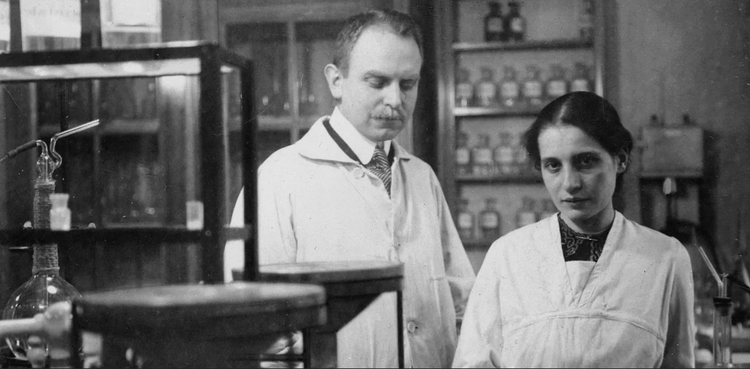
Otto Han & Lise Meitner
By 1940, Danish Niels Bohr (another Nobel Prize winner and exile from Nazi Europe) and American John Wheeler discovered that the best nuclei to be split for a fission reaction were those of the isotope uranium U235 because it was less stable than the more common uranium U238. The trick was to slow down the fission; otherwise, any bomb would blow up immediately rather than near the desired target. Another problem was just how much uranium would be needed to create the desired fission. Otto Frisch and Rudolph Peierls, both Jewish physicists who had fled Adolf Hitler‘s Third Reich, worked together in Birmingham, England, and they proposed the radical idea that just five kilograms of uranium would produce an explosive effect equivalent to a few thousand tons of dynamite. The commonly held view amongst scientists, including those in Germany (which is why the idea was passed over there), was that tons of uranium would be required. Frisch and Peierls turned out to be exactly right. The idea was sufficiently enticing for the British government to set up a committee to investigate whether a nuclear bomb could be made or not and to fund further research.
A parallel development was occurring both in Britain and in the United States, where scientists like Hans von Halban and Lew Kowarski (more refugees from German-occupied Europe) discovered the benefits of mixing nuclei of U235 and U238, a process which produced a new element: plutonium, which could be much more easily separated than uranium. It was also more practical to make a bomb this way, since only a very small amount of rare U235 was needed, the ratio of U235 and U238 being around 1:140. There was a catch, since it was still essential that the few U235 nuclei were split in the reaction. To ensure this happened, a surrounding ‘moderator’ material was used to bounce back neutrons until they split a U235 nucleus. The best moderating material was found to be graphite or deuterium (heavy water). US-based scientists, working at a rather leisurely pace and not well-funded by the government since the country was not yet at war, concentrated on stockpiling plutonium (actually fractions of a gram).
US Military Involvement Begins
The United States government began its first research into nuclear bombs following the collective recommendation to do so by US-based scientists in December 1941. Several of these scientists had personally seen the work of their colleagues in Britain and realised the project for a bomb was nearing final fruition. Thus began the Manhattan Project in August 1942.
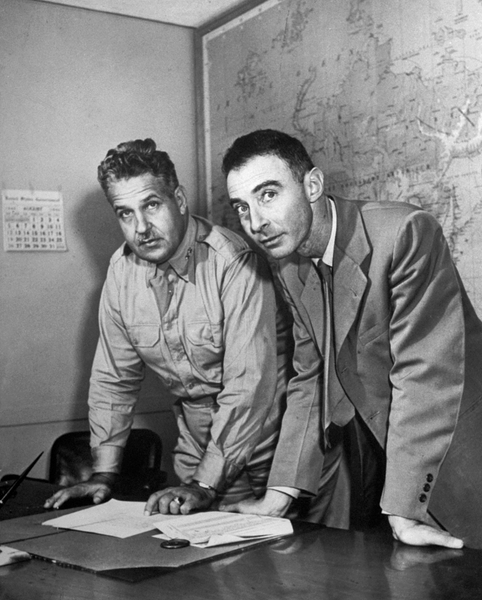
Groves & Oppenheimer, 1942
The Manhattan Project code name derives from the longer name Manhattan Engineer District, itself a code for the area in New York where buildings were set aside for the scientists charged with developing the atomic bomb. The military kept a tight hold on the idea, and, in September 1942, Colonel Leslie R. Groves (later promoted to lieutenant general), a military engineer, was put in overall charge of the project. Groves had already gained fame as the supervisor of the project to build the Pentagon, headquarters of the US Armed Forces in Washington. Except for the most senior scientists, no single person had a view of the project as a whole since, for security reasons, the work was heavily compartmentalised. Many scientists did not even know they were working on a weapon. The project was to be so secret; not even Congress was informed, nor was its authorisation sought.
Like Victor Frankenstein’s lumbering monster, the science was no longer in the hands of the scientists.
The US nuclear physicist Robert Oppenheimer (1904-1967) was chosen to head the international team of scientists – mostly US and British scientists, including some transferred from the British research project – that would develop the atomic bomb. Oppenheimer, who had a well-established reputation in his field, both for research and teaching, was also a bit odd, described by the biographer M. M. Boatner as “frail, intense, and unworldly” with a “cold, abrasive manner towards those he did not respect” (404). He was also young, at least for this field, and his appointment was objected to by several other key scientists. In addition, the FBI had a dossier on Oppenheimer concerning his early associations with left-wing organisations, an indicator of the almost paranoid tendencies of US government agencies at the time concerning espionage by agents of the USSSR. Groves stood by his appointment of Oppenheimer as team lead for the Manhattan Project.
Oppenheimer selected a site for development and actual testing: Los Alamos in New Mexico. There were two additional research sites: one at Oak Ridge in Tennessee and another at Hanford in the state of Washington. Ultimately, factories and research centres across the United States would become involved in the race to develop what was code-named the S-1 bomb. The Manhattan Project would involve over 100,000 individuals and rack up costs of around $2.5 billion (Moskin, 281).
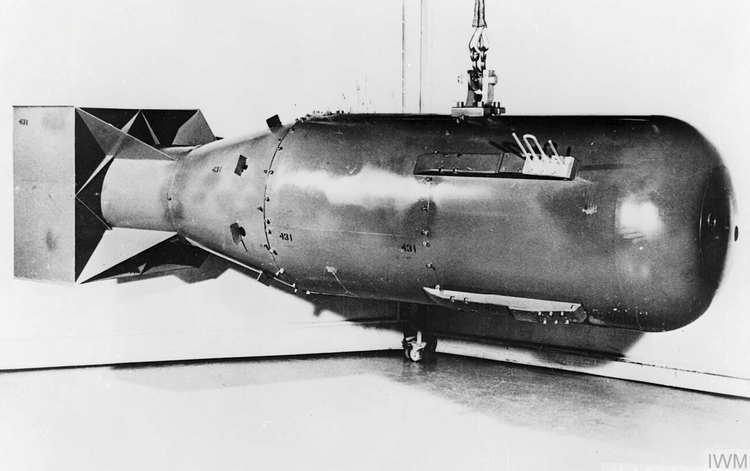
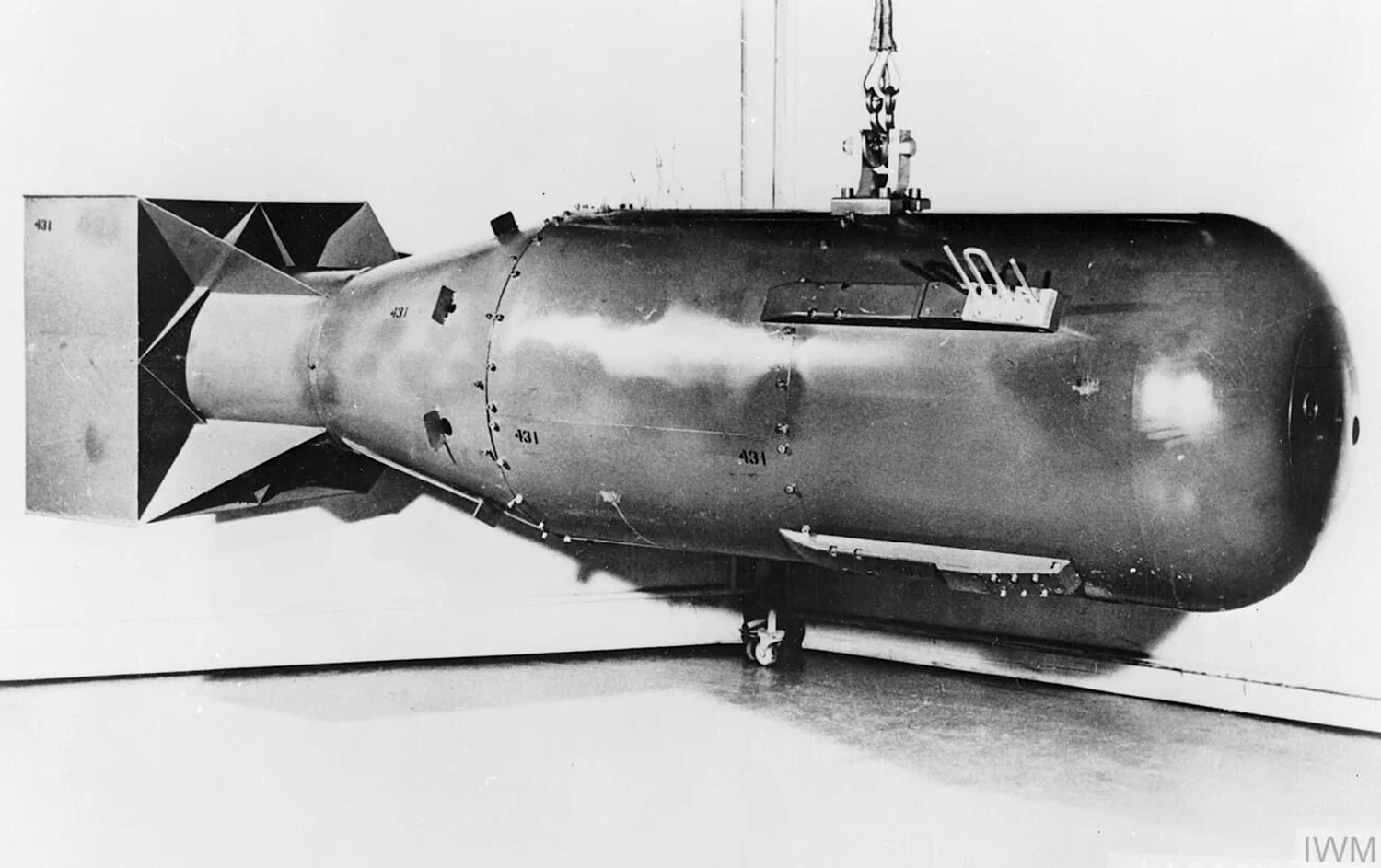
Little Boy Atomic Bomb
Testing the Bomb
There was still the problem that, for a practical bomb to work, the fission reaction had to be controlled. Szilard, who had fled Nazi Germany in 1933, created the first nuclear chain reaction, an experiment conducted with Fermi in Chicago in December 1942. The solution to controlling an explosion using plutonium proved relatively simple. This was to use conventional explosives either side of or entirely around the quantity of plutonium, which would compress it, increasing the density and the rate of fission. This type of explosion was tested, code-named Trinity, at a remote spot in the desert near Alamogordo, New Mexico, on 16 July 1945.
In the Trinity test, the explosion was equal to 18,600 tons of TNT, and it destroyed all plant and animal life within a mile radius. The shockwave was so powerful that it blew out windows 200 miles (322 km) away. The blast had been ten times more powerful than the scientists had expected. Not just the war but the fate of the entire world had changed in one moment. Oppenheimer was reminded of the line from the sacred Hindu text the Bhagavad Gita: “Now I am become Death, the destroyer of worlds” (Marston, 292).
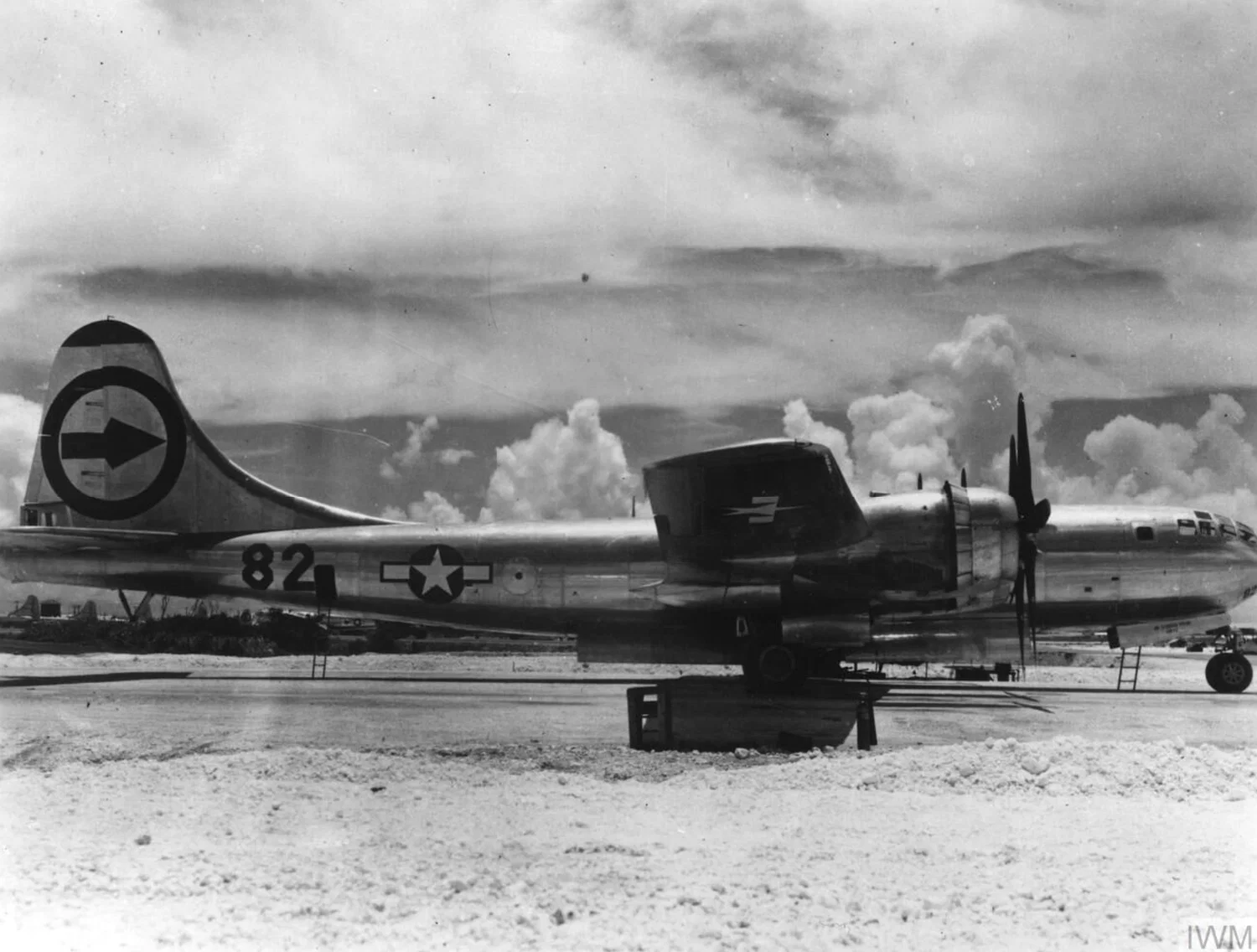
A uranium bomb required a different solution. The answer was to keep the critical mass in two separate parts until required. One half would then be fired at the other to create the explosion. This is exactly the mechanism used by the uranium bomb ‘Little Boy’, dropped by the Boeing B-29 Superfortress Enola Gay on the Japanese city of Hiroshima on 6 August 1945. This operation was, in effect, a test explosion. The plutonium bomb variation, given the name ‘Fat Man’, was dropped by the B-29 Bockscar on Nagasaki three days later on 9 August 1945.
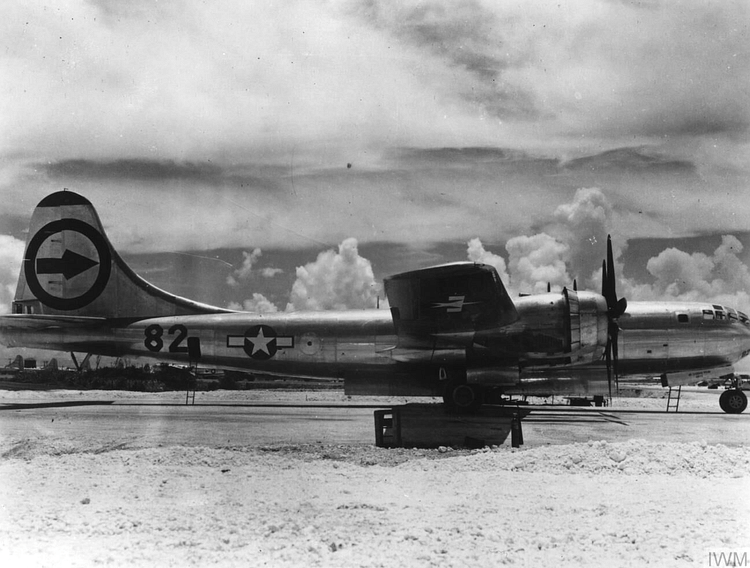
Enola Gay B-29 Superfortress
Both bombs had been dropped by parachute to explode at a height of around 1,625 feet (500 m) from the ground. ‘Little Boy,’ named in honour of the late President Roosevelt, measured 9 feet 9 inches (3 metres) in length, weighed almost 8,000 lbs (3,600 kg), and had an explosive power equivalent to 12.5 kilotons of TNT. Geoffrey Leonard Cheshire, an official British observer in another plane that flew with the Enola Gay, remembered its effects:
The flash just lit the cockpit, the moment I first saw it, it was like a ball of fire, but the fire rapidly died down and became a churning, boiling, bubbling cloud, getting larger and larger and rocketing upwards and I would think that within 2 or 3 minutes it was at 60,000 ft.
(Imperial War Museums)
‘Fat Man,’ named in honour of the portly British prime minister, Winston Churchill, measured 11 feet 4 inches (3.5 metres) in length, weighed over 9,000 lbs (4,000 kg), and had an explosive power equivalent to 22 kilotons of TNT.
The decision to drop two atomic bombs on Japan was taken by the new United States President Harry Truman with the full agreement of Churchill. It was decided not to give any warning to increase the psychological impact of the attack. The targets selected were to be relatively unaffected by the conventional Allied bombing campaign for the same reason. The hope was that such a terrible new weapon would force Japan’s military government to immediately surrender.
So far, all through the Pacific War, US and Allied forces had suffered dreadful casualties as they took various Pacific island archipelagos which Japanese forces had occupied and defended almost to the last man. At the Battle of Okinawa in April, May, and June 1945, around 100,000 Japanese combatants, up to 150,000 civilians, and around 12,000 US troops were killed. It was hoped that the two bombs on Hiroshima and Nagasaki would bring a surrender that avoided a highly dangerous amphibious operation on the main Japanese islands, one which had no guarantee of success. Even if successful, if the 35% casualty rate of Okinawa was repeated, the Pentagon estimated at least half a million US dead or wounded from such an operation. In the end, the objective of dropping the two bombs was achieved. Emperor Hirohito declared his willingness to sign a surrender on 15 August. The atomic bomb had won the war.
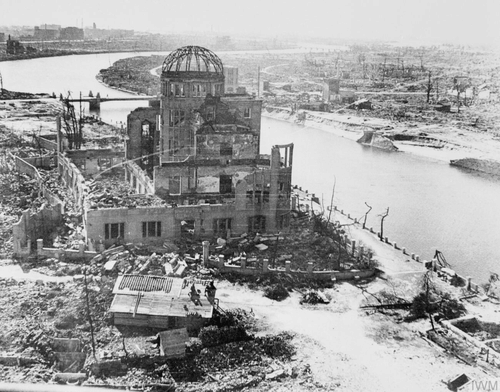
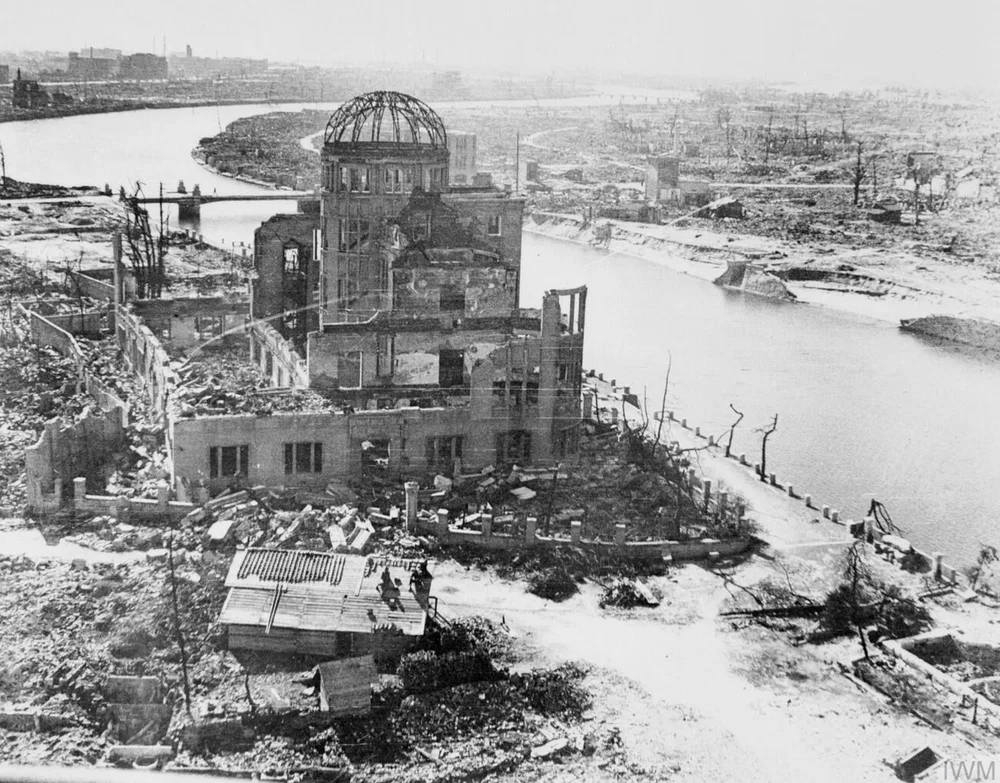
Hiroshima after the Atomic Bomb Attack
Aftermath: A Brave New World
While the keenest minds in physics had been solving the problem of how to best create an atomic bomb, not many had considered what its effects might be in reality. The immediate consequences of the bomb were, of course, suffered by the people of Hiroshima and Nagasaki.
The bomb explosions created a flash, a boom, and then vaporised everything and everyone in a gigantic fireball of 6,000 degrees Celsius. Further away from the epicentre, the effect of the explosions instantly burned the skin of people, and the shock or pressure wave, like a raging typhoon but lasting a mere second, ripped off clothing and flattened buildings. Trams were thrown in the air, trees were instantly charred, and fires spread throughout the city as an enormous dust cloud of debris smothered everything and rose miles into the air.
Estimates vary, but perhaps as many as 140,000 people were killed in the attack on Hiroshima when over 5 square miles (13 square kilometres) of the city were reduced to ashes. At Nagasaki, the bomb killed around 74,000 people and injured another 75,000 when around 2.6 square miles (6.7 square kilometres) of the city were also reduced to ashes. In both atomic bomb attacks, tens of thousands of survivors suffered the negative effects of radiation exposure in the following weeks, months, and years; indeed, many more people died in this way than in the initial blast.
Oppenheimer received the Presidential Medal of Merit for his work on the bomb, but he and many other prominent scientists protested at nuclear fission being used for weapons and called for moves to make the control of such weapons the domain of an international body. Oppenheimer had his security clearance revoked for this stance, a measure which effectively barred him from working at the cutting edge of the field. Szilard went even further than Oppenheimer and called for the total ban of nuclear weapons. But now, like Victor Frankenstein’s lumbering monster, the science was no longer in the hands of the scientists.
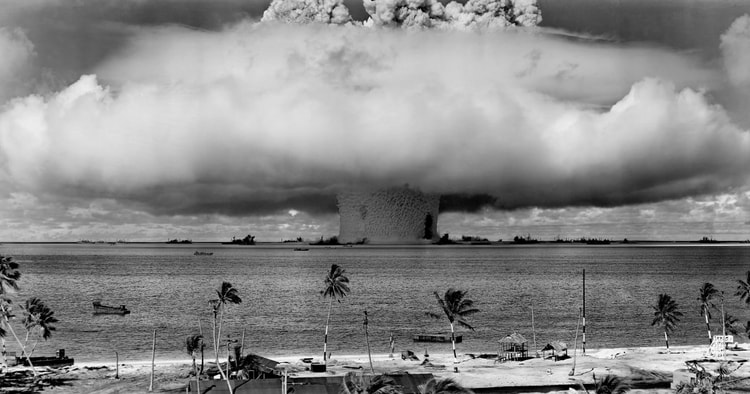
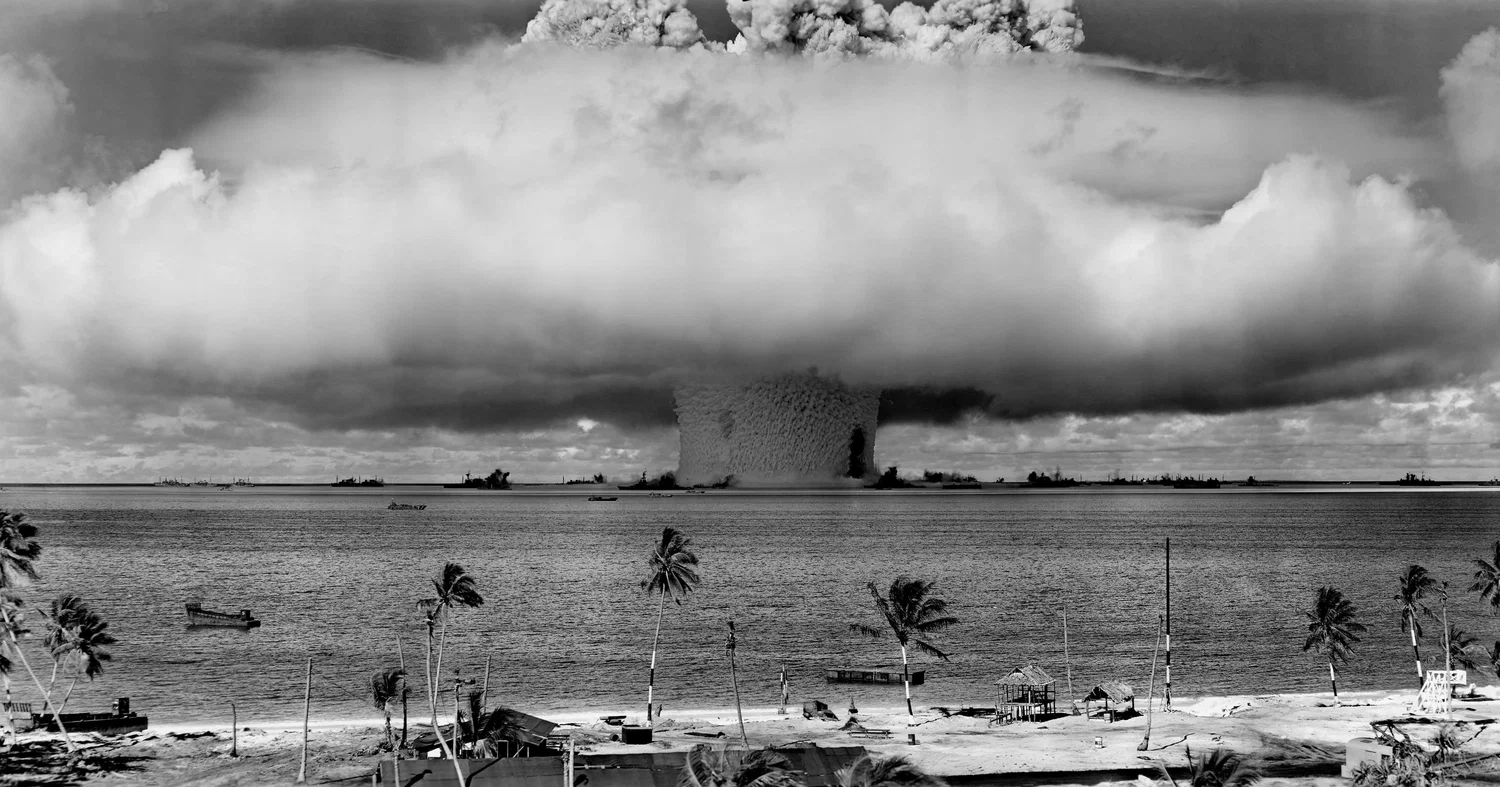
1946 Nuclear Test, Bikini Atoll
The two bombs dropped demonstrated to the USSR that the USA now possessed the most powerful weapon on Earth. These two military giants had already been jostling for who would control which pieces of territory once occupied by the losing Axis powers. In fact, the dropping of the bombs and the effect on present and future US-Soviet relations was a prime objective of the whole project, even if saving the lives of Allied servicemen had been the public justification. As the Manhattan Project’s leader General Groves noted:
There was never from about two weeks from the time I took charge of this project any illusion on my part but that Russia was our enemy and the project was conducted on that basis.
(Dear, 57)
The USSR had been rather slow in realising the potential of nuclear weapons and did not begin serious research until May 1942. The Soviet government, in any case, preferred to invest in espionage to simply steal the ideas developing in the West, and this, through the work of spies like Allan Nunn May and Klaus Fuchs working at Los Alamos, did pay dividends after the war as their nuclear programme developed more fully.
Meanwhile, scientists in the US continued to experiment in making an even more powerful bomb, the hydrogen bomb, which was first tested in 1952 in the Marshall Islands. Nuclear weapons were here to stay and greatly contributed to the prolonged divide between East and West known as the Cold War. An enduring fear remains today that devastating nuclear weapons could be used again in a future conflict.

