АНУ-ын Хойд Дакота мужаас олдсон тираннозаврын мөрийн мөр нь уг аварга махчин амьтны хөдөлгөөн болон зан төлөвийг судлах ховор боломжийг олгож байна.
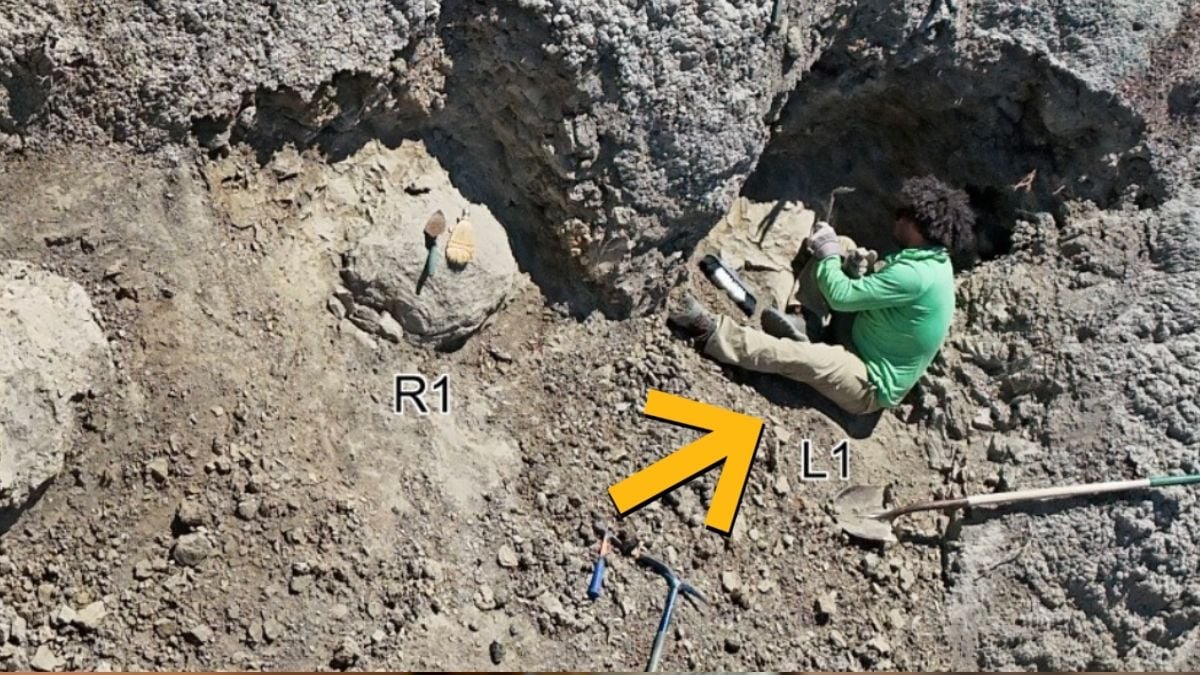
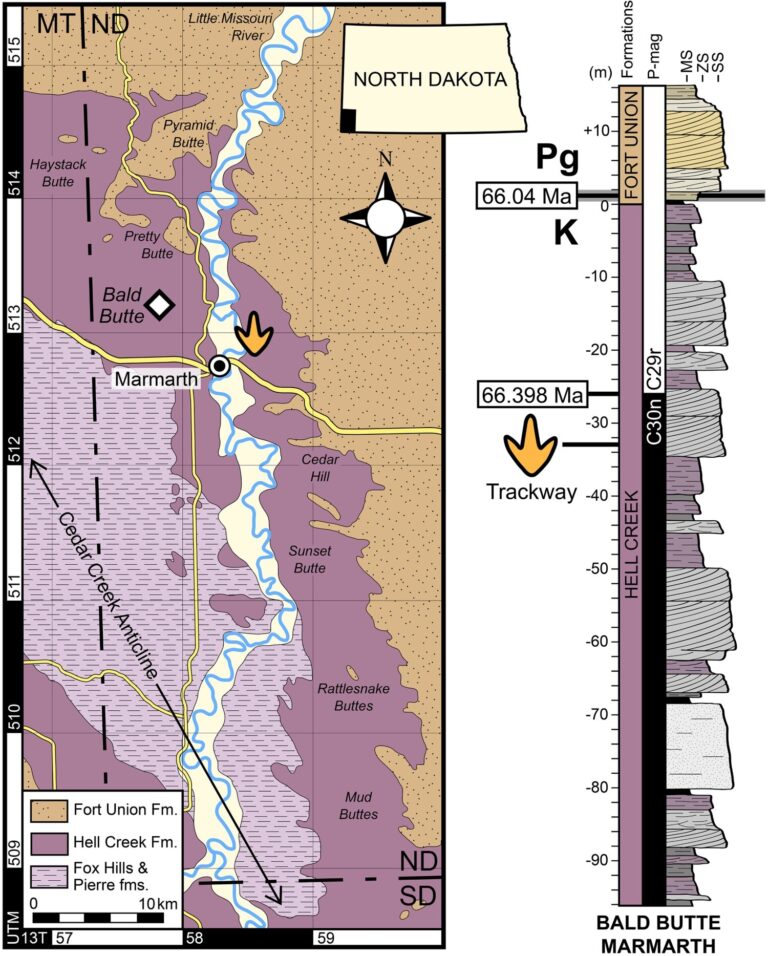
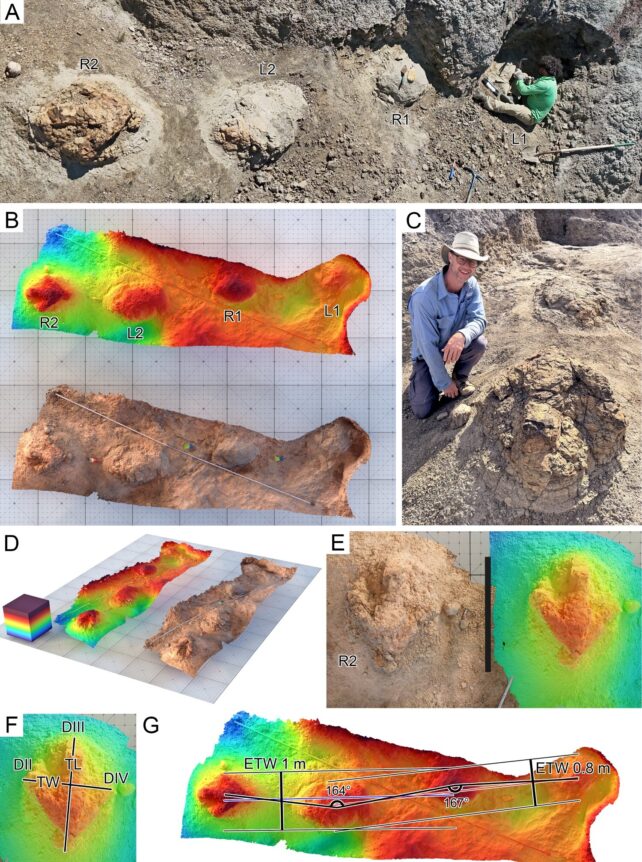
Палеонтологичид Хойд Дакота мужаас 66.5 сая жилийн настай, насанд хүрсэн Tyrannosaurus rex-ийн мөрийн мөрийг илрүүлснээ “Journal of Vertebrate Paleontology” сэтгүүлд нийтэлжээ. Одоогоор олдоод буй цорын ганц энэхүү мөрийн мөр нь 7 метр үргэлжлэх бөгөөд дөрвөн ширхэг том мөрийг агуулж байна. Мөр бүр нь 1 метр орчим урт, 0.8 метр хүртэл өргөн хэмжээтэй байгаа нь тухайн үеийн аварга махчин амьтны биеийн бүтцийг илтгэнэ.
Денверийн Байгаль, шинжлэх ухааны музейн ахлах куратор Тайлер Лайсон болон түүний багийнхан олдворын алхмын уртад үндэслэн тухайн үед уг үлэг гүрвэл секундэд 1.5-2 метрийн хурдтайгаар алхаж байсныг тогтоожээ. Энэ нь хүний алхах хурднаас хоёр дахин бага үзүүлэлт бөгөөд аварга том биетэй амьтны хувьд хэвийн хурд гэж судлаачид үзэж байна.
Ихэвчлэн үлэг гүрвэлийн яс олддог боловч мөрийн мөр олдох нь туйлын ховор байдаг. Энэхүү олдвор нь үлэг гүрвэлийн нүүдэл болон амьдралын хэв маягийг ойлгоход чухал ач холбогдолтой бөгөөд олдворын гурван мөрийг цаашид судлах зорилгоор Денверийн музей рүү шилжүүлэхээр төлөвлөж байна. Уг нээлтийг 2025 онд шинжлэх ухааны сонирхогч, багш Кент Хупс анх илрүүлсэн ажээ.
Дэлгэрэнгүйг эх сурвалжаас харах
↓Эх сурвалжийг нээх ↓
Very few, if any, animals single-handedly represent an entire geological episode lasting nearly 100 million years.
But Tyrannosaurus rex is no regular animal. Furthering that fact, a spate of recent findings has rekindled our childhood amazement of the Cretaceous period’s most iconic poster child.
These revelations include evidence that T. rex spawned multitudinous, cat-like babies, and an evolutionary explanation for its much-mocked, chicken-winged physique.
Fueling the fires of fascination, researchers have just reported one of the most revealing T. rex relics ever unearthed: a series of footprints left by this not-so-gentle giant as it stomped its way across a mystical land now known as North Dakota.
“Bones tell us an enormous amount about these animals, but footprints capture a moment of behavior,” says Tyler Lyson, a senior curator of vertebrate paleontology at the Denver Museum of Nature & Science and one of the study’s co-authors.
“With a trackway, we can actually follow an animal as it moved across the landscape. That is incredibly rare for T. rex.”
And although paleontologists have unearthed a relative bounty of T. rex skeletal remains – but lamentably little sex stuff – they have found only a couple of isolated footprints (not tracks) attributable to this reptilian overlord, previously unearthed in New Mexico and Montana, the researchers point out.
So this finding is especially enlightening as the first and only known footpath made by an adult T. rex, recreated impressively in the Journal of Vertebrate Paleontology.
The researchers extrapolated its age to 66.5 million years ago, on the epochal eve of the fated asteroid strike that devastated the non-avian dinosaurs and prompted the Paleocene epoch.
Importantly, it’s uncommon to find tracks and osteological (bony) fossil remains in the same place.
For one, they may each require different preservation conditions. Plus, trackways may be trodden upon by many living animals and therefore prone to destruction – imagine trying to find evidence of a long-gone hot dog at a state fair in the heart of seagull country.
Additionally, “footprints are not feet,” the researchers note. So as sediments shift, the resulting track may not mirror the morphology of the feet that shaped it.
Finally, even ‘mint condition’ tridactyl (three-toed) tracks may be hard to identify due to the foot-shaped similarities between the mostly-carnivorous theropods and the herbivorous ornithopods.
But this discovery presents lots of essential evidence. The trackway examined here is about 7 meters (23 feet) long and preserves four formidable footprints, each about 1 meter (3.2 feet) long and up to 0.80 meters (2.6 feet) wide, cemented for posterity by calcium carbonate.
Though heavily weathered, the track separation suggests an average stride length of about 4 meters (13.1 feet).
This results in an estimated walking speed of 1.5 to 2 meters per second (3.3 to 4.5 miles per hour), which is reasonable for a large animal, the researchers clarify.
For comparison, this isn’t even twice as fast as the average human walking speed. So, hopefully, this individual had nowhere important to be, considering the Chicxulub impactor sucker-punched Earth with the force of 10 billion atomic bombs not long thereafter.
Altogether, given the age, locality, and physical features of the tracks, the researchers say that “an adult Tyrannosaurus rex is the most likely trackmaker”.
This supplements some similar but different previous findings. In a paper published in PLOS One in 2014, researchers described an intriguing trio of concurrent tracks made by other, smaller tyrannosaurids, hinting at gregariousness in some members of this fearsome family.
Related: ‘Vanishingly Rare’ Discovery: T. Rex Hatchlings Were Smaller Than a Cat And Born by The Dozen
And though additional excavations could reveal more of the trackway, or other features that inform dinosaurian walking behavior, the overburden of the steep “gumbo” butte nearby “means that further excavations may be unlikely,” the researchers say.
Fortunately, three of the footprints will be saved and soon airlifted to the Denver Museum of Nature & Science.

Finally, this revelation highlights the mind-expanding value of our innate human yearning for learning, explains Kent Hups, a science teacher at Northglenn High School and amateur fossil sleuth who discovered the trackway in 2025, as well as one of the study’s co-authors:
“As a teacher, I’m always telling my students that science starts with curiosity, passion and careful observation. I never imagined that could lead me to a discovery like this.”
This research was published in the Journal of Vertebrate Paleontology.
This article was fact-checked by Fiona MacDonald and edited by Fiona MacDonald. While we pride ourselves on our process, we are only human. If you spot a mistake, please let us know.

