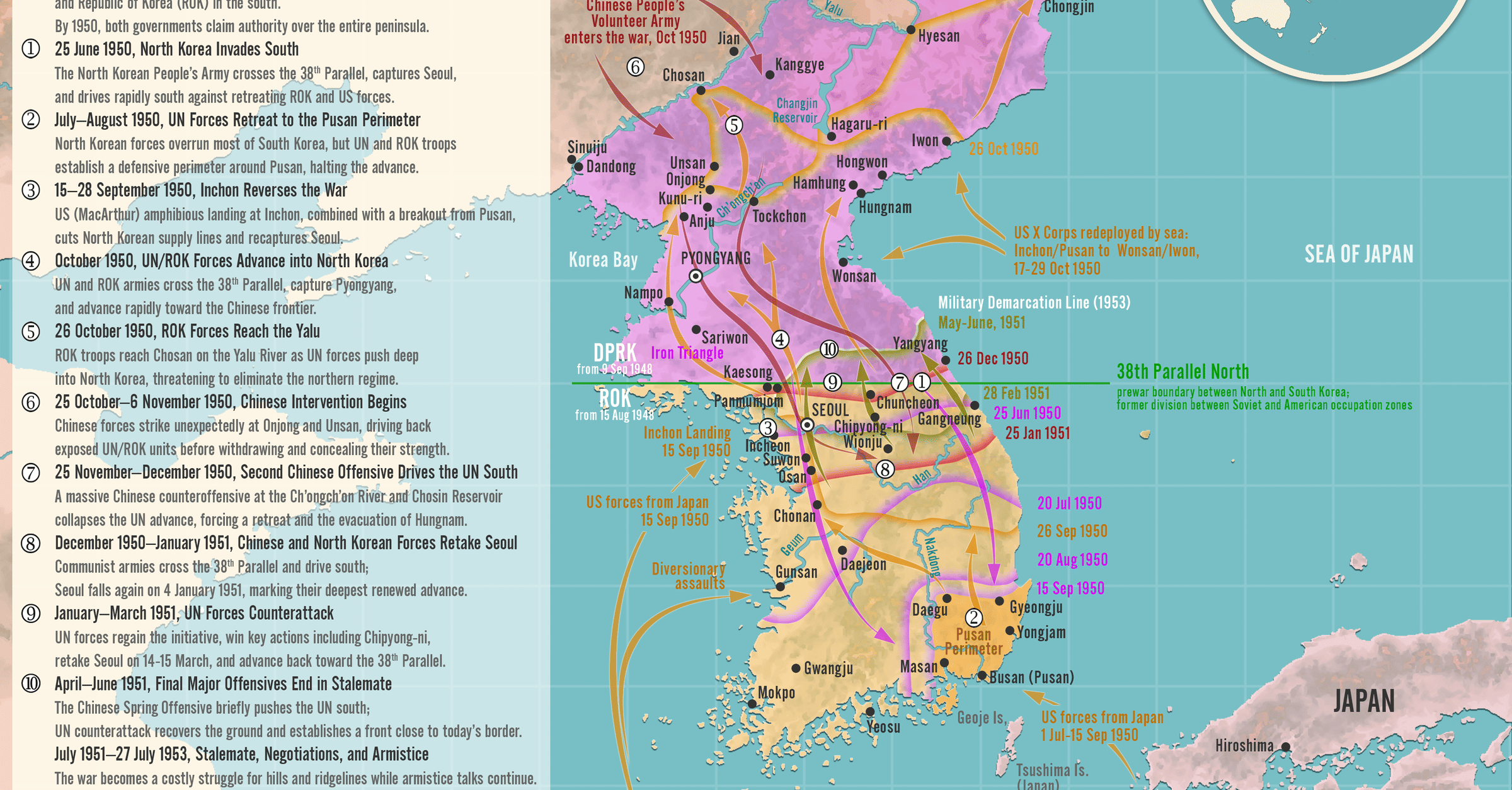
Солонгосын дайн нь 1950-1953 оны хооронд Хойд болон Өмнөд Солонгосын хооронд өрнөсөн Хүйтэн дайны үеийн томоохон зэвсэгт мөргөлдөөн байв.
Дэлхийн хоёрдугаар дайны дараах ертөнц капиталист ба социалист хэмээх хоёр туйл болж хуваагдсан нь Хүйтэн дайны эрин үеийн улс төр, эдийн засаг, технологийн тасралтгүй өрсөлдөөнийг бий болгосон билээ. Нацист Германыг ялсны дараа Зөвлөлт Холбоот Улс өөрийн эргэн тойронд социалист дагуул улсуудыг байгуулж эхэлсэн бол АНУ коммунизмын тархалтыг зогсоохыг зорьж байв. Энэхүү үзэл суртлын зөрчилдөөн Солонгосын хойгт хурцаар илэрч, Умард нь коммунист, Өмнөд нь капиталист/либерал замыг сонгосноор иргэний дайн дэгдэх үндэс суурь тавигджээ.
38-р өргөрөг ба хоёр Солонгосын хуваагдал
1905-1945 оны хооронд Япон улс Солонгосыг колоничлон захирч байсан бөгөөд солонгосчууд тусгаар тогтнолын төлөө партизаны дайн өрнүүлж байв. 1943 оны Каирын бага хурлаар Холбоотнууд Солонгосыг ирээдүйд тусгаар тогтносон улс болгохоор шийдвэрлэсэн ч, Японы удаан хугацааны ноёрхлоос гарсан тус улсыг олон улсын асрамжийн дор байлгахаар төлөвлөсөн байна.
1945 оны Ялтын бага хурлын дараа ЗХУ Японы эсрэг дайнд оролцохоо амлаж, наймдугаар сард Солонгосын хойгт цэргээ оруулжээ. АНУ Зөвлөлтийн нөлөө хэт тэлэхээс болгоомжилж, Америкийн хоёр офицер газрын зураг дээр 38-р өргөрөгийг ашиглан “хиймэл хил” тогтоосон нь Солонгосыг хоёр цэргийн бүсэд хуваах эхлэл болсон юм.
Ким Ир Сен ба Сингман Рхи
1945-1948 оны хооронд хойд хэсгийг Зөвлөлтийн цэргийн захиргаа, өмнөд хэсгийг АНУ-ын цэргийн захиргаа удирдаж байв. Японы эсрэг партизаны тэмцэлд оролцож байсан Ким Ир Сеныг хойд хэсгийн удирдагчаар сонгосон бол, 1948 оны тавдугаар сард өмнөд хэсэгт сонгууль явагдаж, Сингман Рхи БНСУ-ын ерөнхийлөгчөөр томилогджээ. Удалгүй Ким Ир Сен БНАСАУ-ыг байгуулсан байна.
Хоёр удирдагч хоёулаа улс орноо нэгтгэхийг зорьж байсан тул 1948-1950 оны хооронд хилийн мөргөлдөөн тасралтгүй үргэлжилжээ. ЗХУ Хойд Солонгосыг Т-34 танк, хүнд артиллери, нисэх онгоцоор хангаж байсан бол АНУ Өмнөд Солонгосыг довтолгооны зэвсгээр хангахыг хориглож байв. 1950 онд Ким Ир Сен ЗХУ-д нууцаар айлчилж, Иосиф Сталинаас довтолгоо хийх зөвшөөрөл авчээ. Сталин ЗХУ-ыг барууны орнуудтай шууд зэвсэгт мөргөлдөөнд оруулахыг хүсээгүй ч шаардлагатай зэвсгээр хангахыг зөвшөөрсөн байна.
Дайны эхлэл ба Сөүлийн уналт
1950 оны зургадугаар сарын 25-ны ням гарагт Хойд Солонгосын гэнэтийн довтолгоо эхэлж, Өмнөд Солонгосын арми бэлтгэлгүй байсан тул хоёр хоногийн дараа Сөүл хотын үүдэнд тулаан өрнөжээ. 100,000 цэрэг, 300 танк, 150 нисэх онгоц бүхий Умардын армийн давшилт АНУ-ыг цочролд оруулсан байна. АНУ коммунист дэглэм Солонгост ялах нь Япон, Тайванийн аюулгүй байдалд заналхийлж, Номхон далайн бүс нутагт ЗХУ болон Хятадын нөлөөг нэмэгдүүлнэ хэмээн үзэж, цэргийн хүчээр оролцохоор шийджээ.
Номхон далайн дайны баатар, генерал Дуглас МакАртур Вашингтоны зөвшөөрлийг хүлээлгүйгээр Японоос зэвсэг илгээж, зургадугаар сарын 28-нд Сөүл унасны дараа газрын цэргийн ажиллагааг эхлүүлэх шаардлагатайг мэдэгдсэн байна. Сөүл хот дайны туршид дөрвөн удаа гар дамжсан бөгөөд хотын уналт Өмнөдийнхнийг ихээхэн сандаргасан юм.
Пусаны хамгаалалт ба Инчоны буулт
1950 оны найм, есдүгээр сард АНУ болон Өмнөд Солонгосын хүч Пусаны эргэн тойронд бүслэлтэд орсон ч “Эцсээ хүртэл тулалдах” тушаалын дор хамгаалалтын шугамаа барьж чаджээ. Генерал Уолтон Уокер цэргүүддээ “ухрах газар байхгүй” хэмээн тушааж, Пусан боомтыг алдах нь бүхэлдээ ялагдал болохыг сануулсан байна.
МакАртур дайсны ар тал руу цохилт өгөх стратегийг боловсруулж, 1950 оны есдүгээр сарын 15-нд Инчон хотод амфиби буулт хийжээ. Энэхүү зоригтой алхам амжилттай болж, есдүгээр сарын 28-нд Сөүлийг эргүүлэн авсан бөгөөд НҮБ-ын хүчин 38-р өргөрөгийг давж, Ялу гол хүртэл давшив.
Хятадын оролцоо ба сунжирсан дайн
Хятад улс НҮБ-ын хүчин хил рүү нь ойртсоныг үндэсний аюулгүй байдалд заналхийлэл гэж үзэн “сайн дурынхны” армийг илгээжээ. 1950 оны аравдугаар сард 300,000 Хятад цэрэг тулаанд орж, НҮБ-ын хүчнийг ухраав. Арваннэгдүгээр сарын 25-нд эхэлсэн Хятадын хоёр дахь довтолгооны үеэр Чосин усан сангийн орчимд АНУ-ын тэнгисийн явган цэргийн 30,000 хүнтэй хүч 120,
Дэлгэрэнгүйг эх сурвалжаас харах
↓Эх сурвалжийг нээх ↓
The Korean War was a Cold War conflict that took place between North and South Korea from 1950 to 1953. It pitted US-led United Nations (UN) forces against the communist bloc supported by the Soviet Union and China, and it is considered the first armed conflict between the capitalist and socialist worlds following World War II (1939-45).
The era known as the Cold War was characterized by continuous economic, political, military, and technological rivalry between the United States and the Soviet Union until the latter’s collapse. The world was divided into two poles by the ideologies of capitalism and communism. The Soviet Union, having emerged victorious from the war against Nazi Germany, began to establish socialist satellite states around itself, while the power representing capitalism was the United States, and it certainly did not want the spread of communism.
The two sides clashed in Korea, both aiming to expand their area of control. Just as the world was fundamentally divided into two during the Cold War, Korea was split into South and North; while the North chose communism, South Koreans opted to become part of the capitalist/liberal world, which led to a civil war.
38th Parallel
Between 1905 and 1945, Korea was a Japanese colony, and Koreans waged a primarily guerrilla war for independence. However, they were unable to stand against Japan‘s superior firepower, naval and air forces, and war industry. At the 1943 Cairo Conference, Allied leaders (the US, the UK, and also nationalist China) decided that Korea would eventually become independent, but having endured a prolonged Japanese occupation, the country would struggle with governing itself for decades, and so Korea was placed under international trusteeship.
The 38th Parallel emerged as a 200-mile (320-km) boundary on the map, which divided Korea into two separate military occupation zones.
At the Yalta Conference in February 1945, the Soviet Union promised to enter the war against Japan following the defeat of Nazi Germany. In August, the USSR entered the Korean Peninsula via Manchuria, accepting the surrender of Japanese forces there. The rapid entry of Soviet troops into Korea caused alarm in the United States that the entire Korean Peninsula might fall under Soviet control. Consequently, two American officers, working without any reliable data (they were using National Geographic maps), designated an “imaginary border,” which became famously known as the 38th Parallel, as the limit of the Soviet advance. The 38th Parallel emerged as a 200-mile (320-km) boundary on the map, which divided Korea into two separate military occupation zones: North and South Korea.
Kim Il Sung & Syngman Rhee
Between 1945 and 1948, the Soviet Military Administration governed in the north, and the United States Army Military Government in Korea (USAMGIK) was in charge of the south. Kim Il-sung (1912-1994), who was known in his youth for his guerrilla activities against Japanese forces and received training and rose to the rank of major within the Red Army during WWII, was selected to lead North Korea. The plan was to hold joint elections across the entire country under United Nations supervision, but this was blocked by Soviet opposition, and so elections were held only in the south in May 1948. The Republic of Korea (South Korea) was established in August 1948 under the leadership of Syngman Rhee (1875-1965), and in the north, Kim Il-sung founded the Democratic People’s Republic of Korea. He is remembered to this day as Korea’s “Eternal President of the Republic” (Gonghwagug-ui yeongwonhan juseok).
Kim Il-Sung During Korean Elections
Both Syngman Rhee and Kim Il-sung sought to unify Korea under their own control, which led to frequent and bloody border clashes between 1948 and 1950. However, while the US withheld heavy offensive weaponry from the South Korean army out of concern that Rhee might attack the North, the Soviet Union extensively equipped and trained the North Korean army with T-34 tanks, heavy artillery, and fighter aircraft. In 1950, Kim Il-sung traveled secretly to the Soviet Union, where Joseph Stalin (1878-1953) finally granted the necessary authorization for North Korea to invade the remainder of the peninsula. Stalin had no intention of directly drawing the Soviet Union into the war. “He felt the Soviet Union itself was not yet ready for a military conflict with the West. However, all requested war material would be delivered” (Malkasian, 16).
The First Shots
On 25 June 1950, a Sunday morning, the silence was broken by the sounds of gunfire and artillery rounds. To this day, the question of which side fired the first shot remains a matter of dispute. The sudden North Korean offensive caught South Korean troops completely off guard. Many generals and party leaders were abroad at the time. Just two days later, the North Korean army stood at the gates of Seoul. The South Korean military was in a state of panic, which caused the early demolition of a strategic bridge over the Han River, leaving the South Korean army’s equipment stranded on the opposite side of the river. An invasion force of 100,000 soldiers, 300 Soviet-made tanks, and 150 aircraft had surged toward South Korea.
This sudden North Korean offensive took the United States – no less than South Korea itself – by surprise; no one had anticipated an attack to occur this soon. The United States had no intention of allowing such a strategic peninsula as Korea to fall into the hands of Communist forces. The United States was adamantly opposed to the spread of communism and was determined to ensure that the mistakes of the 1930s, such as failing to stop Adolf Hitler earlier, would not be repeated. A victory for the Communist regime on the Korean Peninsula would have directly placed Japan and Taiwan in jeopardy, while enabling China and the Soviet Union to operate with greater freedom in the Pacific and endangering US policies in the region.
President Truman and General MacArthur at Wake Island 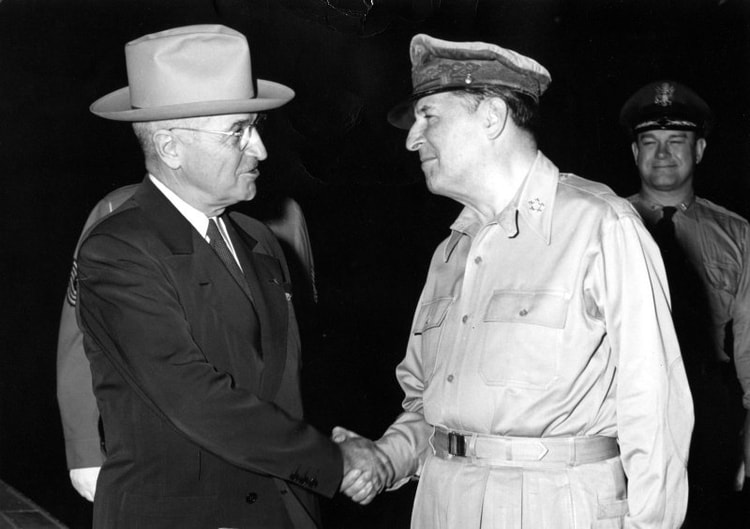
Among those who did not want communism to be spread into Korea was the renowned American General Douglas MacArthur (1880-1964). The legendary commander of the Pacific War, MacArthur, had assumed command of the Allied Forces against Japan and became known for leading the US troops to victory. Subsequently, having personally overseen Japan’s surrender, he established his headquarters specifically in the Dai-Ichi Seimei (First Insurance) building in Tokyo and governed Japan from there. The moment he received the news of the offensive launched by the North Korean army, he began dispatching arms from Japan to Korea without even waiting for approval from Washington. Upon landing in Pusan, Korea, on 28 June, MacArthur assessed the state of the Korean military and realized this war could not be won solely through the support of US air and naval forces. On 30 June, he sent reports to Washington and asserted that ground operations needed to begin immediately.
Fall of Seoul & Retreat
Meanwhile, on 28 June, Seoul had fallen under the control of Communist forces. South Korean President Syngman Rhee had been evacuated from the city shortly before it was captured, and the rushed abandonment of the capital, coupled with the lack of coordination during the bridge incident, plunged the South Korean side into a state of demoralization and chaos during the opening days of the war. The city had devolved into a literal war zone within just 72 hours, and as the conflict went on, it would change hands four times.
Syngman Rhee 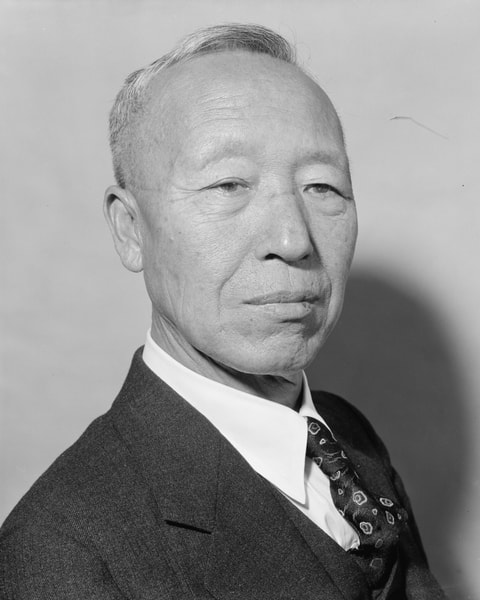
On 5 July, Lieutenant Colonel Charles B. Smith confronted North Korean troops that had decided to halt and rest just south of Seoul. This unit, which was destined to go down in history as Task Force Smith, numbered only around 500 men and became the first US force to engage North Korean tanks during the Battle of Osan. As expected, this force was hopelessly outnumbered by the North Korean troops, and a chaotic general retreat began as a result.
Terrain, logistics, poor communications, and refugees did more to delay the North Korean advance in the first weeks of July than the American infantry in their path.
(Hastings, 79)
Pusan Perimeter
The American and South Korean armies appeared to be largely encircled in southeastern Korea. The defensive line, known as the Pusan Perimeter, was established in August and September 1950, early in the war, and had effectively become the “last bastion” for South Korea and UN forces. Pusan was a vital port city in the southeast of the Korean Peninsula, and the vast majority of military equipment and supplies were supplied through this port. The fall of the city would have meant total defeat. While the Americans were occupied with dealing with their foes in the north, a critical situation was developing on the western front at the same time:
North Korean division had hooked around Taejon and hastened through the defenseless countryside southward. By August 1 its leading elements were near Masan, just thirty miles short of the southeastern port of Pusan.
(Hastings, 82)
This line, stretching approximately 230 kilometers (140 mi), was based on the Naktong River as a natural barrier to hold against. It was here that the commander of the US Eighth Army and a veteran who had fought alongside General George S. Patton (1885-1945) on the African and Northwest European fronts during World War II, General Walton Walker (1889-1950), issued his famous order to his troops, declaring that retreat was no longer an option. The order was quite simple: “Stand or Die!”
Two United Nations Soldiers Take a Smoke Break 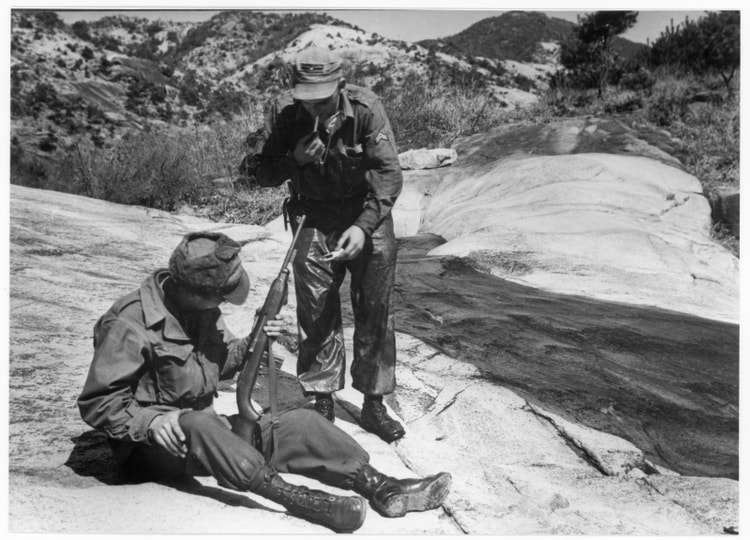
This situation actually played to the advantage of the US and South Korean forces; their supply lines were shortened, and the front line became clearer, whereas the North Korean army’s supply lines were extended. Walker described the situation:
There will be no more retreating, withdrawal, or readjustment of the lines or any other term you choose. There is no line behind us to which we can retreat. one Every unit must counterattack to keep the enemy in a state of confusion. There will be no Dunkirk, there will be no Bataan; a retreat to Pusan would be of the greatest butcheries in history. We must fight until the end. Capture by these people is worse than death itself. We will fight as a team. If some of us die, we will die fighting together.
(Appleman, 207-208)
The Inchon Landing
MacArthur had a brilliant plan to extricate the United Nations forces from this predicament. Drawing upon the experience he gained fighting the Japanese army during a series of island campaigns during World War II, he was convinced that striking behind enemy lines and severing their supply routes would leave them helpless. A suitable location for this amphibious assault needed to be identified, and Inchon was the perfect fit for this. Many officers had doubts about Inchon’s suitability as a landing site, and they had no intention of diverting their already outnumbered troops away from their sole existing defensive line to undertake such a high-risk operation. MacArthur, however, was certain he had chosen the right location, and he took the gamble:
It will be like an electric fan. You go to the wall and pull the plug out, and the fan will stop. When we get well ashore at Inchon, the North Koreans will have no choice but to pull out, or surrender.
(Hastings, 100).
Inchon was a significant port city west of Seoul, and reaching Seoul from there would be easier than fighting all the way up north from the south. Ultimately, the amphibious landing took place on 15 September 1950, and Seoul was recaptured on 28 September. The North Korean army had no other choice than to retreat or die. Determined to push beyond their current territory, UN forces continued their advance north of the 38th Parallel and were pushing toward the Yalu River.
US Marines Conducting Inchon Landing 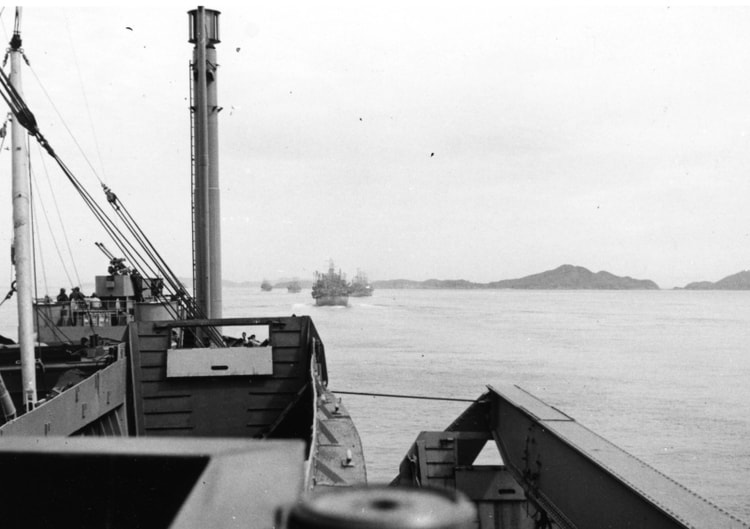
The Chinese First Offensive
The UN forces’ advance toward the Yalu River near the Chinese border was perceived by China as a national threat to itself, and a Chinese army, composed of ‘volunteers’ to fight on behalf of Communist North Korea, was immediately dispatched. The deployment of this army under the name of ‘volunteers’ was a deliberate measure taken to avoid direct conflict between the United States and China. In October, approximately 300,000 Chinese volunteer troops crossed the Yalu River and began marching toward the United Nations forces. Meanwhile, UN forces had already captured Pyongyang, the capital of North Korea, and everyone believed the war was nearing an end. However, the Communist forces had not yet given up, and now they had the backing of Chinese ground troops as well as Soviet air support provided by MiG-15 fighter jets.
UN forces faced with the Chinese First Offensive were unable to withstand the onslaught of this massive army surging toward them and began to retreat once again. Just as UN forces were beginning to advance northward again after having recovered from the shock of the First Offensive, the Second Offensive was launched on 25 November 1950. While the US Eighth Army on the western side of the peninsula suffered a severe blow and was forced into a bug-out (a panicked retreat), the US Marines on the eastern flank at the Chosin Reservoir managed to defend their positions in the mountains and withdraw while maintaining discipline and order. A force of 30,000 Marines was encircled by a Chinese army numbering 120,000. The battle took place during the winter months, with temperatures dropping to -40 degrees Celsius; the enemy did not have to be in the form of a human body, it could be nature itself. Fighting their way to the port of Hungnam, these units were ultimately able to break free from the encirclement, evacuating by sea and taking hundreds of thousands of civilians with them.
General vs. President: The War of Attrition
One of the most remarkable episodes of the war was the rift that emerged between General MacArthur & US President Harry S. Truman.
The repercussions of this Second Offensive were not merely military; they also carried significant political weight. One of the most remarkable episodes of the war was the rift that emerged between General MacArthur and US President Harry S. Truman (1884-1972). MacArthur viewed the conflict as a war of annihilation, defending the idea that victory could only be achieved by directly bombing China and its ports and airfields and severing its logistical supply lines to trigger critical shortages. Truman believed that the Soviet Union, rather than China, was the primary rival. He argued that the United States should not expend its entire strength in this region, fearing that if it used and thus wasted all of its resources in Korea, the Soviet Union might seize the opportunity to launch a war in Europe and capture it before the US could replace its ammunition stocks. Consequently, he advocated for the conflict to be conducted as a limited war.
Nevertheless, the event that drove the final nail into the coffin of their relationship was MacArthur’s intervention in politics. More specifically, his decision to send a letter to Republican members of the Senate in which he openly criticized President Truman’s decisions caused Truman to remove him from his office. In April 1951, the renowned Pacific general, MacArthur, was relieved of his command, and this decision sent shockwaves through the nation. The rest of the war mostly settled into a state of static warfare along the front lines.
Ceasefire
In 1952, Dwight Eisenhower (1890-1969) was elected as the President of the United States. The notion that Eisenhower’s election would play a more decisive role in the course of the war was gaining more acceptance (Malkasian, 82). By 1953, both sides were actively seeking a military or political resolution. Eisenhower sought to avoid taking actions that might draw the Soviets into the war, while simultaneously attempting to convince the Communist side that there was no point in prolonging the war any further. Meanwhile, in the Soviet Union, Stalin died in March 1953. Peace no longer seemed so distant.
Korean War Armistice Agreement 1953 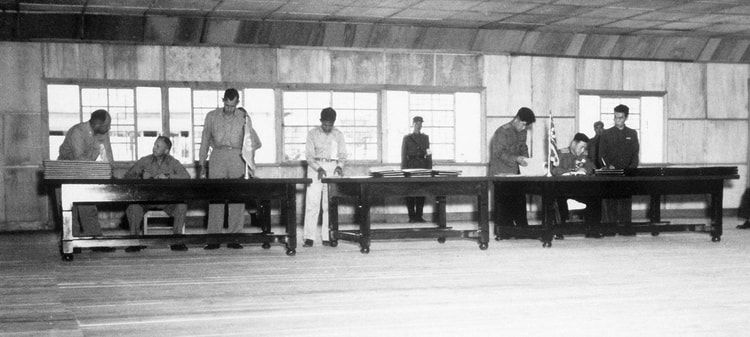
The UN delegation presented its final position in May 1953, and if the Communists rejected this agreement, the only remaining solution would have been to bring the conflict to an end through military means. On 27 July, the armistice was finally signed.
Conclusion
While the North Korean military suffered approximately 600,000 casualties, civilian losses amounted to around two million (Malkasian, 88), and the Chinese Volunteer Army suffered over one million casualties. The armed forces of South Korea counted 70,000 fatalities, while the US troops lost approximately 33,000 men. The peace talks in Geneva in 1954 brought no resolution, and, in fact, the war never actually ended.
Kim Il-sung, for his part, succeeded in consolidating the communist regime within the borders of North Korea, establishing a communist state that has survived to this day. South Korea, meanwhile, pursued the exact opposite path, adopting a liberal approach.

