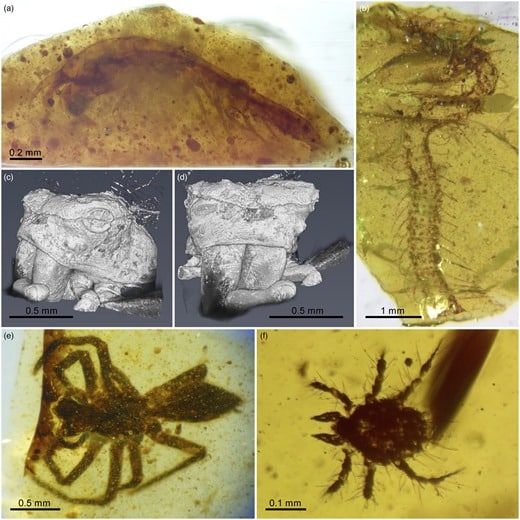
Эл Соплао орчмын бүсээс олдсон энэхүү ховор олдворууд нь эртний экосистемийн хөгжлийг судлах чухал ач холбогдолтой байна.
Испанийн хойд хэсгийн Кантабриа мужид авто замын ажил гүйцэтгэх явцад 105 сая жилийн тэртээх хувны орд санамсаргүй байдлаар илэрчээ. 2005 онд анх нээгдсэн энэхүү “Эл Соплао” талбай нь өдгөө 1500 гаруй үе хөлтөн амьтдын олдвор болон шинээр тодорхойлсон 40 зүйл амьтныг агуулсан, палеонтологийн онцгой ач холбогдолтой цэг болсон байна. “Journal of the Geological Society” сэтгүүлд 2026 оны наймдугаар сарын 13-нд нийтлэгдсэн судалгаагаар, энэхүү олдвор нь цэцэгт ургамал дэлхий дахинд тархаж эхэлсэн Цэрдийн галавын эхэн үеийн биологийн өөрчлөлтийг судлах ховор боломж гэдгийг онцолжээ.
Хувны хэсгүүд нь химийн гваязулен нэгдлийн нөлөөгөөр цэнхэр-ягаан туяатай байдгаараа дэлхийн бусад ижил төстэй олдворуудаас ялгардаг. Валенсиагийн их сургуулийн доктор Альба Санчез-Гарсиа тэргүүтэй судлаачдын тогтоосноор, энэ хув нь тухайн үед давамгайлж байсан шилмүүст модны Cheirolepidiaceae овгийн төрөл зүйлээс үүсэлтэй аж. Олдворуудын ихэнх нь гурван хэмжээст хэлбэрээ хадгалсан байх бөгөөд микротомографийн шинжилгээгээр тэдгээрийг хоосон хэвүүд болохыг тогтоосон байна.
Тус олдворуудын дунд шинжлэх ухаанд мэдэгдэж буй хамгийн эртний хачиг болон өнөөгийн шавжтай ижил төстэй аргаар өөрийгөө хамгаалдаг lacewing авгалдай зэрэг ховор амьтад багтаж байна. Түүнчлэн цэцэгт ургамлаас өмнөх үеийн тоос хүртэлтийн үйл явцыг батлах цэцгийн тоос тээж яваа ялаа болон теропод үлэг гүрвэлийн өд зэрэг нь тухайн цаг үеийн экосистемийн нарийн ширийн зан төлөвийг илтгэдэг.
Гэсэн хэдий ч судалгааны явцад тодорхойгүй асуудлууд хэвээр үлдсэний нэг нь бусад бүс нутгийн ижил төстэй олдворуудад илэрдэг шоргоолжны үлдэгдэл Эл Соплаогийн орд газраас огт олдоогүй явдал юм. Судлаачид орчин үеийн дэвшилтэт арга техникийг ашиглан байгалийн жамаар хадгалагдан үлдсэн эдгээр олдворын экосистемийн хэв шинжийг нарийвчлан тайлбарлахаар судалгаагаа үргэлжлүүлж байна.
Дэлгэрэнгүйг эх сурвалжаас харах
↓Эх сурвалжийг нээх ↓
In the hills of Cantabria, northern Spain, a deposit of amber unearthed by chance during roadworks has become one of the richest windows scientists have into life 105 million years ago. Glowing with an unusual blue-violet hue, the El Soplao site has yielded more than 1,500 arthropod specimens and 40 newly described species.
The story of El Soplao began almost by accident in 2005, when construction work exposed the deposit, though it took another two years before a pair of geologists recognized its scientific value. Since then, nearly two decades of excavation have turned it into what researchers call a reference Konservat-Lagerstätte, a site of exceptional fossil preservation that helps reconstruct how entire ecosystems functioned, not just what individual organisms looked like.
The amber itself dates to the Albian stage of the Early Cretaceous, a period of sweeping biological change when flowering plants began their ascent over the conifer forests that had dominated for millions of years. According to a new review published August 13, 2026 in the Journal of the Geological Society, this timing is precisely what makes the deposit so valuable.
Why This Amber Glows Blue?
Unlike most amber deposits, El Soplao’s pieces are marked by a striking blue-violet glow, a feature traced to a chemical compound called guaiazulene. This distinctive coloration sets the site apart from other ambers of similar age found elsewhere in the world. Researchers led by Dr. Alba Sánchez-García of the Universitat de València note that the amber’s botanical origin points to a producer within the conifer family Cheirolepidiaceae, one of the dominant resin-producing trees of the period.
Beyond color, the quality of preservation is what has drawn sustained scientific attention. Bioinclusions at the site are generally three-dimensional, retaining high anatomical fidelity, though the researchers point out that most specimens correspond to hollow casts based on the examination of broken inclusions and microtomographic data.
“Impressions in amber are rare, but some examples are known, such as wing imprints orFrenelopsisaxes imprinted on a large amber flow,” the authors stated.
Life Trapped in Amber
What distinguishes El Soplao from many other amber sites is not just what it preserves, but how much behavioral detail survives. Among the standout discoveries is the oldest tick known to science, alongside a lacewing larva, Hallucinochrysa diogenesi, that camouflaged itself by carrying a packet of debris on its back, the same strategy still used by its modern descendants more than 100 million years later.

Also recovered was a fly preserved in the midst of feeding, with pollen from an extinct gymnosperm group clumped on its body, offering direct evidence that pollination was already underway before flowering plants took over that ecological role. Feathers from theropod dinosaurs have turned up as well, with some specimens showing signs of having been pulled from living animals that brushed against the sticky resin as it flowed.
Two Decades of Unsolved Mysteries
Despite the volume of material recovered, spanning crustaceans, spiders, insects and marine or brackish-water invertebrates such as pyritized gastropods and bryozoan colonies, several puzzles remain unsolved.

Chief among them is the total absence of ants from El Soplao and other Spanish amber deposits, even though ants of comparable age have been documented in amber elsewhere in the world. As the study‘s authors put it:
“Ongoing multidisciplinary research at the El Soplao fossil site, including continued fieldwork, seeks to refine interpretations of taphonomic pathways and ecological patterns through the application of state-of-the-art techniques and analytical approaches,”
Enjoyed this article? Subscribe to our free newsletter for engaging stories, exclusive content, and the latest news.

