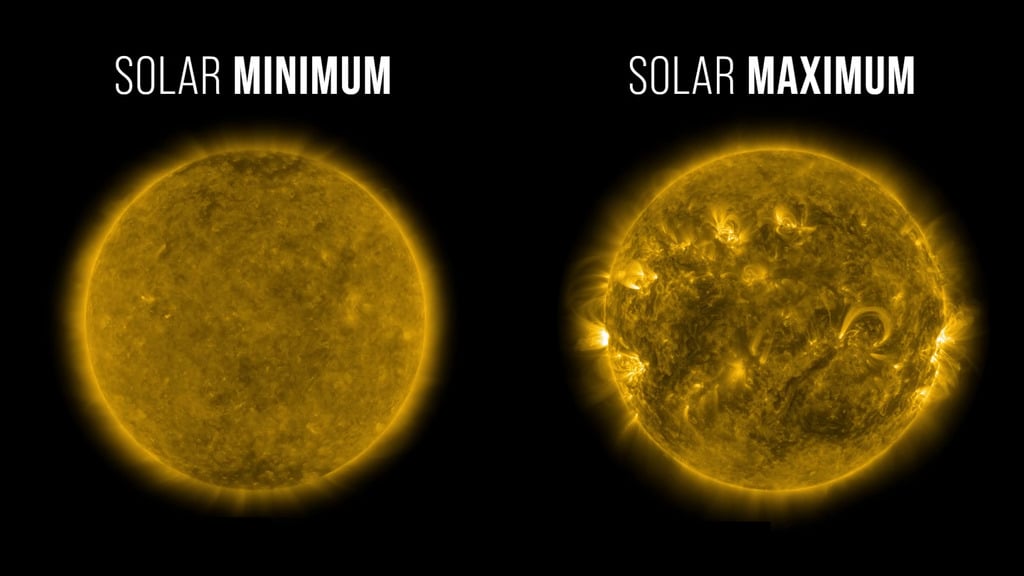
Нарны идэвхжлийн мөчлөгийг тодорхойлдог шинэ судалгаа нь нарны толбоны тоо эрс буурах цэгийг ашиглан дараагийн мөчлөгийн хүчийг урьдчилан тооцоолох боломжтойг харуулж байна.
Нар нь 11 жилийн давтамжтайгаар идэвхтэй болон нам гүм үеийг дамждаг боловч эрдэмтэд нарны идэвхжлийн оргил үе хэзээ болох, түүний эрчим ямар байхыг урьдчилан таамаглахад одоог хүртэл бэрхшээлтэй тулгардаг. Нарны идэвхжил нь дэлхийн орчин үеийн технологийн дэд бүтцэд ихээхэн нөлөө үзүүлдэг тул энэ нь чухал ач холбогдолтой юм.
Судлаач Сандра Чэпмэн нарны өмнөх мөчлөгүүдийн үйл явцыг судлахдаа нарны идэвхжил аажмаар буурдаггүй, харин тодорхой нэг цэгт нарны толбоны тоо огцом цөөрч, “тасрах” үзэгдэл ажиглагддагийг тогтоожээ. Энэхүү огцом бууралтын үеийн нарны толбоны тоо нь дараагийн нарны идэвхжлийн оргил үеийн хүч чадалтай шууд хамааралтай байна.
Одоогийн байдлаар Нар 2019 онд эхэлсэн 25-р мөчлөгтөө үргэлжилж байгаа бөгөөд оргил үеэ өнгөрөөж, 2030 он хүртэл идэвхжил нь буурах төлөвтэй байна. Сандра Чэпмэний загвараар бол 26-р мөчлөг нь өмнөхөөсөө арай сул байх төлөвтэй байгаа юм.
Энэхүү таамаглалыг шалгах жинхэнэ сорилт нь 2028 онд тохиох ёстой нарны дараагийн “тасрах” цэг дээр ирэх болно. Загварын үнэн зөв эсэхийг 2030-аад оны дунд эсвэл сүүл үед бүрэн баталгаажуулах боломжтой юм.
Дэлгэрэнгүйг эх сурвалжаас харах
Эх сурвалжийг нээх ↓
The Sun is such a constant in our lives that it can be difficult to imagine our star ever changing. But the Sun can be quite variable. There are times when its magnetic field is turbulent and generates many sunspots and other times when it is quiet and dormant. Since the 1800s we’ve known that these active and passive periods follow an 11-year pattern known as the solar cycle. But even after centuries of observation, we still have a difficult time predicting exactly when solar maximum will be and just how intense it will be. This is important because solar activity can have a significant impact on our modern technological infrastructure.
Fortunately, we do have some clues to help our predictions, as a new study shows. Sandra Chapman has looked at the solar activity of previous cycles and noticed that rather than having a smooth rise and fall of activity, solar maxima have a sharp cutoff point. At that moment the number of sunspots drops significantly. The number of sunspots at that cutoff point correlates with the strength of the next solar maximum. There is also a weaker correlation between the overall strength of one maximum and the predicted strength of the next.
The Sun is currently in Cycle 25, which began in 2019. It is just past its peak and will continue to decline in activity until around 2030. Based on the observations we have so far, Chapman’s prediction is that Cycle 26 will be a bit weaker than Cycle 25. But the real test will be when the Sun reaches its next switch-off point. Based on Cycle 24, that should be in 2028. After the cutoff, Chapman will have a hard prediction for Cycle 26. By the mid-to-late 2030s, we’ll know whether Chapman’s model is correct.
Reference: Chapman, Sandra C. “A New Declining Phase Precursor and an Early Prediction of Cycle 26 Maximum.” The Astrophysical Journal 1003.2 (2026): 159.

