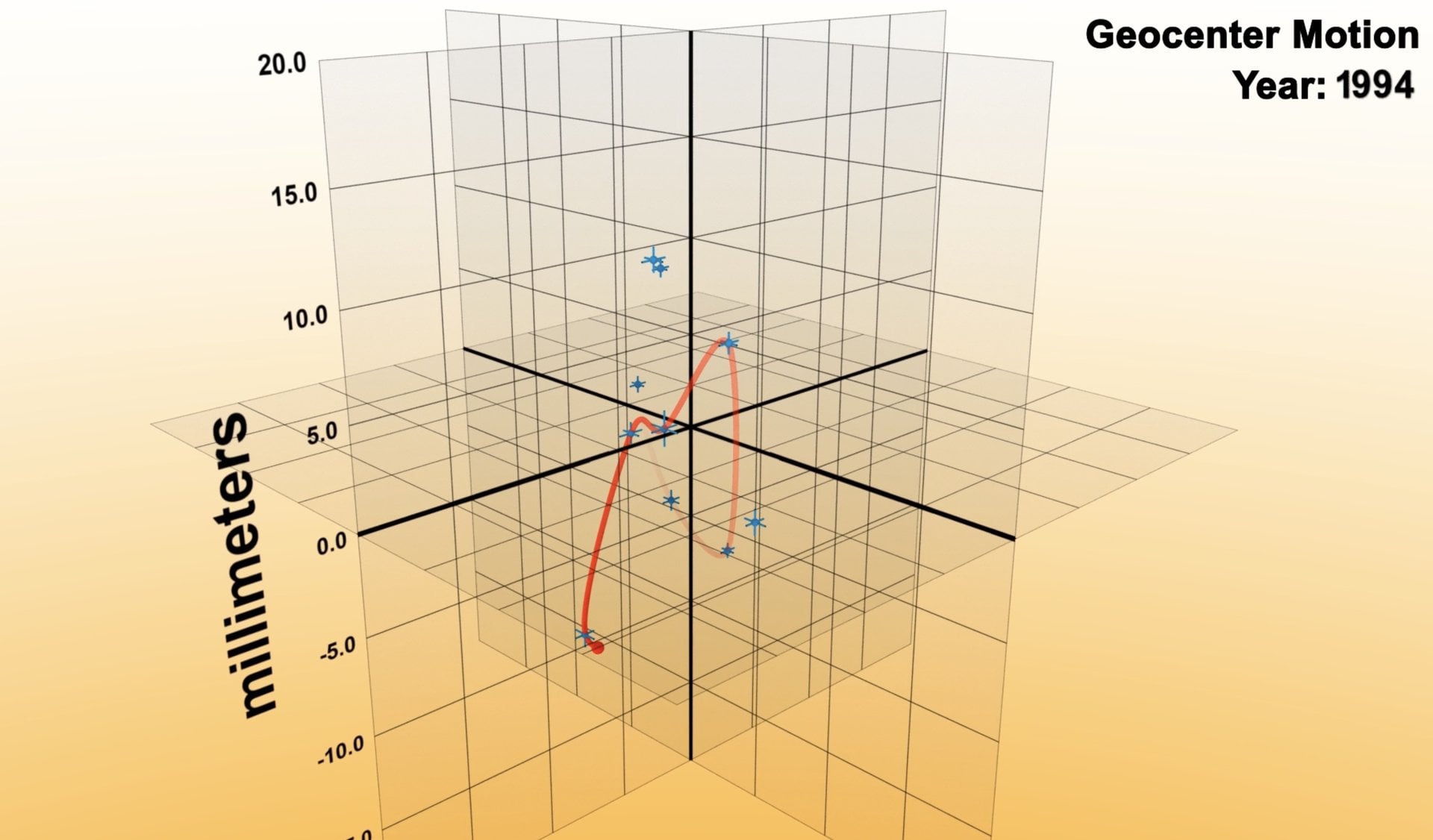
Шинэ судалгаагаар дэлхийн массын төвийн улирлын чанартай шилжилтийг миллиметрийн нарийвчлалтайгаар хэмжиж, өмнөх тооцооллыг залрууллаа.
Дэлхийн массын төвийг тодорхойлох нь гаригийн дотоод бүтцийн өөрчлөлт болон түүний сансрын уудам дахь хөдөлгөөнийг ойлгоход чухал ач холбогдолтой юм. Өмнө нь 1980-аад болон 1990-ээд онд LAGEOS хиймэл дагуулуудыг ашиглан газрын лазерын станцуудын тусламжтайгаар уг төвийг сантиметрийн нарийвчлалтайгаар тогтоодог байв. Харин одоо GPS-ийн өгөгдөл болон нам орбитын хиймэл дагуулуудын мэдээллийг нэгтгэснээр хэмжилтийн алдааг нэг миллиметрээс бага болтол бууруулжээ.
Судалгаагаар Дэлхий нь тогтмол масстай биет бус, улирлын чанартай байнга өөрчлөгдөж байдаг нь батлагдлаа. Хойд хагас бөмбөрцгийн өвлийн улиралд цас, мөсөн бүрхүүл хуримтлагдах, далайн усны нягт болон температурын өөрчлөлт, Амазоны бүс нутгийн хур тунадасны хуваарилалт зэрэг нь массын төвийг тогтмол шилжүүлж байдаг. Гэвч энэхүү шилжилт нь урьдчилсан таамаглаж байснаас хоёр дахин бага байгаа нь хагас бөмбөрцгүүд хоорондын ус болон агаарын солилцоо таамаглаж байснаас бага гэдгийг харуулж байна.
Түүнчлэн галт уулын идэвхжил, газар хөдлөлт зэрэг геологийн хүчин зүйлс нь массын төвд урт хугацааны өөрчлөлт оруулдаг болохыг ажиглажээ. Эдгээр өөрчлөлт нь Дэлхийн эргэлтийн хурдад нөлөөлөх боломжтой юм. Энэхүү өндөр нарийвчлалтай хэмжилт нь геологийн үйл явцыг судлахаас гадна тээвэр, далайн тээвэр болон хиймэл дагуулын орбитын тооцоололд чухал ач холбогдолтой хэвээр байна.
Дэлгэрэнгүйг эх сурвалжаас харах
Эх сурвалжийг нээх ↓
Where is Earth’s center of mass? The answer seems trivially obvious. It’s right in the middle of the planet. Ah, but that kind of thinking won’t get you a paper in the Geophysical Journal International. It’s also not a trivial question. Knowing Earth’s center of mass down to the order of millimeters reveals some interesting facts about our planet.
To measure Earth’s center of mass accurately, we must look to space. Satellites don’t just orbit Earth; they orbit the exact center of Earth’s mass. Any small shift in that center of mass means there is a shift in orbital trajectories. All you have to do is measure the orbits precisely. Back in the 1980s and 1990s, this was done using satellites known as LAGEOS. These spherical satellites were covered in reflective panels so that ground-based laser observatories could measure their positions over time. These allowed us to determine the center of mass to within a centimeter or so.
This new study improves this accuracy by using GPS data to account for tiny shifts in the locations of ground-based observatories. It also adds data from a host of low-orbit satellites to improve accuracy even further. The result reduces our uncertainty to less than a millimeter.
Part of the results are what we expected. The Earth is not a static mass. During the winter season of the Northern Hemisphere, snow and ice build up in the polar region, which means there is more mass there. The warming and cooling of oceans shifts their densities. The rainy season of the Amazon moves water to its delta. All of this causes Earth’s center of mass to move seasonally.
The surprise is that this shift is smaller than we thought. The results of this study find a seasonal drift that is about half of earlier estimates. This means that there is less water and air moving between hemispheres. The two regions aren’t as interconnected as we assumed. The team also observed longer-term shifts in the center of mass due to geological effects such as volcanic activity and earthquakes. These shifts can also affect things such as Earth’s rotational speed.
Precise measurements such as these not only help us understand geological changes; they also help us better locate our location on Earth. It has an impact on everything from transportation and shipping to the orbital drift of satellite constellations. It’s also remarkable to think that we can pinpoint the middle of the Earth with such accuracy.
Reference: Argus, Donald F., et al. “Estimation and cause of the seasonal oscillation between Earth’s centre of mass and centre of figure.” Geophysical Journal International 247.2 (2026): ggag314.

