Эрдэмтэд олон арван жил үргэлжилсэн палеонтологийн нууцлаг олдворыг судалж, түүнийг бүтээгч нь өт хорхой биш, харин үе хөлтөн амьтан байх магадлалтай гэж үзжээ.
Палеонтологийн салбарт 170 гаруй жилийн турш судлаачдын анхаарлыг татаж ирсэн “paleodictyon” хэмээх зургаан өнцөгт хэлбэртэй хонгилын сүлжээ нь 500 сая жилийн тэртээх Кембрийн галавын үеийн чулуулагт анх бүртгэгджээ. Энэхүү бүтэц нь өнөөг хүртэл далайн ёроолд үүссээр байгаа ч түүнийг бүтээгч амьтан нь хэзээ ч олдоогүй, мөн чулуужсан байдлаар бүртгэгдээгүй байна. Андреа Баукон тэргүүтэй судлаачдын баг Итали, Португал, Польш улсаас олдсон чулуужсан дээжүүдийг өндөр нарийвчлалтай гэрэл зураг болон 3D загварчлалын тусламжтайгаар шинжилжээ.
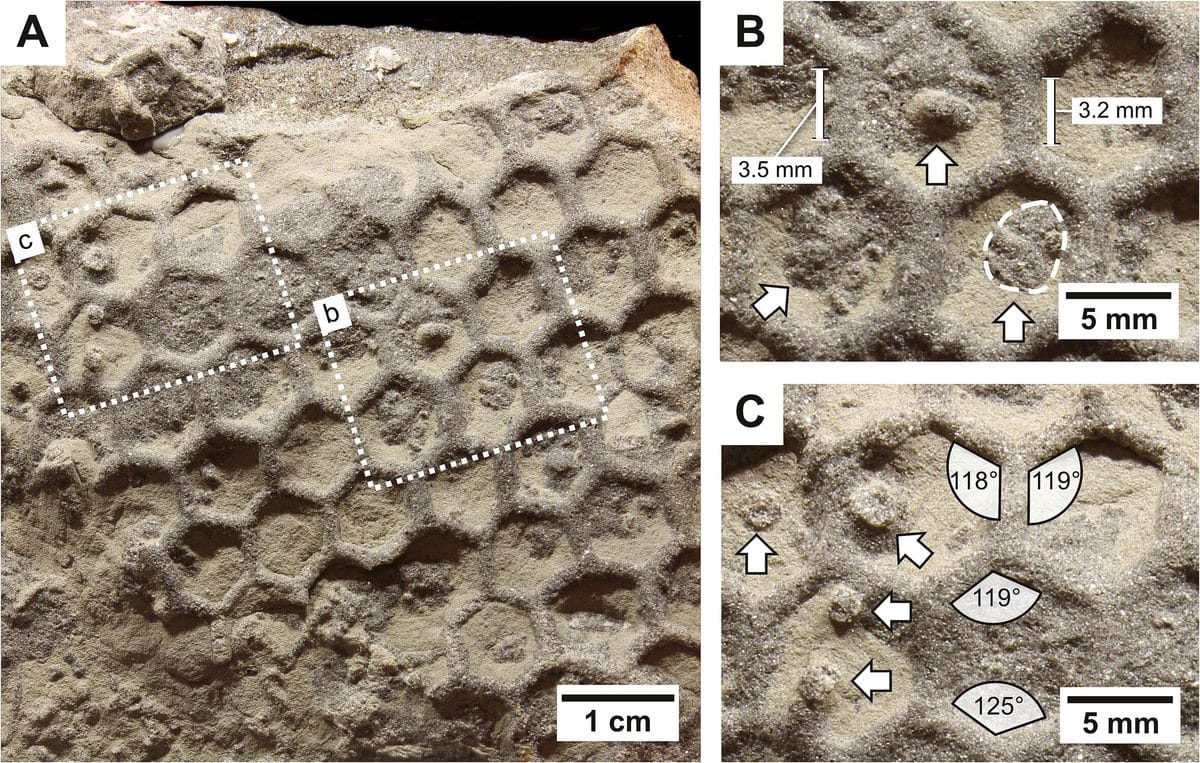
Судалгааны үр дүнгээр хонгилууд нь 120 градусын өнцөгтэй, төгс зургаан өнцөгт хэлбэртэй, хурц өнцөг бүхий шулуун шугамуудаас бүрдэж байгааг тогтоосон байна. Зөөлөн биетэй өт хорхойнууд нь ихэвчлэн муруй, замбараагүй хонгил ухдаг бол үе хөлтөн амьтдын тунадас хусах механик үйлдэл нь ийм нарийн геометр бүтэцтэй илүү нийцэж байгааг эрдэмтэд онцолжээ. Түүнчлэн хонгилын хэмжээсүүд маш тогтвортой байгаа нь тухайн амьтан орон зайн мэдрэмжтэй бөгөөд алдаагаа засварлах чадвартай байсныг илтгэж байна.
Одоогийн байдлаар эдгээр хонгилыг юуны тулд бүтээсэн нь тодорхойгүй байгаа бөгөөд эрдэмтэд үүнийг хоол тэжээл хайх, хамгаалах байр, эсвэл колони амьтдын дохио дамжуулах систем байж болно хэмээн таамаглаж байна. Энэхүү дүгнэлт нь одоогоор таамаглал төдий бөгөөд судлаачид далайн гүнд цаг хугацааны явцад хяналт тавих, ДНХ-ийн шинжилгээ хийх замаар уг амьтныг бодитоор нь олж харах судалгааны ажлыг төлөвлөж байна. Ингэснээр палеонтологийн хамгийн нууцлаг бүтэц хэрхэн үүсдэгийг шууд ажиглах боломж бүрдэнэ гэж тэд үзэж байгаа аж.
Дэлгэрэнгүйг эх сурвалжаас харах
↓Эх сурвалжийг нээх ↓
For over 170 years, one of paleontology’s strangest puzzles has resisted explanation: perfectly hexagonal tunnel networks etched into marine rocks, found on nearly every continent, with no clear culprit ever caught in the act. Now, a new study suggests the long-favored suspect, a worm-like creature, may have been wrong all along. The real architect, researchers argue, was more likely a small arthropod, possibly a crustacean.
The fossil pattern in question is known as “paleodictyon,” and it first appears in rocks dating back more than 500 million years, to the early Cambrian period. What makes it so puzzling is not just its age but its persistence, because these hexagonal burrow systems are still forming today on the modern seafloor, meaning whatever built them never went extinct, even though it has never once been observed or found fossilized inside its own handiwork.
That combination of ancient origin and modern reappearance has kept the debate alive for generations. According to the study’s authors, speculation about the structure may stretch back even further than expected, potentially to a drawing attributed to Leonardo da Vinci, who is credited as a pioneering figure in the study of trace fossils.
A Geometry Better Suited to Jointed Limbs Than Soft Bodies
The research team, led by Andrea Baucon and published in Earth-Science Reviews, examined fossil specimens collected across Italy, Portugal, and Poland, with samples ranging from the Cambrian to more recent geological eras. Using high-resolution photography paired with 3D modeling, the scientists measured the tunnels‘ widths, lengths, and angles with unusual precision, then compared those measurements against burrows made by arthropods still living today.
What they found was telling that the tunnels consistently branch at angles close to 120 degrees, the interior angle of a perfect hexagon, and their walls run in straight lines with sharp, deliberate corners.
Worms, the study notes, typically burrow along paths of least resistance, producing winding, rounded tunnels rather than crisp geometric ones. Arthropods, by contrast, burrow by scraping sediment from the tunnel wall ahead of them and relocating the material, a mechanical process that lines up neatly with the sharp-edged architecture seen in paleodictyon.
Consistency That Hints at Real Navigational Skill
Perhaps the most striking detail in the findings is how uniform the tunnels are, even across long stretches of the network. The team observed that dimensions stayed remarkably consistent throughout, as though the builder were actively correcting small mistakes along the way rather than drifting off course.
That kind of self-correction implies a creature with genuine spatial awareness and the ability to sense distance, traits the researchers associate with arthropods rather than simpler, soft-bodied organisms.

The earliest known paleodictyon fossils appear around the same period as the first arthropod trace fossils in the Cambrian record, and modern examples of the structure turn up in habitats and depth ranges where arthropods are known to thrive. As the study authors put it:
“The modern occurrences of paleodictyon suggest that the bathymetric range for its tracemakers is between ~1300 and ~ 5000 m. Within this range, numerous infaunal arthropods with body widths suitable for paleodictyon openings are found, including isopods, amphipods, copepods, and decapods.”
What Were These Ancient Structures Built For?
Even the function of these tunnels remains debated. Past explanations have included grazing trails, traps, bacterial farming, and brooding sites, and the new study adds another possibility. The team stated that the network may have served as a kind of signaling system, letting colonial organisms transmit acoustic, hydraulic, or chemical cues to one another.
Still, per the researchers, all of this evidence remains circumstantial, inferred from shape and behavior rather than direct observation. To close that gap, they are proposing deep-sea monitoring using autonomous time-lapse imaging, environmental DNA sampling, and sediment profile imaging at sites where paleodictyon is actively forming, in hopes of finally watching the builder at work.
“Being able to watch the producer alive as it creates these structures would be like travelling back in time — giving us the chance to observe directly how one of the most enigmatic patterns in the fossil record is made,” said Baucon.

Enjoyed this article? Subscribe to our free newsletter for engaging stories, exclusive content, and the latest news.

