Европын сансрын агентлагийн JUICE хөлөг Бархасбадь гараг болон түүний дагуулуудыг судлах аяллын хүрээнд Дэлхийн таталцлын хүчийг ашиглах маневр хийхээр төлөвлөж байна.
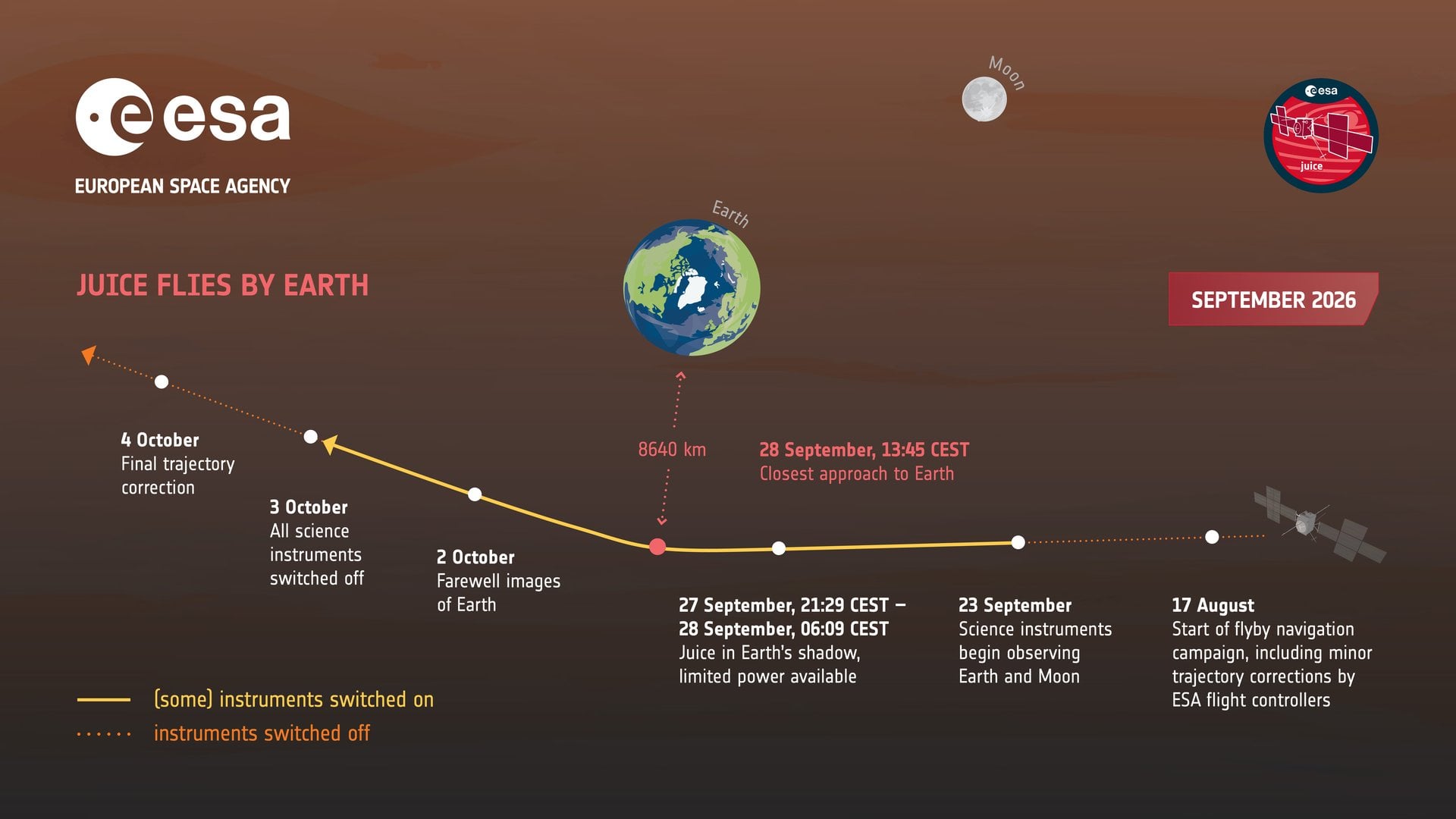
Европын сансрын агентлагийн (ESA) JUICE хөлөг 2031 оны долдугаар сард Бархасбадь гарагт хүрэх урт хугацааны аяллынхаа хүрээнд даваа гарагт буюу есдүгээр сарын 28-нд Дэлхийтэй ойртон өнгөрөх маневр гүйцэтгэнэ. Энэ үеэр хөлөг Дэлхийн гадаргуугаас 8640 км-ийн зайд хамгийн ойр цэгт хүрэх бөгөөд уг үйлдэл нь хөлгийн хурдыг нэмэгдүүлж, зөв чиглэлд оруулах чухал ач холбогдолтой юм. Энэхүү нарийн төвөгтэй аяллын замналыг амжилттай гүйцэтгэснээр JUICE хөлөг Бархасбадь гараг болон Ганимед дагуулын тойрог замд ороход шаардлагатай түлшээ хэмнэх боломжтой болно.
Хөлөг есдүгээр сарын 27-ноос 28-ны хооронд Дэлхийн сүүдэрт байрлах тул зай хураагуураа ашиглаж, эрчим хүч хэмнэх үүднээс зарим багажаа түр унтраах юм. Гэсэн хэдий ч есдүгээр сарын 23-наас аравдугаар сарын 3-ны хооронд Дэлхий болон Сарны талаарх мэдээллийг цуглуулж, багажуудаа нарийвчлан тохируулах боломж бүрдэнэ. Мөн уг маневрын үеэр Дэлхийн соронзон орны сүүл хэсэг болох “magnetotail”-ийн бүтцийг судалж, нарны салхитай хэрхэн харилцан үйлчлэлцэж байгааг шинжлэхээр төлөвлөж байна.
Төслийн удирдагч Анжела Дитцийн мэдээлснээр, нислэгийн динамик хариуцсан баг хөлгийг маневр хийх хамгийн тохиромжтой байрлалд оруулахын тулд маш нарийн бэлтгэл ажлыг хангажээ. Төслийн эрдэмтэн Клэр Валлатын дурдсанаар, өмнөх сар-Дэлхийн маневраас ялгаатай нь энэ удаагийн үйл ажиллагаа нь сансрын хөлгийн багажуудыг Дэлхий болон Сарны янз бүрийн хэсэг рүү чиглүүлэн ажиглалт хийхэд илүү таатай нөхцөл бүрдүүлж байгаа юм. Энэхүү аялал нь 2029 оны нэгдүгээр сард хийх сүүлийн маневрын өмнөх чухал үе шат болж байна.
Дэлгэрэнгүйг эх сурвалжаас харах
Эх сурвалжийг нээх ↓
On April 23rd, the European Space Agency launched its JUpiter ICy moons Explorer (JUICE), a robotic explorer mission bound for Jupiter’s moons Ganymede and Europa. Since then, mission controllers have performed several maneuvers intended to put the spacecraft on a trajectory that will deposit it around Jupiter by July 2031. The next maneuver will be a gravity assist with Earth, which will take place on Monday, September 28th, with its closest pass (8,640 km; 5,370 mi) at 13:45 CEST (07:45 a.m. EST; 04:45 a.m. PST).
The first maneuver occurred on August 19th, 2024, when JUICE conducted the first-ever lunar-Earth flyby. This braking maneuver put it on track toward Venus, followed by a gravity-assist maneuver (GAM) with the planet by August 31st, 2025, that altered the spacecraft’s trajectory and allowed it to pick up extra speed. The upcoming flyby with Earth will set it up for a final Earth flyby in January 2029, which will place the spacecraft on the optimal flight path toward Jupiter.
These maneuvers are all necessary to ensure JUICE has the necessary velocity to reach Jupiter without overshooting. The complicated flight path will also mean that JUICE will have plenty of fuel to orbit Jupiter in 2031 and Ganymede in 2034. Arranging the upcoming flyby with Earth has been similarly complicated, with six time slots established for making small course corrections to ensure it arrives at the right angle and velocity for an optimum GAM.
“Until now, only one maneuver at minus four weeks was needed,” says Angela Dietz, Juice Spacecraft Operations Manager. “It was of relatively small size, but extremely effective. It put Juice in the right spot for the flyby. Our Flight Dynamics Team did an amazing job to prepare it!”
Before the closest approach, from 03:29 p.m. EST (12:29 p.m. PST) on Sept. 27th to 12:29 p.m. EST (09:29 a.m. PST) on Sept. 28th, JUICE will pass within Earth’s shadow. This means the mission will run on battery power alone, requiring some instruments to be shut down to conserve power. However, the mission will still collect data on Earth and the Moon between September 23rd and October 3rd, just as it did during its 2024 lunar-Earth flyby.
This will give instrument teams another chance to calibrate the spacecraft’s instruments and data analysis tools. This is essential to ensuring that the spacecraft collects the best scientific data and images once it arrives around Jupiter. JUICE also has some interesting scientific objectives for this flyby, including gathering data on Earth’s magnetotail (the tail of its magnetic field). JUICE will spend several days within this complex structure created by Earth’s interaction with solar wind.
JUICE’s navigation camera team will also train on the Moon’s horizon to test out a new technique to improve its accuracy. Juice’s two onboard monitoring cameras will also take photos throughout the flyby, which will be shared on the ESA’s website and social media accounts. Said Claire Vallat, a Juice Project Scientist:
All flybys are risky, requiring very careful planning and continuous monitoring. But the upcoming Earth flyby is much simpler from an operational perspective than the 2024 lunar-Earth flyby, where a flyby of the Moon set Juice up for a flyby of Earth the next day. This is great news for science, because it means we will be able to turn Juice in all different directions to point its science instruments at different parts of Earth and the Moon.
Further Reading: ESA

