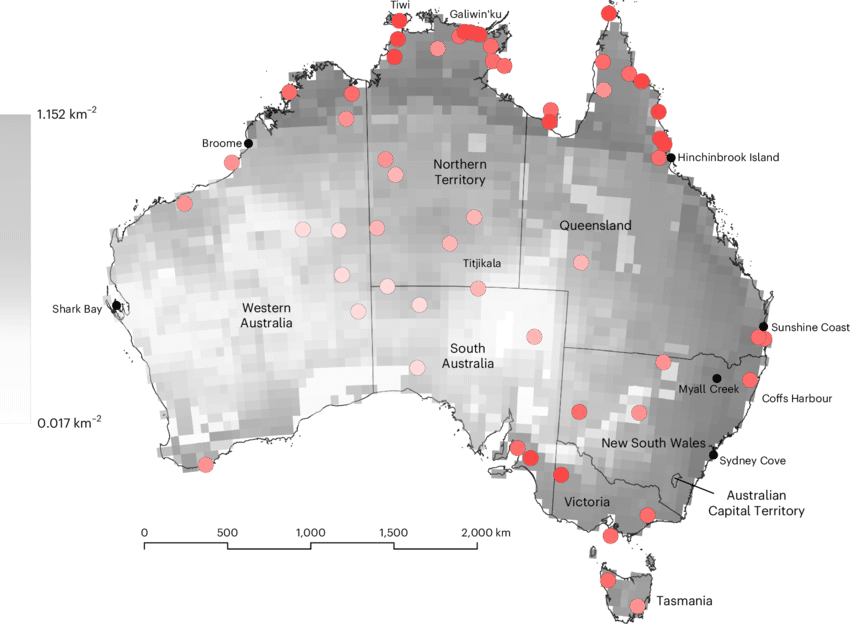
Шинэ загварчлалын үр дүнд 1788 онд Британийн анхны флот ирэхээс өмнө Австрали тивд 2.22 сая орчим уугуул иргэн амьдарч байсныг тогтоосон байна.
Судлаачдын баг 1930-аад оны үеийн антропологич Альфред Радклифф-Брауны тогтоосон 250,000 гэх хуучирсан тооцоолол нь өвчин эмгэг, хил хязгаарын мөргөлдөөн болон нийгмийн системийн нөлөөллийг дутуу үнэлснийг онцолжээ. Энэхүү алдааг засахын тулд эрдэмтэд угсаатны зүйн тэмдэглэл, археологийн олдвор, генетикийн судалгаа болон тухайн бүс нутгийн байгаль орчны даацын загварчлалыг хослуулан ашигласан байна. Nature Human Behaviour сэтгүүлд нийтлэгдсэн энэхүү судалгаа нь уугуул иргэдийн хүн амд суурилсан өмнөх тооцооллыг долоо дахин их байж болохыг харуулжээ.
Судалгааны загварчлалаар 1788-1861 оны хооронд уугуул иргэдийн тоо 93 хувиар огцом буурсан гэж тооцоолсон нь колоничлолын нөлөөгөөр 2.06 сая хүн амь үрэгдсэнийг илэрхийлж байна. Энэхүү демографийн сүйрэл нь Австралийн түүхийн гол цөмд байх ёстой эмгэнэлт үйл явдал бөгөөд уугуул иргэдийн тэсвэр тэвчээр, соёлын сэргэн мандалтыг ойлгоход чухал ач холбогдолтой юм.
Профессор Кори Брэдшоу болон түүний багийнхан энэхүү судалгааны үр дүнг үнэн түүхийг сэргээн таниулах, эвлэрлийн үйл явцад зайлшгүй шаардлагатай гэж үзэж байна. Хэдийгээр 1950-аад оноос хойш уугуул иргэдийн тоо өсөж байгаа ч 2021 оны хүн амын тооллогоор бүртгэгдсэн тоо нь судалгааны медиан үнэлгээний дөнгөж 37 хувийг эзэлж байгаа нь колоничлолын урт хугацааны үр дагаврыг харуулж байна.
Дэлгэрэнгүйг эх сурвалжаас харах
↓Эх сурвалжийг нээх ↓
A new study puts Australia’s Indigenous population before colonization at a median of 2.22 million people, well above what historians have long assumed. The same model suggests numbers then fell by roughly 93% between 1788 and 1861.
European colonization began in 1788 with the arrival of Britain’s First Fleet. By the time early censuses started counting Indigenous people, disease and violence had already devastated their communities, leaving those records an incomplete guide to how many people had lived on the continent.
A national research team, working with Indigenous partners, set out to fill those gaps in the written record. Their findings, the researchers say, challenge us to rethink the scale of what happened after 1788.
Why Earlier Estimates Fell Short?
Much of the earlier thinking traces back to anthropologist Alfred Radcliffe-Brown, who in the 1930s calculated that about 250,000 Indigenous people had lived in Australia before colonization.
His estimate did not account for lethal diseases, frontier violence or structural violence, meaning harm caused by social systems and institutions. Later evidence has shown those effects reached further than previously understood, which strengthens the case that early figures were too low.
Historical estimates have ranged from 250,000 to 1 million people. The new median of 2.22 million sits far above that, and the researchers report estimates up to seven times larger than previous calculations. According to the study, published in Nature Human Behaviour, the median corresponds to an average density of 0.29 people per square kilometer, or about 0.75 per square mile.
Piecing Together The Evidence
Rather than lean on a single source, the team reviewed ethnographic observations, which is the descriptions of people and their communities, alongside archaeological and genetic reconstructions. They also modeled the continent’s environmental carrying capacity, an estimate of how many people its environments could support. The final calculations rested on the modeling and genetic evidence, with historical and ethnographic accounts playing a supporting role.

The team says using multiple approaches is essential when reconstructing population histories from incomplete or biased records. There’s a public purpose, too. According to Professor Corey Bradshaw of Flinders University:
“Understanding the size of Indigenous populations in Australia before European invasion in 1788 is essential to truth-telling and reconciliation.”
How Millions Were Lost in Just 73 Years?
To line that starting population up with early census records, the model estimates 2.06 million excess deaths between 1788 and 1861, an average of about 28,200 a year beyond what would otherwise have been expected. By 1861, the Indigenous population had fallen to about 7% of its 1788 size, a decline of roughly 93% in 73 years.

Distinguished Professor Larissa Behrendt, chair of the Centre Advisory Committee at the Australian Research Council Centre of Excellence for Indigenous and Environmental Histories and Futures, said that:
“These research findings challenge us to rethink the scale of what happened after 1788. We are not talking about a marginal consequence of colonization but a demographic catastrophe at the heart of the Australian story. But the research also tells us something extraordinary. Our survival is one of Australian history’s most remarkable stories.”
Co-author Distinguished Professor Lynette Russell of Monash University links the findings to intergenerational trauma and future policy. The Indigenous population has grown since the 1950s, yet the 2021 census count is still only about 37% of the study’s median estimate. Lead author Associate Professor Alan Williams explained that:
“These devastating findings highlight the major impacts of invasion experienced by Indigenous Australians, and demonstrate their remarkable survival, resilience and recovery over the past century.”
Enjoyed this article? Subscribe to our free newsletter for engaging stories, exclusive content, and the latest news.

