
Хоолны үлдэгдэл дараа өдөр нь илүү амттай болдог гэх түгээмэл ойлголтыг шинжлэх ухааны үндэслэлтэй эсэхийг Австралийн Дикин их сургуулийн судлаачид туршилтаар шалгав.
Тус багийнхан үхрийн махтай лазанья, цөцгийн тостой тахианы мах (butter chicken), дал болон алимны нурмаг гэсэн дөрвөн төрлийн хоолыг ашиглан 65 оролцогчтой сохор туршилт явуулжээ. Судалгааны үр дүнгээр эдгээр хоолны амт маргааш нь заавал сайжирдаг гэсэн баттай нотолгоо олдоогүй бөгөөд зөвхөн цөцгийн тостой тахианы махыг оролцогчид илүүд үзсэн байна.
Хоолны амт дараа өдөр нь өөрчлөгдөх нь тухайн хоолны орц найрлага, бүтэц болон шинжлэх ухааны тодорхой нөхцөлүүдээс шууд хамаардаг болохыг судлаачид онцолжээ. Тухайлбал, халуун ногоотой, тослог ихтэй соус бүхий хоолнууд нь хадгалах явцад амтны нэгдлүүд нь дахин хуваарилагдах замаар амтаа хадгалдаг бол цардуул ихтэй хоолны бүтэц хатуурах зэрэг химийн өөрчлөлтөд ордог аж.
Энэхүү судалгаа нь хоолны үлдэгдэл илүү амттай байх нь ерөнхий үзэгдэл бус, харин хоолны төрөл зүйлээс хамаарсан мэдрэхүйн үр дүн гэдгийг харуулж байна. Түүнчлэн хүний сэтгэл зүйн хүлээлт нь тухайн хоолыг амтлах мэдрэмжид нөлөөлдөг хүчин зүйл болохыг тэмдэглэжээ.
Дэлгэрэнгүйг эх сурвалжаас харах
↓Эх сурвалжийг нээх ↓
There’s a specific kind of joy in opening the fridge to find leftovers waiting for you like a gift from your past self. Many people insist that they taste better than the original.
Some might accept this as one of life’s little quirks, similar to how one sock disappears in the wash.
But scientists like to investigate quirks, and a team at Deakin University in Australia did just that. To see whether this kitchen myth is backed by evidence, they recruited people to blind-test fresh dishes against their day-old counterparts.
Their study is posted as a preprint (it hasn’t yet undergone peer review) and concludes that ‘leftovers taste better’ is not entirely a myth. But it isn’t as universal as we might think.
In fact, only one of their test dishes lived up to the reputation.
“Few culinary beliefs are as persistent as the idea that some foods taste better the next day,” the team writes.
First author Russell Keast has a personal history with this phenomenon. Before becoming a food and sensory scientist, he trained as a chef and heard the claim many times, even experiencing it himself.
“You have a takeaway curry one night, then eat the leftovers for breakfast the next morning, and somehow it seems even better,” Keast told James Woodford at New Scientist.
Starting with a list of 25 dishes, the researchers asked 30 university staff and students to rank the four they most strongly believed improved overnight.
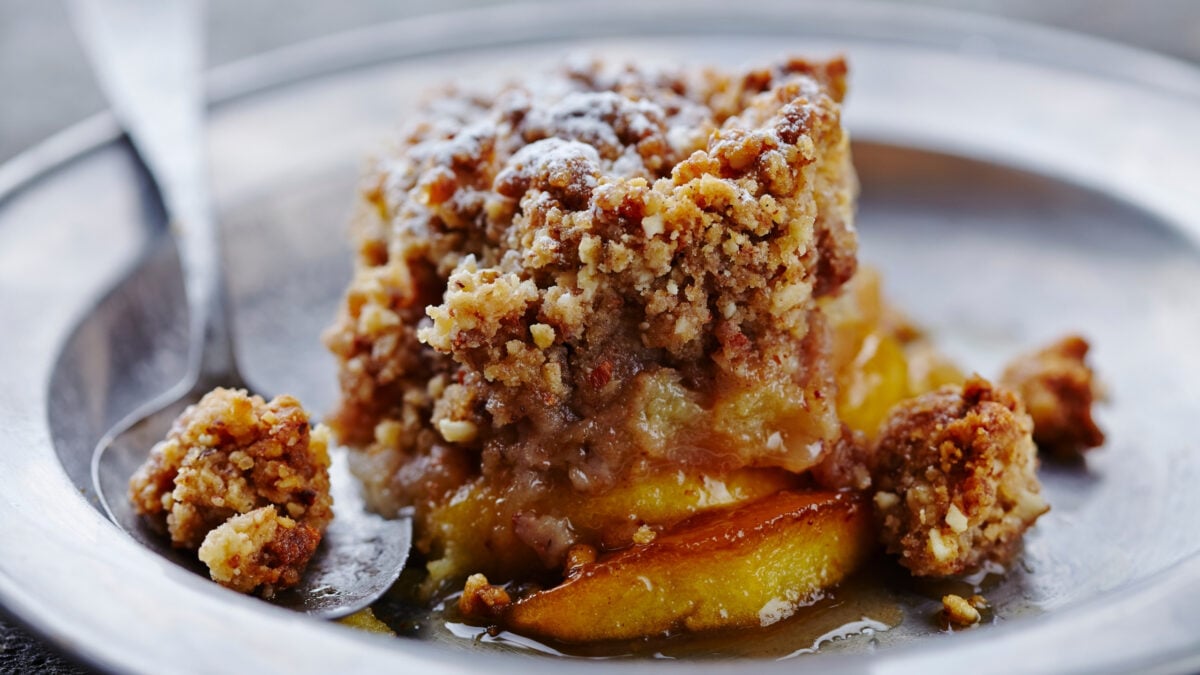
The winners were a familiar lineup: beef lasagna, butter chicken, dhal, and apple crumble.
The winners were a familiar lineup: beef lasagna, butter chicken, dhal, and apple crumble.
For the experiment, a separate group of 65 adults received randomly coded samples of each of the four dishes over two sessions. Some were freshly made that day; others were prepared 24 hours earlier, refrigerated, and reheated.
Crucially, nobody was told which was which, so there was less chance of anyone’s ‘leftovers are better’ bias influencing their taste buds.
Participants took three challenges for each food: could they distinguish between fresh and day-old versions; if they tasted both side by side, which one they preferred; and, sampled on its own, how much they liked each sample.
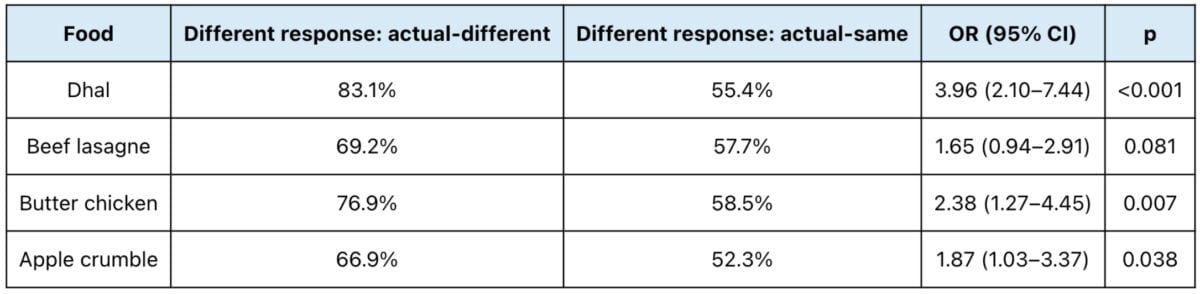
In terms of simply detecting a difference, dhal was the most obvious – people responded “different” 83 percent of the time when the samples were actually different, compared to just over half of the time when given identical samples.
Butter chicken and apple crumble were also distinguishable after a night in the fridge.
Beef lasagna hid its true identity best: The study found no statistically reliable evidence that people could tell the fresh and day-old versions apart.
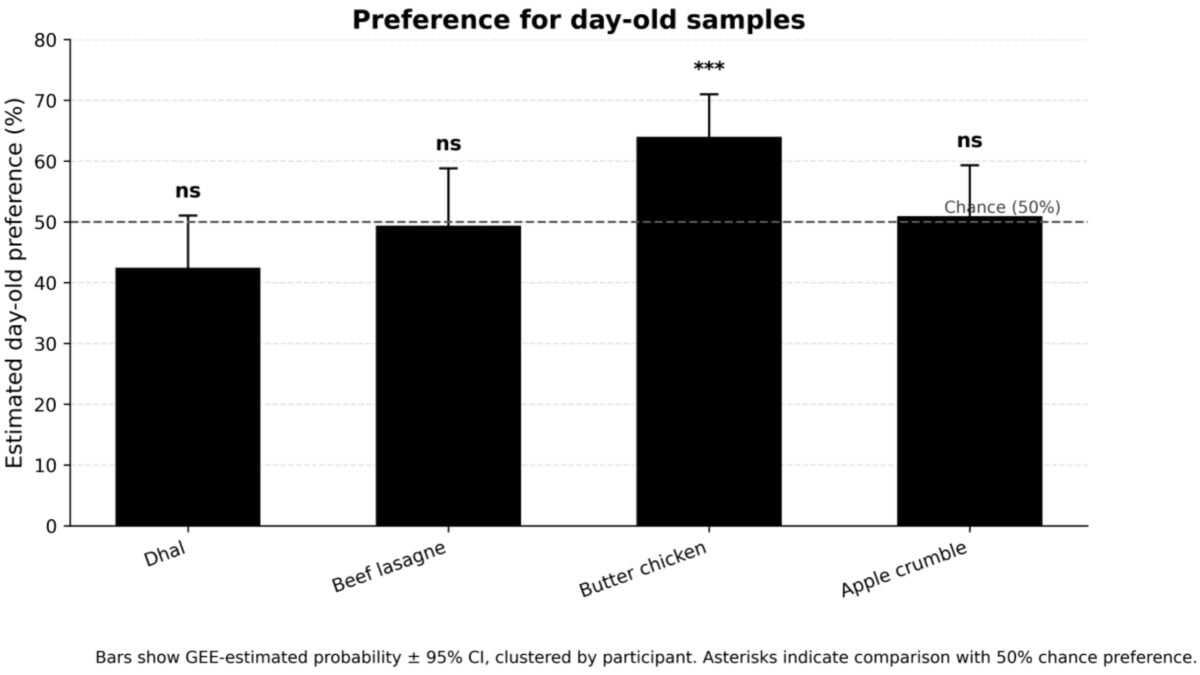
However, noticing a change and actually liking something better are two different things. Of the four dishes, only butter chicken was clearly preferred as a day-old leftover, with nearly 64 percent of taste comparisons favoring it.
Although dhal and apple crumble were detectably different, people were about as likely to prefer the fresh version as the leftovers. Lasagna also showed no meaningful preference either way.
And when it came to overall liking scores, rated without a side-by-side comparison, there was no statistically significant difference between fresh and day-old for any of the four foods.
Apple crumble was the most popular dish overall, but that only tells us people really like apple crumble. And we’re not surprised.
“These findings show that the next-day effect is modest, food-specific, and dependent on the sensory outcome measured,” Keast and colleagues write.
You can even run your own tests on the same foods if you’re feeling adventurous, since the researchers included their exact recipes in their supplementary materials.
The study can’t say why butter chicken improves overnight, since it measured what people tasted, not the chemistry behind it. But a few established food science mechanisms are worth considering.
One is that food flavor is a complex, multi-sense experience.
Aroma, taste, texture, temperature, and even memory all fold together in your brain before it registers deliciousness, according to a perspective article by experimental psychologist Charles Spence from the University of Oxford.
A sauce-rich dish like butter chicken may have more moving parts for flavor and aroma compounds to redistribute overnight than a more structured dish like lasagna, the researchers suggest.
There is a less appealing possibility. When you store and then reheat meaty dishes, you can get what’s called warmed-over flavor, a slightly stale or cardboard-like note caused by fats in the meat reacting with oxygen while sitting in the fridge.
Researchers have studied warmed-over flavor since at least the 1950s, and a 1977 review linked it to fat breakdown in stored cooked meat. A more recent study using sensitive aroma-detecting equipment on reheated pork identified several of the specific compounds responsible for it.
The Deakin team suggests that butter chicken’s spiced, fatty sauce might actually help to mask or counteract those less tasty changes. But they stress that they didn’t test this.
Today’s rice and pasta may be firmer or grainier tomorrow due to retrogradation, when starch molecules reform more rigid structures after cooling and storing. That could be one reason why lasagna’s pasta-cheese-meat structure didn’t get a next-day glow-up.
In the real world, there’s also the psychological ‘seasoning’: our own anticipations.
Research shows that believing a food will taste a certain way can measurably shift how good we judge it to be, sometimes even altering our brain’s response to it.
This experiment was blind, but in your actual kitchen, with your expectations fully switched on, the effect might well be more powerful than these results suggest.
There are other limitations. The research hasn’t been peer-reviewed yet, and 65 people testing four recipes is hardly a sweeping verdict on all foods.
It does seem that leftovers aren’t always better.
But the findings support a more precise version of the story.
“The next-day effect should therefore be understood as a product-specific sensory outcome rather than a general property of meat-based, curry-style, or savory foods,” Keast and team write.
Perhaps the next time someone insists that their curry is scientifically better the next day, you can tell them it depends on the curry.
The research is available on Preprints.org.
This article was fact-checked by Rachel Garner and edited by Fiona MacDonald. While we pride ourselves on our process, we are only human. If you spot a mistake, please let us know.

