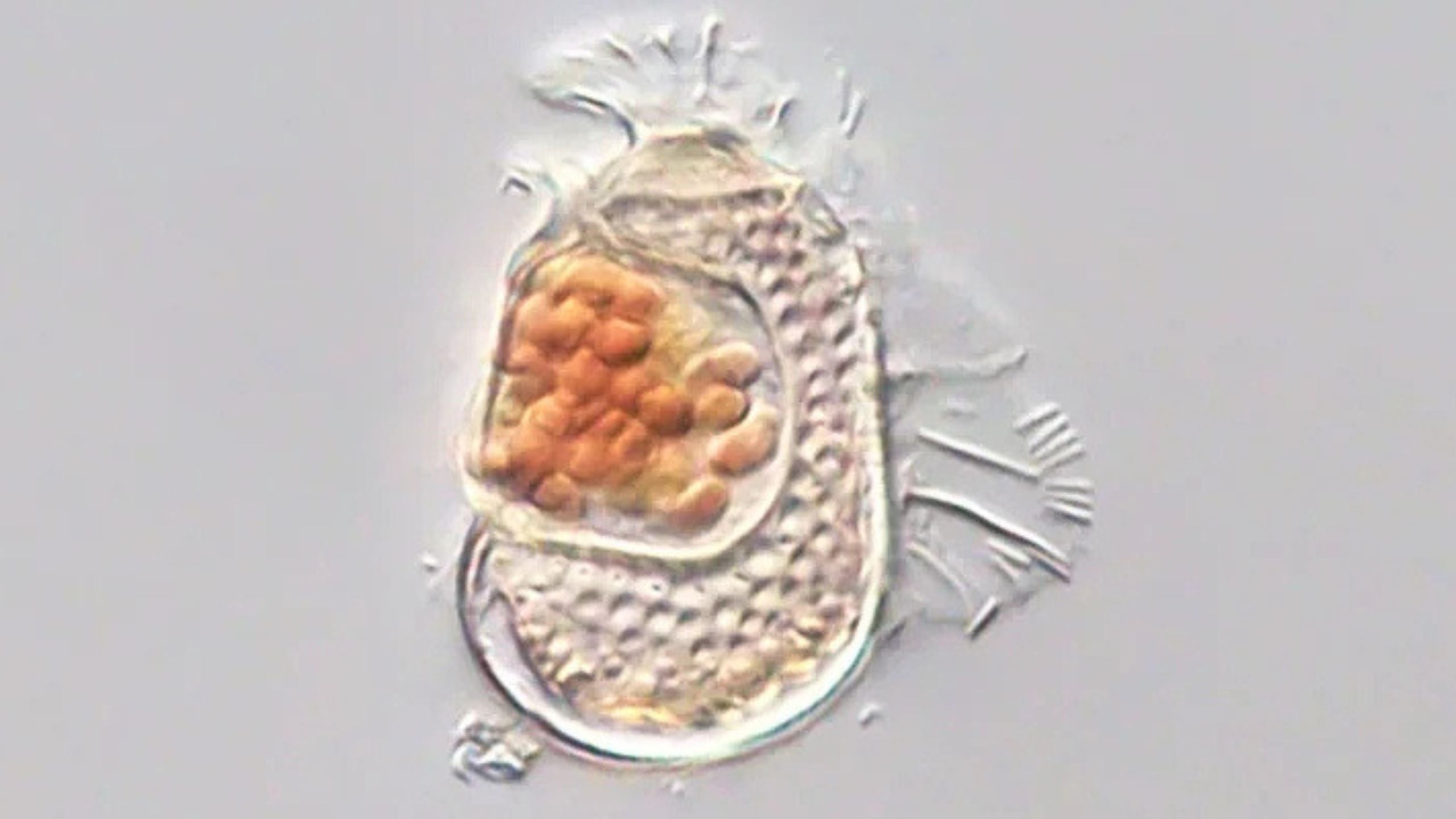
Шинэ судалгаагаар Японы эрэг орчмын далайн планктоноос амьд организмын ангилалд багтах хамгийн жижиг геномтой Sukunaarchaeum mirabile хэмээх бичил биетнийг олж илрүүлжээ.
Судлаачид Японы Шимода орчмын далайн гадаргуугийн давсгаас Citharistes regius хэмээх нэг эст планктоныг цуглуулах явцдаа энэхүү өвөрмөц организмыг санамсаргүйгээр олжээ. Sukunaarchaeum mirabile нь ердөө 238 килобаза хос ДНХ-ээс бүрдсэн геномтой бөгөөд энэ нь өнөөг хүртэл мэдэгдэж буй амьд организмын геномын хамгийн доод хязгаарт ойрхон үзүүлэлт юм. Current Biology сэтгүүлд нийтлэгдсэн энэхүү судалгаа нь амьд организмын бүтэц хэдий хэр энгийн байж болохыг харуулсан шинжлэх ухааны томоохон нээлт боллоо.
Archaea буюу архейн бүлэгт хамаарах энэхүү бичил биетэн нь бодисын солилцоо явуулах бараг бүх генээ алдсан тул бие даан амьдрах чадваргүй байж болзошгүй гэж эрдэмтэд үзэж байна. Ноттингэмийн их сургуулийн молекул биологич Торстен Аллерсийн тайлбарласнаар, энэ нь амьд эс өөрийгөө хувилж, удамшлын мэдээллээ хадгалахын тулд шаардлагатай хамгийн бага мэдээллийн түвшинд ойртсоныг илтгэж байгаа юм.
Судлаачид уг бичил биетнийг шимэгч байж болзошгүй хэмээн таамаглаж байна. Үүнийг батлах нэг гол нотолгоо нь түүний геномын дөрөвний нэг нь эзэн организмыг нэвтрэн ороход ашиглагддаг мембран уураг үйлдвэрлэхэд зориулагдсан байгаа явдал юм. Энэхүү нээлт нь эсүүд хэрхэн эволюцийн явцад нэгдэж, илүү төвөгтэй бүтэцтэй болдгийг ойлгоход чухал ач холбогдолтой юм.
Дэлгэрэнгүйг эх сурвалжаас харах
↓Эх сурвалжийг нээх ↓
A tiny microbe detected inside a marine plankton has one of the smallest genomes of any organism ever found, and it’s really putting biologists’ definition of ‘life’ to the test.
The team of researchers who first came across this mote of life weren’t even looking for it.
They were collecting single-celled plankton, Citharistes regius, swimming in surface seawater off the coast of Shimoda in Japan.
Citharistes regius survives with the help of photosynthesizing cyanobacteria, and the researchers profiled the genetic material of these bacteria to better understand how this symbiosis evolved.
But among the genomes they discovered, there was a strange, tiny loop of genetic material, made up of just 238 kilobase pairs (kbps) of DNA: barely enough to sustain life, as far as we know.
In a new paper published in Current Biology, an international team of biologists and computer scientists have come together to describe this baffling entity.
They’ve named it Sukunaarchaeum mirabile, after a Shinto spirit named Sukuna known for his small size and power.
It’s a member of the domain Archaea. Archaea were long mistaken for bacteria because, like bacteria, they’re single-celled and their DNA is not packaged up inside a membrane-bound nucleus.
But archaea have a distinct evolutionary history from bacteria, and many unique traits to show for it.
Archaea are always pretty small, but Sukunaarchaeum mirabile sets a new record. Scientists have never before seen an archaeon with a genome this tiny.
There are viruses with genomes larger than this microbe, with some reaching 730,000 base pairs or even 2.5 million. And by mainstream definitions, those don’t even qualify as living things, since viruses don’t have their own metabolisms.
Sukunaarchaeum is missing almost all the genes it would need to maintain its metabolism, which is why, when the preprint was released back in 2025, we reported that the microbe led a ‘virus-like’ existence.
“The near-complete absence of recognizable metabolic pathways in Sukunaarchaeum suggests that it can neither sustain itself independently nor provide an obvious metabolic benefit to its host,” the researchers explain.
But the final, published version of the paper drops that analogy, presumably to avoid confusion about the microbe’s true taxonomic classification.
“The key to defining life is whether something can replicate itself, and whether it can do this autonomously,” explains molecular biologist Thorsten Allers, of the University of Nottingham.
“This exciting discovery provides new clues about how simple a living cell can become while remaining capable of reproducing and maintaining its own genetic information.”
The only other organisms with fewer pieces of DNA than Sukunaarchaeum are bacteria that have become so dependent on a symbiotic host, they’ve almost lost their identity as a separate organism.
This is how more complex cells, including our own, may have come about.
For instance, it’s how scientists explain the fact that our mitochondria have their own separate set of conserved DNA: free-living bacteria, they say, moved inside eukaryotic cells, and 1.5 billion years later, they’re still in there, now an integral part of us.
Perhaps Sukunaarchaeum mirabile, which scientists know only via its genome and have yet to see through a microscope, is also in the process of merging with its host.
But for the mutual benefit of the relationship, endosymbionts need a metabolism to give something back to their host. That’s why the researchers are instead proposing that Sukunaarchaeum may be a parasite.
If that’s the case, it would be only the second parasitic archaeon on record.
Another clue that its lifestyle may be parasitic is that a quarter of its genome is dedicated to producing large membrane proteins. These same proteins have been seen in the only other known parasitic archaea, weaponized as a way to invade a host.
“Although [Sukunaarchaeum] has lost almost all of the genes needed to make nutrients and energy, it has kept much of the machinery required to copy its genome and produce proteins from its genetic information,” says Allers.
“This suggests that Sukunaarchaeum may be close to the minimum level of genetic information needed for an organism to remain an independent cell.”
The research has been published in Current Biology.
This article was fact-checked by Fiona MacDonald and edited by Fiona MacDonald. While we pride ourselves on our process, we are only human. If you spot a mistake, please let us know.

