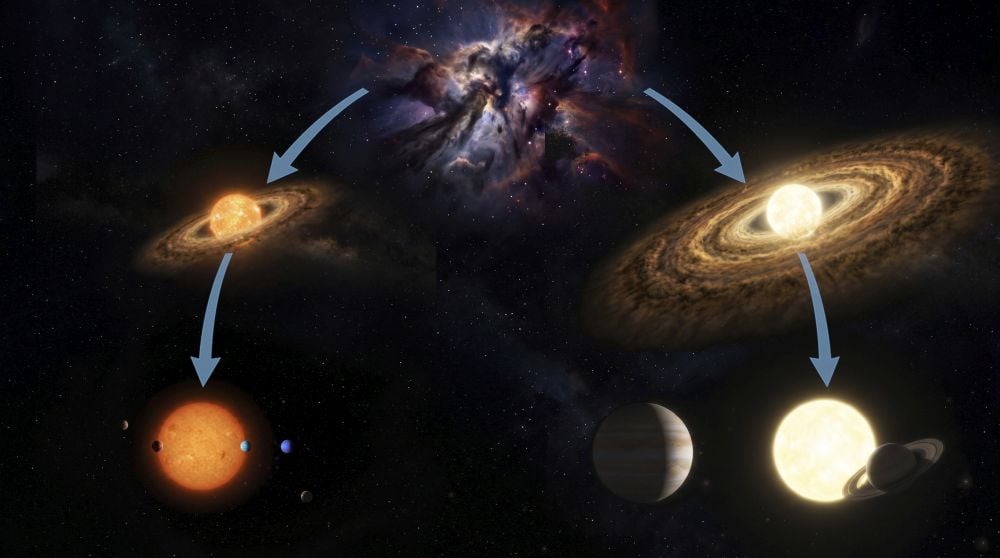
Одон орон судлаачид экзопланетийн системүүд нь одны масс болон бүрэлдэхүүнээс хамааран хоёр өөр бүлэгт хуваагддаг болохыг шинэ судалгаагаар илрүүлжээ.
Наран аймаг нь бусад гаригийн системийн хувьд ерөнхий загвар болдог гэсэн хуучин ойлголт үгүй болж, одон орон судлаачид 300 гаруй экзопланетийн системд дүн шинжилгээ хийснээр тэдгээрийн бүтэц нь хоёр өөр хэв шинжтэй болохыг тогтоожээ. Судлаачид “Нормачилсан өнцгийн импульсийн дутагдал” (NAMD) хэмээх үзүүлэлтийг ашиглан гаригийн системийн динамик түүхийг тодорхойлсон байна. Энэхүү үзүүлэлт нь системийн гаригуудын тойрог замын хазайлт болон хазгай байдлыг хэмждэг бөгөөд утга өндөр байх тусам тухайн систем илүү үймээнтэй, “халуун” түүхтэй болохыг илтгэдэг.
Судалгаанд хамрагдсан системүүдийг нарны масстай тэнцүү буюу түүнээс бага масстай ододтой “бага масстай” болон металлын агууламж өндөртэй ододтой “өндөр масстай” гэж ангилжээ. Бага масстай системүүд нь манай Наран аймагтай төстэй, гаригууд нь ойролцоо хэмжээтэй, нам гүм динамик түүхтэй “хүйтэн” системүүд байдаг бол өндөр масстай системүүд нь илүү нягт, гариг хоорондын мөргөлдөөн ихтэй “халуун” шинж чанартай байна.
Италийн Istituto Nazionale di Astrofisica (INAF)-ийн эрдэмтэн Диего Туррини болон түүний хамтран судлаачдын Nature Astronomy сэтгүүлд нийтлүүлсэн энэхүү ажил нь гаригийн системийн ирээдүйг тухайн одны үүсэлтэй холбоотой “генетик” хүчин зүйлс шийддэгийг харуулж байна. Өндөр масстай системүүд нь үүсэх явцдаа хий болон хатуу биетээр баялаг орчинд төрдөг тул анхнаасаа тогтворгүй байдалд орж, улмаар гариг хоорондын тархалт, мөргөлдөөн үүсгэдэг байна.
Энэхүү судалгаа нь Наран аймгийг бүх нийтийн загвар гэж үзэх нь алдаатай болохыг баталж, гаригийн системийн онцлог нь одны үүсэл болон хувьслын явцтай салшгүй холбоотой болохыг нотолжээ. Даниэльски нарын судлаачид ажиглалтын технологийн хязгаарлалт нь энэхүү ялгааг бүрхэгдүүлж байсан ч, эцсийн дүндээ гаригийн системүүдийн гүнзгий ялгаатай бүтэц нь бодитой болохыг тогтоосон байна.
Дэлгэрэнгүйг эх сурвалжаас харах
Эх сурвалжийг нээх ↓
The age of exoplanet science took shape with the Kepler mission, and gained more momentum with the TESS mission. The initial goal had a simple definition: use the transit method to find planets orbiting other stars. Beyond that, scientists have worked hard and used multiple tools at their disposal to determine exoplanet compositions and other characterstics.
Now exoplanet science is advancing beyond these initial stages. Planetary scientists want to understand not only the wide diversity in the exoplanet population; they also want to understand the different types of solar systems they’re detecting.
In the 1990s, astronomers thought that our Solar System was a kind of template, where massive planets were further from their stars, while less massive ones were closer. That idea has fallen out of favour as exoplanet observations show us that it’s not true.
Other ideas about solar system architecture came along. One idea was that giant planets on eccentric orbits are attributed to planet-planet scattering, and another was the idea that the occurrence of giant planets rose with stellar metallicity. The important ‘peas-in-a-pod’ idea was presented in a 2018 paper.
But a 2020 paper was particularly important, because it presented a way to compare how violent the dynamical histories of different solar systems is. It introduced the concept of the normalized angular momentum deficit (NAMD). NAMD compares a system’s combined orbital angular momentum with the angular momentum of a hypothetical system with the same planet masses and orbital characteristics. Since inclined or eccentric orbits carry less angular momentum, a larger NAMD means a hotter system, or one with a more violent history of interactions.
The lead author of that important paper is also a co-lead author of new research that uses NAMD to establish a link between host star and solar system architecture.
The new research in Nature Astronomy builds on underlying ideas about host stars and how they shape their solar systems. It’s titled “Two families of multi-planet systems with distinct architectures and stellar hosts,” and has two co-first authors. One is Diego Turrini, an astrophysicist and planetologist at the Istituto Nazionale di Astrofisica (INAF) in Italy. The other is Camilla Danielski, a researcher at the University of Valencia and former INAF postdoctoral fellow.
“The fundamental question we started from was: what determines the characteristics of planetary systems as we see them today?” – Diego Turrini, INAF.
“The rapidly growing census of exoplanets now includes over a thousand multi-planet systems, revealing architectures that span more than four orders of magnitude in mass and five in orbital scale,” the authors write. “Explaining the origin of this striking diversity remains a central challenge for planet formation theory, compounded by observational biases that limit access to Solar System-like regimes.”
Astronomers know of more than 1,000 multi-exoplanet systems in the Milky Way, and in this work, the researchers focused on 300 of them. These 300 are the most well-understood and best characterized of the 1,000. The researchers found that they can be divided into two distinct families of solar systems, and that the host star shapes the system in multiple ways.
“We identify a clear bimodality in system masses, dividing known architectures into two distinct families,” the authors write. One family they describe as the lower-mass family, and they’re hosted by stars with masses equal to or lower than the Sun. These systems exhibit “tightly packed configurations with mass distributions consistent with the ‘peas-in-a-pod’ pattern,” the authors write. This means that neighbouring planets have similar sizes and masses. These systems also have “modal dynamical excitation comparable with that of the Solar System,” according to the authors. This means how eccentric and inclined the orbits are, and that it’s similar to in our Solar System, where orbital eccentricity is low and most planetary orbits aren’t highly inclined. This points to systems with less violent, dynamical histories, which are termed ‘cold’ systems.
The second family features planets on wider orbits, and with combined masses that range from two times to ten times that of our Solar System.
“By contrast, the high-mass family forms in metal-rich environments around solar-to-supersolar stars, displays gravitationally compact architectures and is an order of magnitude dynamically hotter than both the Solar System and the lower-mass counterparts,” the authors write. In this context, “hotter” means that the exoplanets have more inclined and more eccentric orbits. “Their high level of dynamical excitation points to violent evolutionary pathways driven by global instabilities and planet–planet scattering,” the researchers explain. These systems are termed ‘hot’.
This figure shows a system’s normalized angular momentum deficit (NAMD), its normalized system mass (NSM), and the orbital period of its outer planets (Pout). The horizontal grey dotted line represents our Solar System. “High-mass systems are always about an order of magnitude more excited than both lower-mass ones and the Solar System, suggesting violent dynamical histories shaped by instabilities and planet–planet scattering,” the authors write. Image Credit: Turrini, Danielski et al. 2026. NatAstr.
“The main difficulty during the data analysis was determining whether the two families of planetary systems were real or just an illusion created by the technological limits of current observational techniques,” added Danielski. “At the end of the path, it became clear that selection effects acted as the tip of the iceberg, revealing the existence of much deeper structural diversities between these systems.”
The researchers uncovered a clear link between the stars in each type of system and the planets in each type of system.
“The distinct architectural properties of the high- and lower-mass families of multi-planet systems can be explained by the interplay between planet formation and the different characteristics of their stellar hosts,” the authors write.
“Lower-mass systems emerge from Solar System-like planet-forming environments,” and are especially reliant on the host star’s metallicity and mass.
“High-mass system are, instead, born from planet-forming environments that are, on average, three times richer in gas and solids,” the authors write, and this creates a situation where planetary growth is a more efficient process than planetary migration.
“The scenarios that best reproduce the dynamical properties of the family of wide and massive systems are those in which the systems are unstable from birth,” emphasises co-author Danae Polychroni, an INAF researcher. “The greater abundance of material from which planets form around their host stars causes them to be born too large, preventing the system from remaining stable.”
Interestingly, both families share common properties that are different from our Solar System. The architectures of both families of system are less compact than our outer Solar System, and more compact than in our inner Solar System.
In the early stages of exoplanet science, researchers assumed that our Solar System was a template for all systems. Since we hadn’t observed any others, this was a more or less sensible statement. But now, thanks to plenty of research, including this effort, we know that was an error. This research replaces that idea with a new template based on the links between the host star and the system’s architecture.
“The distinct architectural properties of the high- and lower-mass families of multi-planet systems and their connections to different stellar properties show the importance of accounting for the star–planet genetic link instead of adopting the Sun and the Solar System as universal templates,” the researchers write in their conclusion.
“The fundamental question we started from was: what determines the characteristics of planetary systems as we see them today? Are they established at birth or sculpted by evolution over time? The truth, in the end, turned out to lie somewhere in the middle,” Turrini explained in a press release. “Our results show that there is a genetic link between planetary systems and their stars, and that, depending on the star around which they are born, this link also determines their fate.”

