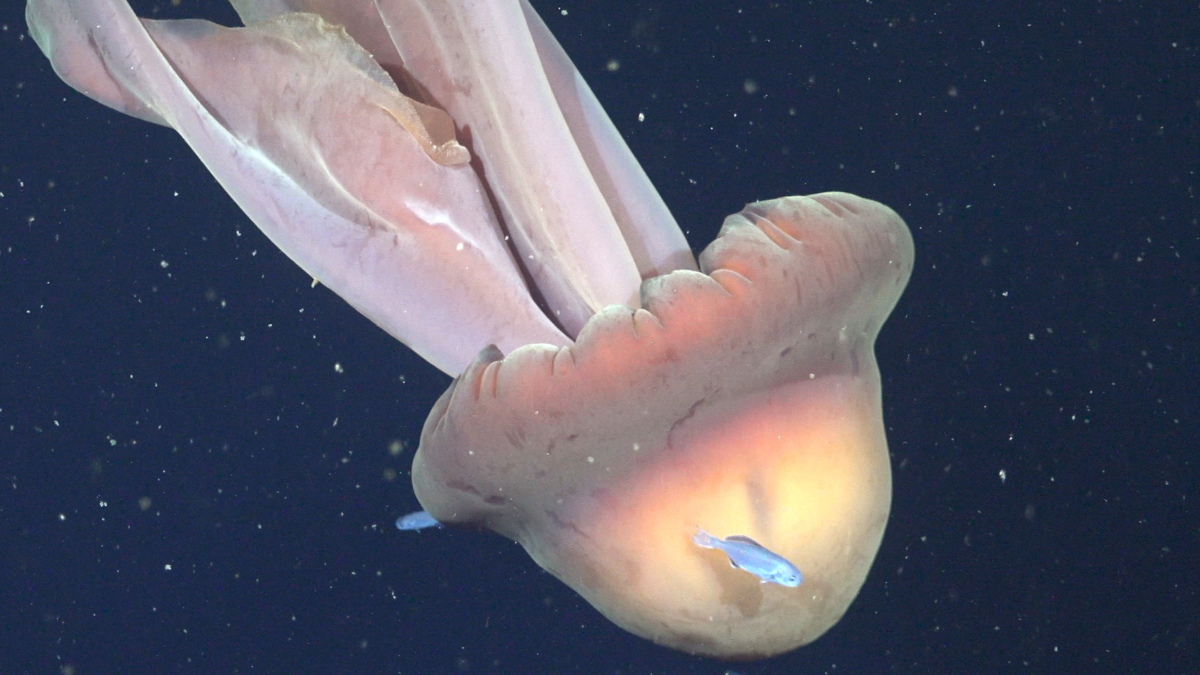
Судлаачид далайн гүнд амьдардаг ховор төрлийн аварга сүнс далайн залхаг болон залуу загаснуудын хоорондын харилцан хамаарлыг анх удаа баримтжуулжээ.
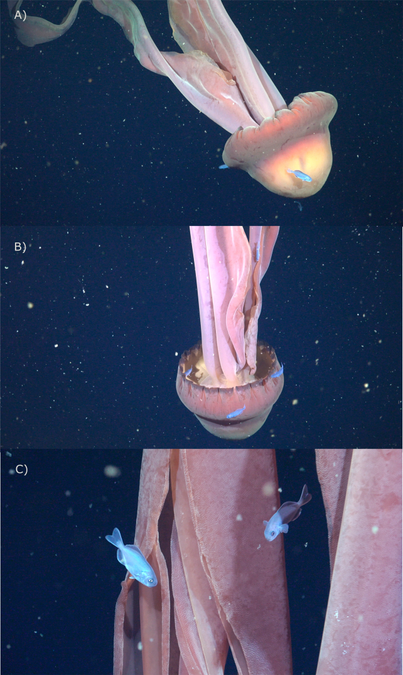
Аргентины эрэг орчмын далайн мезопелагик бүсэд хийсэн судалгааны явцад эрдэмтэд нэн ховор Stygiomedusa gigantea буюу аварга сүнс далайн залхаг болон түүнийг дагалдан яваа 19 ширхэг залуу Centrolophus niger загасны сүрэгтэй таарчээ. Шмидт далайн хүрээлэнгийн (Schmidt Ocean Institute) Falkor (too) хөлөг онгоцны багийнхан SuBastian алсын удирдлагатай хөлөг (ROV) ашиглан 250 орчим метрийн гүнд энэхүү гайхалтай үзэгдлийг дүрсэнд буулгасан байна. Энэхүү олдвор нь 50 гаруй жилийн өмнө эрдэмтдийн таамаглаж байсан хоёр зүйлийн хоорондын харилцааг бодит амьдрал дээр баталгаажуулсан анхны тохиолдол боллоо.
Аварга сүнс далайн залхаг нь биеийн голч нь нэг метр, урт туузан хэлбэртэй тэмтрүүлүүд нь 10 метрээс давдаг дэлхийн хамгийн том далайн залхагуудын нэг юм. Судлаачдын үзэж байгаагаар, залуу загаснууд энэхүү аварга биетнийг махчин амьтдаас хамгаалах “хөдөлгөөнт хоргодох байр” болгон ашиглаж байж болзошгүй. Түүнчлэн загаснууд далайн залхагийн тэмтрүүл дээрх шимэгч хорхойг идэх эсвэл үлдэгдэл хооллоор хооллох зэргээр харилцан ашигтай эсвэл нэг талыг барьсан хамааралтай байж магадгүй хэмээн таамаглаж байна.
Мария Эмилия Браво тэргүүтэй Буэнос-Айресын их сургуулийн судлаачдын баг энэхүү судалгааг “Ecology” сэтгүүлд нийтлүүлжээ. Энэхүү нээлт нь далайн гүний экосистем дэх амьтдын харилцаа холбоо нь бидний төсөөлж байснаас илүү уян хатан бөгөөд нарийн төвөгтэй болохыг харуулж байна. Цаашид ийм төрлийн баримтжуулалт нь далайн гүний биологийн олон янз байдал болон амьтдын далд амьдралын хэв маягийг ойлгоход чухал хувь нэмэр оруулах юм.
Дэлгэрэнгүйг эх сурвалжаас харах
↓Эх сурвалжийг нээх ↓
If you’re just a wee fish swimming around the big, scary ocean, it can help to have a bit of muscle on your side.
For some fish, that’s the protection offered by stinging coral. For others, it’s adhering to the sandpaper skin of a deadly shark.
And for one species of fish, it may be cozying up to one of the most enigmatic denizens of the deep – the giant phantom jellyfish (Stygiomedusa gigantea).
During an ROV dive into mesopelagic waters off the coast of Argentina, marine researchers beheld a rare and stunning sight.
They witnessed a majestic jelly languidly pulsing through the darkness, and with it, an entire entourage of juvenile rudderfish (Centrolophus niger), flitting beneath its bell and among its enormous, trailing arms.
It’s an interspecies relationship scientists have suspected for more than 50 years – and now, hundreds of meters below the waves off Patagonia, here it is.
“Both are poorly known and rarely observed cosmopolitan mesopelagic species, representing the first documented observation of this association in the deep ocean,” writes a team led by marine ecologist María Emilia Bravo of the University of Buenos Aires in Argentina.
The giant phantom jellyfish is one of the largest jellyfish in the world. Its bell – the ‘head’ – can grow to more than a meter (3.3 feet) across, and its four long, ribbon-like oral arms can exceed 10 meters in length.
In spite of this tremendous size, it’s rarely seen by humans.
The first specimen was collected in 1899, and since then, there have been fewer than 120 sightings around the world – likely because it inhabits the deep ocean, and that’s not an easy place for humans to go.
In recent years, that has been changing, particularly with the arrival of ROVs – remotely operated vehicles that can plunge to depths that are logistically much more difficult for squishy, air-breathing humans.
Rather than simply hauling strange creatures out of the depths, these machines allow scientists to watch them going about their mysterious lives, revealing interactions that might otherwise remain completely hidden.
This is exactly what an expedition in December 2025 to January 2026 set out to do. A team of researchers aboard the Schmidt Ocean Institute’s research vessel Falkor (too) deployed the ROV SuBastian in a series of dives into the deep ocean along the Argentine margin.
It enabled, the researchers explain, “unprecedented research into numerous deep-sea ecosystems that had never been seen before,” including 28 species suspected of being new to science.
But the encounter with a giant phantom jellyfish was among the more spectacular of the expedition.
At a depth of around 250 meters, the colossus was just peacefully drifting in the twilight water column – a gentle giant about 6 meters long, trailing its long arms in the current.
But it wasn’t alone.
Flickering around it like a swarm of bustling attendants were some 19 small, blue-grey fish – juvenile rudderfish, hanging around the arms, swimming in and out of the jellyfish’s bell.
The water column of the deep ocean can be a hazardous place to live, especially for vulnerable fish children. The researchers think these little fish were using the jellyfish as a sort of portable shelter – a safe haven from predators that can strike from the darkness, from any direction.
Although giant phantom jellyfish are not known for their sting, their enormous size and trailing arms may provide a formidable obstacle for predators that would otherwise snack on tiny rudderfish.
The jellyfish itself might also be a snack. Like Hansel and Gretel munching on a candy cottage, one of the rudderfish was seen nibbling at something on one of the jellyfish’s oral arms.
The researchers couldn’t tell exactly what the little fish was eating. It might have been stealing prey the jellyfish caught, picking off parasites or other small organisms living on its surface, or even nibbling on the jellyfish’s flesh.
That raises an interesting question: Is this a mutually beneficial arrangement, or are rudderfish simply taking advantage of a very large, accommodating host?
Some fish that associate with jellyfish help their hosts by removing parasites, receiving food and shelter in return. But in this case, the researchers couldn’t determine whether the giant phantom jellyfish was getting anything out of the deal.
This isn’t the first time scientists have observed fish hanging around giant phantom jellyfish. Previous encounters in the Northern Hemisphere have documented individual adult fish of another species, Thalassobathia pelagica, sheltering alongside the enormous jellies and feeding on their parasites.
Meanwhile, juvenile rudderfish have been observed associating with another species of jellyfish, the barrel jellyfish (Rhizostoma pulmo), in the shallower waters of the Adriatic Sea.
But the possibility of a relationship between rudderfish and giant phantom jellyfish goes back much further.
In 1973, researchers suggested that the two species might associate after specimens turned up together in trawl catches in the North Atlantic. Without observing them alive in their natural habitat, however, they couldn’t confirm the relationship.
More than half a century later, the encounter off Patagonia has finally provided the missing visual evidence – and revealed that an entire school of juvenile fish can accompany one of these enormous, elusive jellies.
The discovery isn’t just interesting for its own sake.
It suggests that relationships between species in the wild ocean may be more flexible than we realize, varying according to local conditions and who’s around to join forces – barrel jellyfish in the Adriatic, giant phantoms in the Atlantic.
It also, once again, highlights how little we know about the lives animals live in the deep ocean, and the ecological roles they play in each other’s existences.
“Whether this association provides only refuge for the fish or also includes trophic or mutualistic components remains unresolved,” the researchers write, “but observations such as this help generate new hypotheses about the hidden natural history of deep-sea species.”
The research has been published in Ecology.
This article was fact-checked by Peter Dockrill and edited by Peter Dockrill. While we pride ourselves on our process, we are only human. If you spot a mistake, please let us know.

